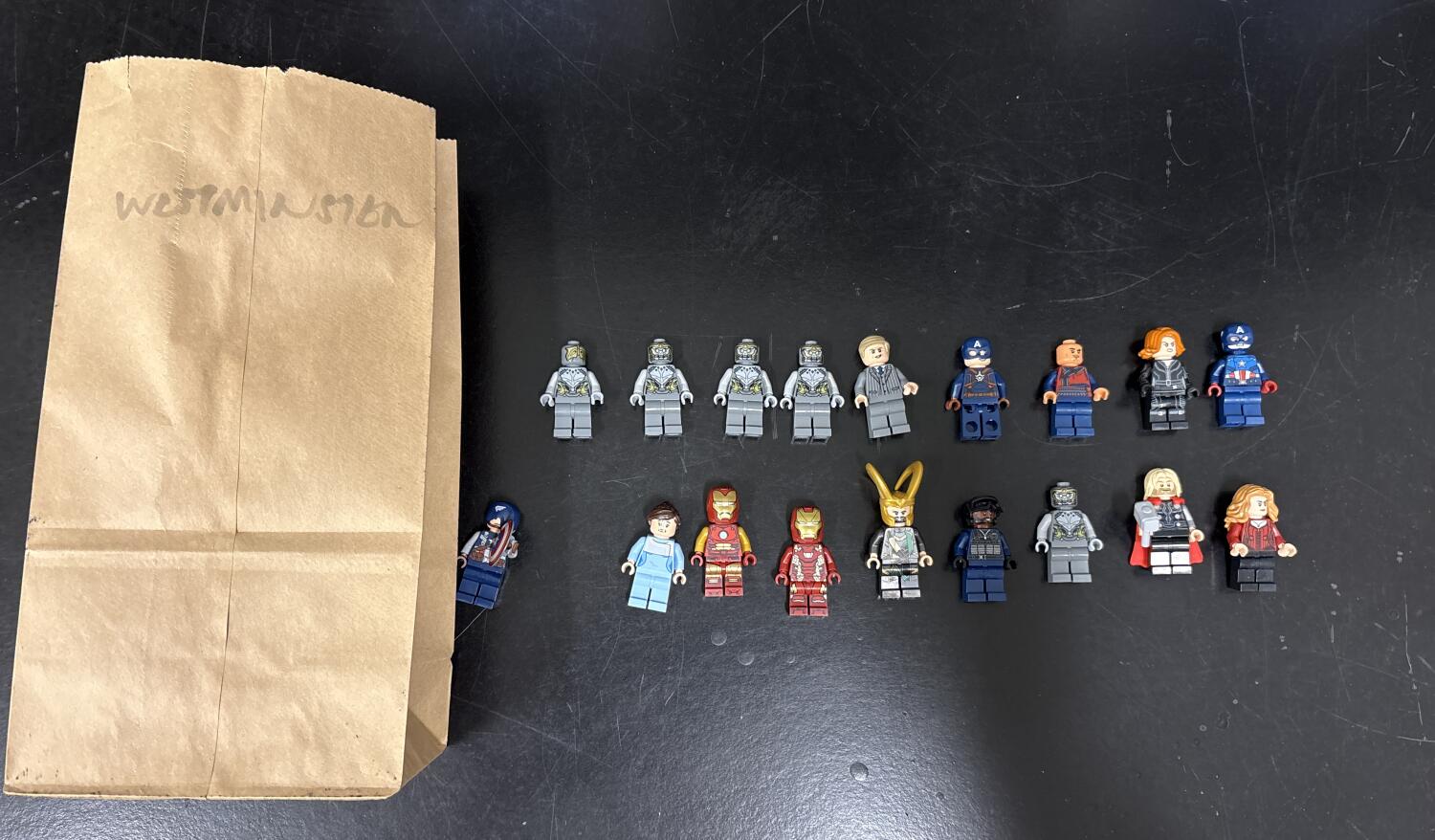
The physical retail environment operates on a fundamental assumption of weight-to-volume consistency. When a consumer selects a sealed box from a shelf, the transaction relies on an implicit contract: the external packaging accurately represents the mass and identity of the internal contents. The recent series of retail thefts involving the substitution of Lego sets with dried pasta exposes a critical failure point in inventory loss prevention. This method, while seemingly primitive, leverages specific physical properties—acoustic mimicry, mass approximation, and tactile feedback—to bypass standard point-of-sale (POS) scrutiny.
The Physics of Deception Acoustic and Volumetric Alignment
The success of the "pasta swap" relies on a sophisticated understanding of how a consumer or retail employee verifies the contents of a sealed container without opening it. This process is governed by the The Law of Conservation of Mass and the Acoustic Signature of Granular Solids.
Acoustic Equivalence
Lego bricks are manufactured from high-quality Acrylonitrile Butadiene Styrene (ABS) plastic. When contained within a cardboard box, these bricks possess a specific resonance when shaken. Dried pasta, specifically short-cut varieties like penne or rotini, shares a similar hardness and density profile to ABS plastic. The sound frequency produced by the collision of pasta against cardboard mirrors the "click" and "slide" of plastic bricks. To an untrained ear, the auditory feedback is indistinguishable from the authentic product.
Mass Calibration
Retailers often utilize automated weight verification at self-checkout kiosks. If a $200 Lego set is expected to weigh 1.4 kilograms, any significant deviation triggers an alert. Pasta provides a low-cost, high-density medium that allows a thief to calibrate the weight of the box to within a 5% margin of error. By adjusting the volume of pasta, the perpetrator ensures the POS scale registers the item as "verified."
The Three Pillars of Retail Arbitrage Fraud
The mechanics of this crime extend beyond simple theft; they represent a form of fraudulent arbitrage where high-value, liquid assets are extracted and replaced with low-value, perishable commodities. This system operates through three distinct phases:
1. The Extraction Phase (Content Removal)
The perpetrator identifies "High-Interest" sets. In the secondary market, Lego sets often appreciate in value or maintain high liquidity due to a global collector base. The extraction requires a clean break of the factory seal. Thieves often use heat-based methods or precision blades to ensure the box can be resealed without visible structural damage.
2. The Substitution Phase (The Pasta Proxy)
The selection of the filler material is a strategic choice. Why pasta?
- Cost-to-Weight Ratio: Pasta is one of the cheapest ways to simulate significant mass.
- Accessibility: It is available in every grocery-carrying retail store, often the same store where the theft occurs.
- Biodegradability: Unlike gravel or sand, pasta does not leave fine dust or residue that might leak from the box corners, which would immediately signal a compromised seal.
3. The Return-Loop Phase (Re-injection)
The fraudulent item is returned to a different retail location. The goal is to obtain a full cash or credit refund. The success of this phase hinges on "Return Policy Friction." Retail employees are often incentivized to process returns quickly to maintain customer satisfaction scores. If the box looks factory-sealed and passes the "shake test," it is frequently returned to the shelf rather than being marked for inspection.
The Economics of Loss Prevention Failure
Retailers face a "Detection vs. Friction" bottleneck. Implementing a policy where every high-value box must be opened and inspected upon return would significantly increase labor costs and alienate legitimate customers.
The Cost Function of Inspection
Let $C_i$ be the cost of inspection, $L_v$ be the value of the lost inventory, and $P_f$ be the probability of fraud. A retailer only finds it economically rational to inspect every box if:
$$C_i < (L_v \times P_f)$$
In the case of Lego sets ranging from $100 to $800, the $L_v$ is high enough that the $P_f$ threshold is surprisingly low. However, most retail systems are not calibrated for this specific type of sophisticated physical spoofing. They rely on "Visual Integrity," which is easily bypassed with a glue gun and a steady hand.
Systematic Vulnerabilities in Big-Box Retail
- Inadequate Training: Employees are trained to look for ripped cardboard, not for subtle variations in tape texture or glue patterns.
- SKU Complexity: With thousands of unique Lego sets, a general associate cannot be expected to know the exact weight or "sound" of a specific Star Wars set versus a Technic set.
- Point of Sale (POS) Limitations: Current POS systems do not record the "heft" or "balance" of a box, only its total weight. Pasta might match the total weight, but it will shift differently than bagged Lego bricks, altering the box's center of gravity.
Structural Hardening Strategies
To mitigate this specific vector of inventory shrinkage, retailers must move beyond visual inspection and adopt a data-driven approach to high-value returns.
Digital Fingerprinting and Serialized Sealing
Manufacturer-level serialization of the adhesive seals would allow retailers to scan the seal itself. If a box is returned, the system could verify if that specific seal ID has been tampered with or if it matches the original shipping data. Currently, Lego boxes use generic circular tape or glue flaps that are easily replicated.
Volumetric Weight Analysis
Standard scales at checkout are too blunt an instrument. Future loss prevention hardware should incorporate Three-Point Balancing. By measuring the weight distribution across three sensors, a system could detect if the internal contents are loose (like pasta or loose bricks) or organized in the specific factory-packed bags. If a set that is supposed to have 15 distinct bags is replaced with loose pasta, the weight distribution during a "tilt test" would trigger a high-risk alert.
The "Return Liquidity" Tax
Retailers could implement a mandatory 24-hour "quarantine" for high-value returns. During this period, the item is moved to a secure area for a more thorough inspection by a dedicated loss-prevention specialist. This creates a "time friction" that discourages professional thieves who rely on the immediate liquidity of a cash refund.
Identifying the Market for Stolen Plastic
The theft of Lego pieces is rarely about the pasta; it is about the secondary market. High-value sets are broken down and sold as "New In Box" (NIB) on third-party marketplaces or broken into individual "Minifigures," which can carry values exceeding $50 per unit.
The lack of a centralized registry for Lego set ownership makes it an ideal asset for money laundering or quick-cash schemes. Unlike electronics, Lego bricks do not have MAC addresses or GPS tracking. Once the content is removed from the box, its provenance is effectively erased.
Strategic Action for Retail Operations
Retailers must immediately reclassify high-value modular building sets and licensed IP sets (Star Wars, Harry Potter) as High-Risk High-Liquidity (HRHL) assets. These items should be moved behind glass or equipped with secondary physical security measures that go beyond standard EAS (Electronic Article Surveillance) tags.
For the return desk, the protocol must shift from "Visual Confirmation" to "Tactical Verification." This involves a mandatory "Roll and Shift" test: tilting the box slowly to feel the movement of internal bags. Unlike loose pasta, bagged Lego pieces move in distinct, staggered increments. Any "fluid" movement of the internal mass must be flagged for immediate supervisor intervention and box opening. The era of trusting the seal is over; the focus must now be on the internal physics of the package.