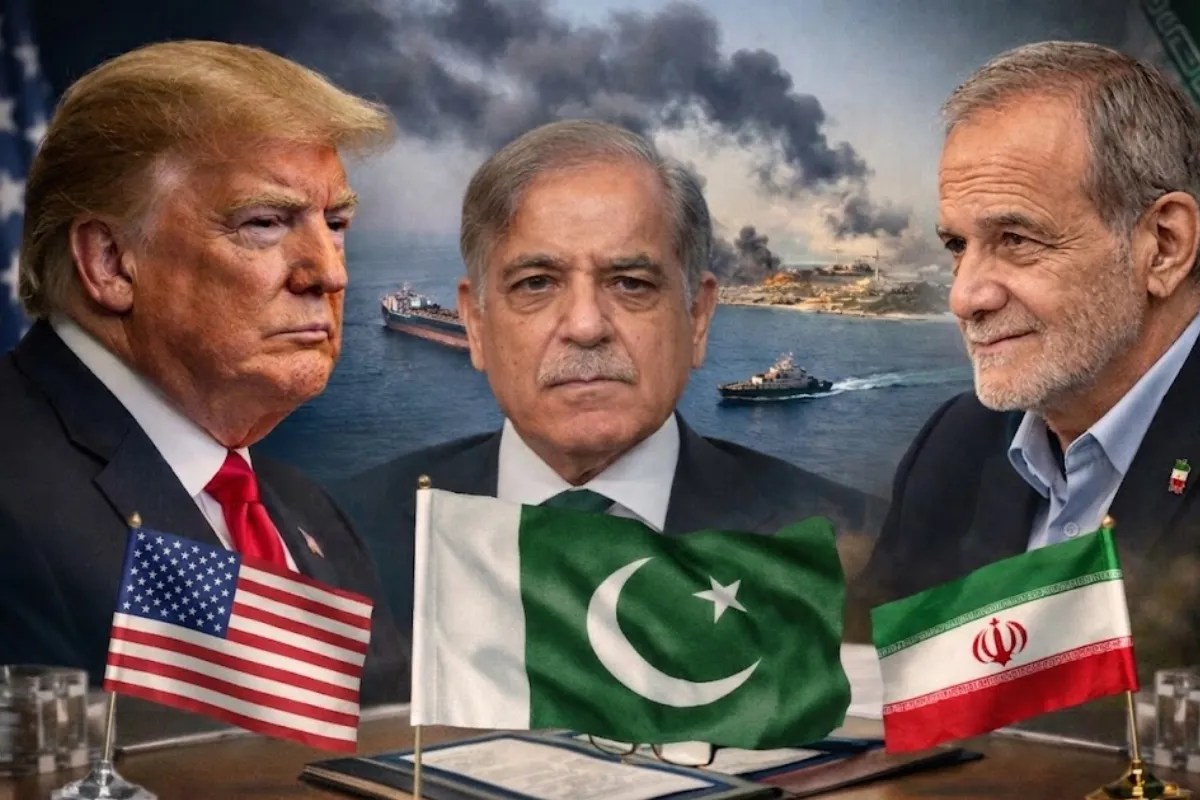
Donald Trump’s return to the White House has sent shockwaves through the Middle East and South Asia. While most leaders are scrambling to figure out his next move, Pakistan is busy playing a high-stakes game of geopolitical matchmaking. The "Islamabad Round-2" strategy isn't just about regional peace. It’s a desperate attempt to stop a full-blown war between the U.S. and Iran that would wreck Pakistan’s already fragile economy. Islamabad is betting that if Trump won't listen to them, he might listen to Beijing.
China remains the only player with enough skin in the game to talk sense into both Tehran and Washington. Pakistan knows it can't handle another wave of sanctions or a border conflict. They’re positioning themselves as the bridge, but the bridge is built on very thin ice. Trump's "Maximum Pressure" campaign is back, and this time, he's got a fresh mandate and a shorter temper. Recently making headlines in related news: Europe is finally forcing a messy breakup with Russian gas.
The Islamabad Round-2 Gambit
Pakistan is trying to resurrect its role as a mediator. During Trump’s first term, former Prime Minister Imran Khan tried to play the middleman between Riyadh and Tehran. It didn't quite work then, but the stakes are higher now. The "Islamabad Round-2" refers to a series of back-channel diplomatic efforts aimed at convincing the Trump administration that a stable Iran is better than a collapsed one.
Pakistan’s current leadership is terrified. If Trump pulls the trigger on even harsher sanctions or military strikes, the spillover into Balochistan will be catastrophic. Refugees, militant influx, and the death of the Iran-Pakistan gas pipeline project are all on the table. They need China to step in because China is the top buyer of Iranian oil. Beijing has a multi-billion dollar reason to keep the peace. Further insights into this topic are covered by Al Jazeera.
Why Trump might actually look toward the Dragon
Trump claims he wants to end "forever wars." That’s his brand. But he also hates the current Iranian regime with a passion that defines his foreign policy. This creates a massive contradiction. You can't dismantle the Iranian state without starting a massive war. That’s where China comes in.
Beijing has spent years building a quiet empire of influence in the Middle East. The 2023 Saudi-Iran deal was a wake-up call for the West. It showed that China can broker peace where the U.S. only brings aircraft carriers. Trump likes deals. He likes winning. If China can guarantee that Iran will stay in its box in exchange for trade concessions, Trump might just take the bait. He gets the credit for "peace" without spending a dime of American taxpayer money.
The Iran factor and the nuclear clock
Iran isn't the same country Trump left in 2020. They’ve moved closer to the "threshold" of a nuclear weapon. Their leaders are cynical and battle-hardened by years of economic warfare. They don't trust Washington, and they barely trust Islamabad.
For Tehran, China is a lifeline. They've signed a 25-year strategic partnership with Beijing. They know the U.S. is distracted by Ukraine and the Pacific. Iran's logic is simple. If they can hold out long enough, the U.S. will eventually have to accept them as a regional power. But they’re also tired. The Iranian public is restless. The economy is bleeding. If Pakistan can convince them that China will guarantee their security in a new deal with Trump, they might sit at the table. It’s a huge "if."
Pakistan’s own survival is the real motivator
Let's be honest. Pakistan isn't doing this out of the goodness of its heart. The country is broke. It’s living on IMF lifelines and Saudi loans. A war next door is the last thing it needs.
The Iran-Pakistan (IP) gas pipeline is a perfect example of this mess. The U.S. has threatened Pakistan with sanctions if they move forward with it. Iran has threatened Pakistan with an $18 billion fine if they don't. Islamabad is stuck between a rock and a very hard place. By bringing Trump and Iran together—via China—Pakistan hopes to get a waiver for the pipeline. They need that gas to keep the lights on in Karachi and Lahore.
The Dragon’s calculated silence
China doesn't do anything for free. If Beijing agrees to help Pakistan mediate between Trump and Iran, they’ll want something in return. This might mean more control over the Gwadar port or a freer hand in the South China Sea.
Beijing’s diplomacy is slow and deliberate. They aren't going to jump into the middle of a Trump-Iran spat unless they know they can win. They’re watching how Trump builds his cabinet. They’re looking at names like Marco Rubio and Mike Waltz—men who aren't exactly fans of China. This makes the "Dragon" move even more complicated. If Trump’s team is purely anti-China, the Islamabad plan fails before it starts.
What happens if the diplomacy fails
If "Islamabad Round-2" falls apart, we're looking at a very dark 2026. Trump won't wait forever for Iran to stop enriching uranium. If the diplomatic route via China is blocked, the U.S. will likely pivot back to pure economic strangulation.
For Pakistan, failure means total alignment with the U.S. at the cost of its relationship with Iran, or vice versa. Neither is a good option. The military leadership in Rawalpindi knows this. They’re trying to balance the two powers, but the rope is fraying.
How this affects regional trade and security
The instability is already hitting the markets. Trade routes through the Strait of Hormuz are sensitive to every tweet and official statement. If Trump goes after Iranian oil tankers, global prices will spike. Pakistan, an oil importer, will see its inflation skyrocket.
The security situation is just as grim. Groups like Jaish al-Adl operate in the border regions. If the central government in Tehran is weakened further, these groups will gain more ground. Pakistan will find itself fighting a multi-front insurgency while trying to pay back billions in debt.
Strategic steps for the coming months
The window for this diplomatic push is narrow. Trump takes office in January. Between now and then, Pakistan has to convince Beijing that it’s worth the risk.
- Focus on the Gas Pipeline: Use the IP pipeline as a bargaining chip. If the U.S. wants Pakistan to stay away from Iran, they have to provide an energy alternative or a sanction waiver.
- Leverage the CPEC Connection: Remind China that a war in Iran destroys the Belt and Road Initiative’s western flank.
- Back-channel with the Trump Transition Team: Start talking to the incoming National Security Council now. Don't wait for the inauguration.
- Strengthen Border Security: Regardless of the diplomacy, Islamabad must beef up its western border. Chaos is coming, one way or another.
The world is watching to see if a mid-sized power like Pakistan can actually sway two giants. It’s a gamble that reeks of desperation, but in the current geopolitical climate, desperation is often the only thing that drives real change. If Trump and the Dragon can find common ground on Iran, Pakistan might just survive another four years. If not, the "Islamabad Round-2" will be remembered as the last gasp of a failing regional strategy.