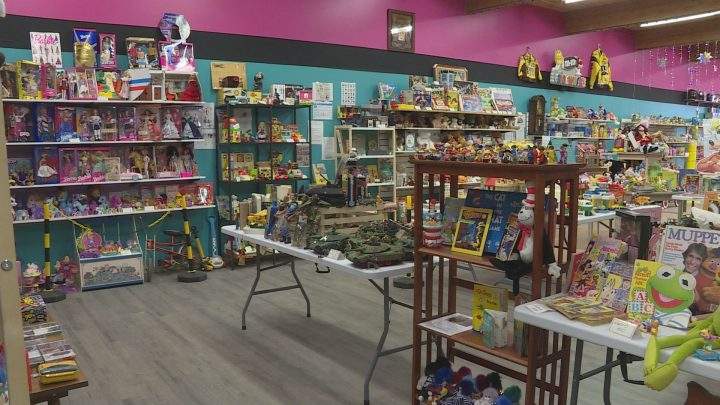
The smell hits you first. It isn’t the sterile, air-conditioned scent of a modern museum or the dusty neglect of an attic. It is the specific, chemically sweet aroma of 1970s vinyl, aged tin, and the faint, lingering ghost of strawberry-scented erasers.
In Drayton Valley, Alberta, a door has opened that doesn’t lead to a room, but to a collective memory. The Gallery of Timeless Toys isn't just a collection of objects. It is a sanctuary for the versions of ourselves we left behind in the sandbox.
The Weight of a Tin Robot
Step inside and the world outside—the fluctuating oil prices, the digital noise of the 21st century, the relentless pace of a town built on hard labor—simply dissolves.
Imagine a man in his fifties. Let’s call him Robert. Robert spends his days managing crews in the oil fields, his hands calloused and his mind occupied by logistics and safety protocols. He walks into this gallery expecting a quick walk-through, a polite nod to nostalgia. Then, he sees it. A battered, primary-colored tin robot behind glass.
His posture changes. The rigid shoulders drop. For a split second, he isn't a foreman; he is seven years old, sitting on a linoleum floor in a sunshaft, believing that this little metal machine can actually walk to the moon. This is the invisible stake of the museum. It isn't about the market value of a mint-condition Barbie or the rarity of a Star Wars action figure.
It is about the reclamation of wonder.
The gallery represents decades of obsessive, love-driven curation. Every shelf is a rebuttal to the idea that toys are "disposable." In an era of planned obsolescence, where a child’s tablet is obsolete in thirty-six months, these objects have survived half a century. They are sturdy. They are tactile. They require the one thing a screen never asks for: an active imagination to provide the batteries.
More Than Just Playthings
The collection spans eras, but the heart of it beats loudest in the mid-century. This was a time when toys were tiny mirrors of the space race, the atomic age, and the burgeoning domestic dream.
To understand why a museum like this matters in a place like Drayton Valley, you have to look at the psychology of the "transitional object." Psychologists often note that toys serve as a bridge between the internal world of a child and the external reality of the adult world. They are the first things we "own," the first things we care for, and often the first things we lose.
When we walk through these aisles, we are looking at a physical map of our development. That Cabbage Patch Kid isn't just a doll; it’s a memory of Christmas 1983, the year the world felt safe and the only thing that mattered was a birth certificate for a yarn-haired baby.
The museum’s arrival in a rural community is a deliberate choice. Cities have their grand galleries and their rotating exhibits of high art. But a toy museum belongs in a town where people understand the value of things that last. There is a grit to these toys. The paint is chipped on the Tonka trucks because they were actually played with in the Alberta dirt. They have earned their place in the display case through years of service in the trenches of childhood.
The Curated Silence
There is a specific kind of silence in the Gallery of Timeless Toys. It’s the silence of people thinking.
You see it in the way couples walk through. They don't talk much at first. They point. They smile. They lean in close to the glass. They are introducing their partners to the children they used to be.
"I had that," is the most common phrase heard within these walls. It’s a confession. It’s a way of saying, I remember who I was before the world told me to grow up.
The owner of this collection didn't just accumulate "stuff." They saved pieces of a vanishing culture. Consider the intricacy of a mechanical wind-up bird from the 1940s. The gears are precise. The movement is fluid. It was designed to be repaired, not replaced. Contrast that with the plastic clutter of a modern big-box store. The museum acts as a silent critic of our current "buy-and-throw" lifestyle. It asks us to look at what we value and why we stopped making things that could survive long enough to be put in a museum.
The Stakes of Forgetting
If we lose these objects, we lose the tactile connection to our history. We live in a digital "landscape"—to use a term that fails to capture the physical reality of a hand-carved wooden horse. When everything is stored in the cloud, nothing has weight. Nothing has a scent. Nothing can be passed from a grandfather’s hand to a grandson’s.
The Gallery of Timeless Toys provides that weight.
There is a hypothetical risk in every small town that history will be paved over in favor of the new, the efficient, and the profitable. By dedicating a space to play, Drayton Valley is making a statement: the joy of the past is a profitable investment for the soul.
It’s easy to dismiss a toy museum as a "niche" attraction. That would be a mistake. This is a repository of human design, social history, and emotional blueprints. Every G.I. Joe tells a story about how we viewed heroism. Every Easy-Bake Oven tells a story about how we viewed the home.
The Long Shadow of the Toy Box
As the sun sets over the Alberta plains and the lights in the gallery dim, the shadows of the toys stretch across the floor. In the dark, a rocking horse looks like it might actually move. A jack-in-the-box holds its breath.
We often think we grow out of toys. We think we put them away because we became more sophisticated, more rational, more "adult."
The truth is much simpler. We didn't grow out of them; we just forgot how to talk to them.
The museum isn't there to show us how much things have changed. It is there to remind us of the one thing that hasn't changed: that human need to project our hopes, our fears, and our adventures onto something we can hold in the palm of our hand.
A child enters the gallery and sees a playground. An adult enters and sees a mirror.
You leave the building and step back onto the streets of Drayton Valley, the cold air hitting your face. The world feels a little sharper now. You look at your hands—the hands that drive cars, sign contracts, and type on glass screens—and for a fleeting moment, you remember the weight of a wooden block. You remember the sound of a marble hitting the bottom of a tin cup.
The ghosts of those toys don't stay in the museum. They follow you home, whispering that the child you used to be isn't gone; they’re just waiting for you to remember how to play.
The door clicks shut, the bell rings, and the toys return to their vigil, waiting for the next person who needs to find their way back.
,webp/018/771/129/526x298.5.webp)