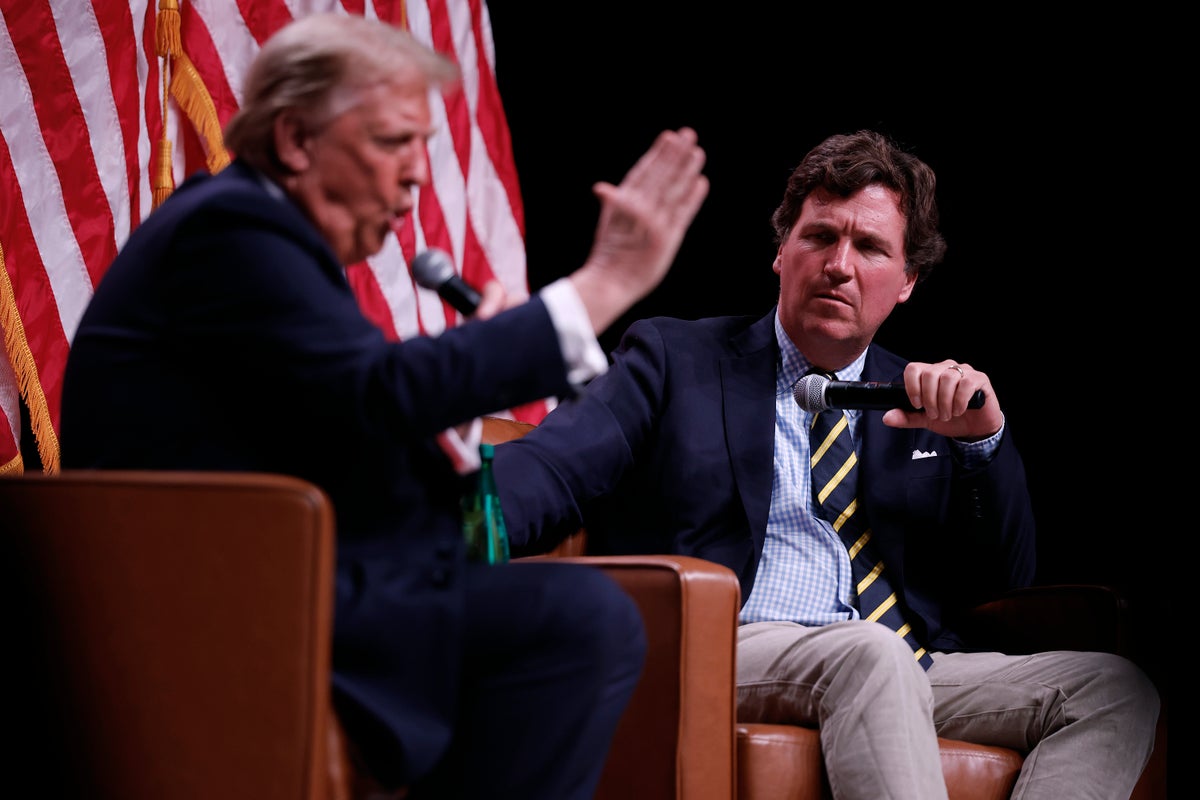
The friction between Donald Trump and Tucker Carlson represents more than a personal disagreement; it is a structural collision between two competing power centers within the American populist right. This conflict functions as a zero-sum game for narrative control. Carlson’s recent characterization of Trump as a "slave" to institutional interests marks an inflection point in the shift from alignment to adversarial positioning. To understand this escalation, one must map the underlying mechanics of audience capture, the degradation of the "outsider" brand, and the specific incentives driving media figures to challenge political leaders they once supported.
The Architecture of Audience Capture
Media platforms and political figures operate on a shared incentive structure: the acquisition and retention of high-intensity attention. In the early stages of their relationship, Trump and Carlson functioned in a symbiotic loop. Trump provided the legislative and executive "input" while Carlson provided the ideological "output" to a massive, overlapping demographic. Recently making news lately: The Vault of Whispers and the Promise of the Sun.
The current rift suggests a decoupling of these interests. Carlson’s rhetoric implies that Trump has transitioned from an agent of change to a functionary of the very bureaucracy—the "Deep State" or the administrative apparatus—that he originally vowed to dismantle. By framing Trump as a "slave" who "can't make his own decisions," Carlson is executing a tactical pivot. He is positioning himself as the true steward of the populist movement, suggesting that the movement's titular leader has been compromised by the constraints of institutional power.
This creates a narrative bottleneck for Trump. If the base begins to perceive him as a puppet rather than a principal actor, his primary political asset—the aura of the unfiltered renegade—evaporates. Carlson is essentially shorting Trump’s brand to increase the value of his own independent media equity. Additional information on this are covered by Reuters.
Structural Constraints on Presidential Autonomy
The accusation that a president is "not making their own decisions" often ignores the rigid operational constraints of the American executive branch. A data-driven analysis of executive action reveals three primary friction points that limit autonomy:
- The Bureaucratic Inertia Coefficient: Any executive order must pass through layers of legal review, agency compliance, and budgetary oversight. This process inherently dilutes the original intent of the actor.
- Information Asymmetry: A president is a consumer of intelligence provided by the very agencies Carlson criticizes. The "decisions" are often choices between curated options presented by advisors, a dynamic that naturally shifts agency from the leader to the staff.
- The Legislative Anchor: Without Congressional alignment, executive power is limited to narrow administrative tweaks. The failure to secure major policy wins through the legislature creates the appearance of weakness, which Carlson interprets as subservience.
Carlson’s critique leverages these structural realities to build a case for incompetence or capture. By ignoring the legal and procedural hurdles Trump faces, Carlson constructs a simplified binary: either the leader is all-powerful and chooses not to act, or he is a "slave" to his handlers. This binary is a powerful tool for mobilizing a frustrated electorate, even if it lacks nuance regarding how the federal government actually functions.
The Economics of Post-Platform Media
Carlson’s move to an independent platform (The Tucker Carlson Network) fundamentally changed his risk profile. While at Fox News, he was tethered to a corporate entity that required a degree of harmony with the Republican Party’s leading candidate. As an independent operator, his revenue model depends on differentiation.
If Carlson simply echoes Trump’s talking points, he becomes a redundant asset. To maintain a premium subscription base, he must provide a perspective that is more "authentic" or "unfiltered" than the politician himself. Attacking Trump from the right—accusing him of being too weak or too controlled—is the only way Carlson can remain the alpha in the populist information ecosystem.
The "slave" comment serves as a stress test for the loyalty of the MAGA base. It forces the audience to choose between the person (Trump) and the ideology (Carlson’s brand of populism). This is a calculated gamble on Carlson's part, based on the hypothesis that the movement has become more radicalized than the man who started it.
Quantifying the Damage to Trump’s Outsider Metric
Trump’s political viability is indexed to his perceived distance from the "Establishment." Carlson is systematically attacking this metric. Every time Carlson highlights a Trump appointment (e.g., John Bolton or HR McMaster) as a "betrayal," he increases the Trust Deficit within the core constituency.
The mechanism of this damage follows a specific sequence:
- The Validation Phase: A trusted media voice identifies a perceived failure in the leader.
- The Framework Phase: The failure is categorized not as a mistake, but as evidence of systemic control.
- The Replacement Phase: The media voice offers themselves as the only source of "truth" remaining in the movement.
This sequence erodes the incumbent’s ability to defend their record. Instead of debating policy outcomes, Trump is forced to defend his personal agency. For a candidate whose entire persona is built on being the "ultimate dealmaker" and an "alpha leader," the accusation of being a "slave" is the most potent psychological and political weapon available.
The Bottleneck of Advisor Dependency
A significant portion of the feud centers on the personnel around Trump. Carlson’s critique often bypasses Trump directly to target the "neocons" and "donors" who allegedly direct his movements. This reflects a broader power struggle within the GOP over foreign policy and trade.
- Interventionism vs. Isolationism: Carlson represents a strict isolationist wing. When Trump fails to fully withdraw from international commitments, Carlson perceives this as a surrender to the "Blob" (the permanent foreign policy establishment).
- Personnel as Policy: In Carlson’s view, the choice of personnel is the only metric that matters. If Trump hires individuals from the traditional GOP infrastructure, Carlson interprets it as a total loss of sovereignty.
This creates a strategic dilemma for Trump. If he ignores Carlson, the "slave" narrative gains traction among the base. If he attacks Carlson, he risks alienating a media figure who commands the attention of millions of his most dedicated supporters.
Strategic Forecast of Narrative Realignment
The escalation of this feud suggests that the 2024-2026 political cycle will be defined by an internal struggle for the "soul of populism." Carlson is not trying to destroy Trump; he is trying to re-subordinate him. By making Trump’s life difficult, Carlson signals to the candidate that the path to the base runs through his platform, not the other way around.
Trump’s response—typically a counter-attack on social media—has so far been unable to neutralize Carlson’s specific brand of criticism. This is because Carlson is not using traditional liberal talking points; he is using the very language Trump used to win in 2016.
The most likely outcome is an uneasy, transactional truce, but the structural damage to the "outsider" brand is likely permanent. Carlson has provided a blueprint for other media figures to challenge the political leadership of the right by framing institutional compromise as a form of personal enslavement.
Political actors must now operate in an environment where their "authenticity" is audited in real-time by independent media moguls with larger reach and fewer constraints than traditional networks. The "slave" comment was not a slip of the tongue; it was a declaration of independence for the media wing of the populist movement.
Political candidates must prioritize the creation of their own direct-to-consumer information channels to bypass the gatekeeping of independent influencers who now have the incentive to cannibalize their own leaders for engagement. Failure to secure narrative sovereignty will result in a permanent state of hostage-taking by the media personalities who own the audience.