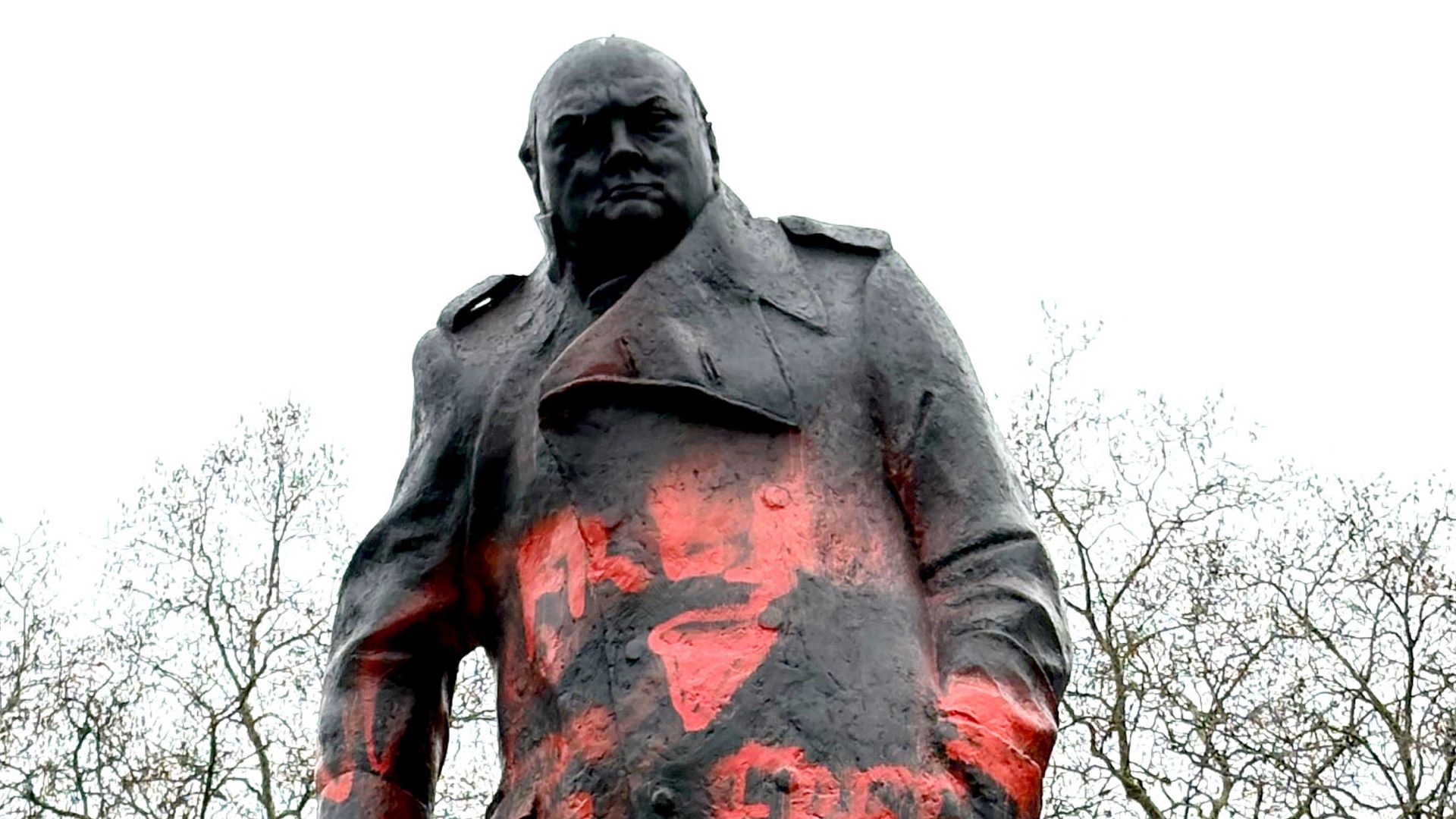
The intersection of criminal damage and political expression creates a distinct friction point within urban governance and the judicial system. When an individual is charged with defacing a monument—specifically the Winston Churchill statue in Parliament Square—the event is frequently reduced to a binary of "vandalism versus activism." This reductionism obscures the underlying mechanics of civil disobedience, the economic costs of specialized restoration, and the legal threshold of the Criminal Damage Act 1971. A rigorous analysis must deconstruct the event through three primary lenses: the jurisdictional mechanics of the charge, the symbolic capital of the target, and the deterrent efficiency of the legal response.
The Jurisdictional Mechanics of Section 1 Prosecution
In the United Kingdom, the legal framework for addressing graffiti on public monuments primarily rests on the Criminal Damage Act 1971. To secure a conviction, the prosecution must demonstrate two distinct variables: the actus reus (the physical act of damage) and the mens rea (the intent or recklessness regarding the damage).
The definition of "damage" in this context is not limited to permanent destruction. Case law has established that if an act requires the expenditure of time, effort, or money to restore the object to its original state, the threshold for criminal damage is met. Graffiti on a Grade II* listed bronze statue necessitates specialized chemical cleaning and, in some cases, the re-application of protective wax patinas. This requirement transforms a seemingly superficial aesthetic change into a quantifiable economic loss.
The legal complexity increases when the defense invokes Article 10 (freedom of expression) and Article 11 (freedom of assembly) of the European Convention on Human Rights. Following the 2021 Supreme Court ruling in Ziegler, and subsequent clarifications in Attorney General’s Reference (No 1 of 2022), the court must perform a proportionality assessment. This assessment weighs the defendant’s right to protest against the state’s interest in preventing disorder and protecting the property rights of the local authority. In the case of a high-profile monument like the Churchill statue, the state’s interest is often weighted more heavily due to the historical significance and the recurring nature of the target.
The Symbolic Capital and Target Selection
Statues are not merely inert bronze; they are repositories of "symbolic capital." Iconoclasm—the deliberate destruction or defacement of symbols—functions as a high-leverage communication strategy. By targeting the Winston Churchill statue, the actor utilizes the "Global Brand" of the figure to ensure maximum media amplification.
Target selection follows a predictable cost-benefit logic for the protestor:
- Visibility Ratio: The physical effort required to apply graffiti is minimal compared to the global reach of the resulting imagery.
- Historical Friction: Churchill represents a polarized historical narrative. Defacing his likeness forces a confrontation between colonial critiques and national heritage narratives.
- Institutional Reaction: The inevitability of a police response and subsequent court proceedings provides a secondary platform for the actor’s message, effectively subsidizing the protest through the state’s own legal infrastructure.
The Cost Function of Restoration and Security
The financial burden of iconoclasm extends beyond the immediate removal of spray paint. A comprehensive cost function for such an event includes:
- Direct Remedial Costs: The engagement of professional conservators. Bronze is a porous alloy; improper cleaning can lead to "bronze disease" or permanent surface scarring.
- Operational Security Costs: Parliament Square requires 24-hour surveillance. When a statue is repeatedly targeted, the Metropolitan Police Service (MPS) must reallocate manpower from lower-profile but higher-risk areas to static guard duty.
- Preventative Infrastructure: The use of physical barriers (e.g., steel boxing or "kellering") during periods of heightened social unrest.
This creates an "unfunded mandate" for local authorities like Westminster City Council. Resources diverted to statue maintenance are resources unavailable for social services or infrastructure improvements, creating a secondary, often unobserved, social cost.
Deterrence Theory and Judicial Outcomes
The effectiveness of charging an individual with criminal damage is measured by its ability to prevent future transgressions—both by the individual (specific deterrence) and the public (general deterrence). However, the "martyrdom effect" within activist circles often negates the deterrent value of a fine or a community order.
If the judicial system imposes a lenient sentence, it may be perceived as a "permission slip" for future acts. Conversely, overly harsh sentencing can radicalize the movement and lead to an escalation in tactics. The current trend in the UK judicial system is toward "protective sentencing," where the historical and cultural value of the asset is factored into the gravity of the offense, moving it from a basic "damage" category to a "violation of national heritage" category.
The bottleneck in this system is the backlog of the Crown Court. A charge brought in early 2024 may not reach a definitive trial until 2025 or 2026. This temporal gap weakens the link between the act and the consequence, diminishing the deterrent signal sent to other potential actors.
Strategic Institutional Response
To mitigate the recurrence of monument defacement, institutional stakeholders must shift from a reactive posture to a structural one. This involves a three-tiered approach:
- Hardening the Asset: Applying sacrificial anti-graffiti coatings that prevent paint from bonding with the bronze, thereby reducing restoration costs to zero-impact pressure washing.
- Digitizing Surveillance: Moving from manual patrols to AI-augmented CCTV that can detect the specific "signature" of graffiti application (e.g., the sound of an aerosol can or specific arm motions) in real-time, allowing for intervention before the damage is completed.
- Legal Precision: Ensuring that the "impact statement" provided to the court meticulously details the specialized conservation requirements. By framing the act as a technical assault on a preserved artifact rather than a political statement, the prosecution can anchor the proceedings in the material reality of the damage.
The prosecution of an individual for graffiti on a monument is a microcosm of the tension between individual expression and collective heritage. The survival of public art in a polarized era depends less on the thickness of the bronze and more on the consistency and clarity of the legal and logistical frameworks used to protect it.
Assess the current anti-graffiti coating status of your municipal assets and implement a tiered response protocol that prioritizes "zero-residue" removal techniques to minimize long-term structural degradation of the substrate.