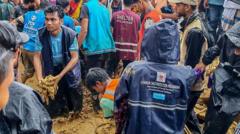
Mud does not care about geopolitical stalemates. When torrential monsoon rains hammered the hills of southeastern Bangladesh, the earth simply gave way, burying a makeshift girls' school in the sprawling Kutupalong refugee camp networks of Cox's Bazar. Eight children died. Five others are fighting for their lives in makeshift field clinics. This was not a natural disaster. It was the mathematically certain consequence of turning steep, deforested mud hills into the world’s most densely populated refugee settlement without permanent foundations.
The tragedy occurred when a heavy mosque wall adjacent to a makeshift madrasa collapsed under the weight of a liquefying hillside. Rescuers dug with their bare hands and plastic buckets through thick clay, pulling out thirteen young female students from the debris. For eight of them, help arrived too late. The incident follows another series of rain-triggered landslides earlier the same week that claimed eight other lives across the camps, bringing the immediate death toll to sixteen.
International reporting on these events typically follows a scripted loop. A sudden downpour hits, a hillside collapses, local officials issue generic condolences, and aid agencies plead for emergency funding. This cycle obscures a far grimmer reality. The structural vulnerability of these camps is entirely man-made, born from a combination of environmental degradation, host-country political anxieties, and an international community that has largely walked away from the crisis.
Engineering a Catastrophe on Unstable Slopes
To understand why these children died, one must understand the soil beneath their classrooms. The hills of Cox’s Bazar are composed primarily of loose sand and clay silt. Historically, these hills remained stable because they were anchored by dense forest canopies and deep root systems. When more than a million Rohingya fled a brutal military campaign in Myanmar, the rapid construction of shelters required the immediate clearing of thousands of acres of forest.
The roots are gone. The canopy is gone. What remains is an exposed, highly porous terrain that acts like a sponge during the annual monsoon season. When heavy rains hit the region, water saturates the upper layers of the soil, dramatically increasing its weight while destroying the internal friction that holds the hillside together. The ground transforms from solid earth into a heavy, viscous liquid that moves down steep slopes with terrifying speed.
Compounding this hazard is the sheer density of human habitation. Shelters made of bamboo and thin plastic tarpaulins are packed tightly against the hillsides, often stacked directly on top of one another. The terraces carved into the slopes to accommodate these structures actually weaken the hills further by creating steep, unsupported vertical cuts. When a slope fails at the top, it triggers a domino effect, crushing everything in its path down to the valley floor.
The school that collapsed was never built to withstand these forces. Like most structures in the camps, it relied on temporary materials and lacked the reinforced concrete footings or retaining walls necessary to hold back thousands of tons of shifting mud. The adjacent mosque wall, built out of unreinforced masonry, became a deadly hazard instead of a protective barrier when the earth shifted behind it.
The Politics of Temporary Architecture
The government of Bangladesh has long maintained a strict policy regarding the permanence of infrastructure within the refugee camps. Authorities fear that allowing concrete foundations, permanent school buildings, or paved roads would signal to the domestic electorate and the international community that the Rohingya are a permanent fixture. Consequently, aid agencies are restricted to using temporary materials like bamboo, tarpaulin, and corrugated iron sheets for construction.
This policy creates a deadly architectural paradox. The structures must be durable enough to withstand extreme weather, yet temporary enough to satisfy political mandates. The result is a vast network of flimsy, fragile buildings that require constant maintenance and offer virtually no protection against structural failures or environmental disasters.
Educators and camp leaders have repeatedly warned that these restrictions put children at extreme risk. Schools and religious learning centers are frequently built on whatever marginal land is available, which usually means the bases of unstable slopes or the edges of flood-prone ravines. Because the Rohingya are legally barred from formal employment and cannot purchase land, they have no agency to select safer locations for community infrastructure.
Humanitarian workers on the ground face immense bureaucratic hurdles when attempting to implement even basic slope-stabilization projects. Retaining walls made of sandbags or bamboo piling provide only a temporary fix and degrade rapidly under the intense heat and heavy moisture of the region. True civil engineering solutions, such as deep-set concrete piles, extensive drainage networks, and terraced retaining systems, remain strictly prohibited under current administrative guidelines.
The Shrinking Lifeline of International Aid
While the physical earth crumbles, the financial foundations supporting the camps are also eroding. The global humanitarian response for the Rohingya has seen a steady, drastic decline in funding over the past several years. International attention has shifted to newer, high-profile conflicts in Europe and the Middle East, leaving the world’s largest refugee settlement to manage an increasingly volatile situation on a shoe-string budget.
The numbers tell a stark story of abandonment. Funding for the Joint Response Plan for the Rohingya humanitarian crisis now routinely falls short of even half its required targets. This deficit translates directly into compromised safety on the ground. When budgets are cut, preventative maintenance is among the first items to be scaled back or eliminated entirely.
The lack of resources affects every aspect of camp safety. Monsoon preparedness campaigns, which once included extensive slope-monitoring programs and widespread community training, have been deeply curtailed. The distribution of high-quality shelter materials has slowed, forcing families to reuse degrading bamboo and torn plastic sheets that offer little to no resistance against heavy rains.
Furthermore, the process of relocating families from high-risk slopes to safer ground has slowed to a crawl. While authorities claim to have moved around one thousand refugees from the most vulnerable hillsides recently, tens of thousands more remain in harm's way. Safe land in southeastern Bangladesh is an incredibly scarce commodity, and without substantial international financial backing to develop alternative sites or improve existing infrastructure, relocation efforts cannot match the scale of the threat.
A Forgotten Crisis Breeding Long Term Instability
The tragedy at the school is a symptom of a broader, unresolved geopolitical stalemate. Nearly a decade after the initial exodus, there is no viable path forward for the safe, voluntary, and dignified return of the Rohingya to Myanmar. Ongoing civil conflict within Myanmar's Rakhine State has only worsened conditions across the border, effectively slamming the door on repatriation for the foreseeable future.
This permanent transience has created a pressure cooker environment inside the camps. Deprived of the right to work, move freely, or access formal education, a generation of youth is growing up in a state of enforced idleness and vulnerability. The makeshift schools, like the one destroyed in the landslide, are among the few spaces where children can find routine and community support. When these spaces become death traps, the psychological toll on the community is profound.
The Bangladeshi public and political establishment are also reaching the limits of their patience. Hosting over a million refugees has placed an immense strain on local resources, the environment, and the economy of Cox’s Bazar. Prices for basic goods have risen, wages for local laborers face downward pressure, and the vast destruction of forest reserves has altered local microclimates, increasing the severity of flash floods and landslides for local Bangladeshi residents as well.
This friction manifests in tightening security and increased restrictions within the camps. Barbed-wire fencing surrounds the settlements, and checkpoints restrict movement between sectors. These security measures, while designed to maintain control, frequently complicate emergency responses. During major disasters like fires or massive landslides, the physical barriers can delay rescue teams and prevent residents from fleeing to open areas quickly.
Immediate Preventive Steps for an Inevitable Next Rain
The Bangladesh Meteorological Department has warned that the heavy monsoon rains will persist. The immediate future holds the certainty of more water, more saturated hillsides, and more structural failures. Waiting for a comprehensive political resolution to the Rohingya crisis before addressing the structural safety of the camps is an approach that will cost more lives.
A fundamental shift in the management of camp infrastructure is required. The absolute prohibition on permanent building materials must be reconsidered for critical infrastructure such as schools, clinics, and community shelters. Allowing the use of reinforced foundations and proper retaining walls for public structures does not equal permanent settlement; it equals basic life safety.
International donors must also realize that funding the Rohingya response is not an act of charity, but a necessity for regional stability. Immediate capital must be directed toward large-scale civil engineering efforts, specifically the construction of comprehensive concrete drainage channels to divert rainwater away from vulnerable slopes. Without proper drainage, any attempt to stabilize the hillsides is entirely futile.
The global community cannot continue to treat the annual monsoon season in Bangladesh as an unexpected emergency. The rains arrive every year with clockwork precision. The properties of waterlogged soil are well understood. The vulnerability of the shelters is visible to anyone who walks the camps. Until structural safety is prioritized over political considerations, the earth will continue to claim the most vulnerable people in Cox's Bazar.
Documentary coverage on the Rohingya camp landslide crisis provides a stark visual record of the ongoing disaster and the challenging rescue conditions on the ground.