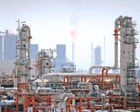
The sea does not care about geopolitics. In the turquoise expanse of the Persian Gulf, the water is warm, shallow, and deceptively still. But three thousand meters beneath the soft silt of the ocean floor lies a geological monster: the South Pars-North Dome field. It is the world’s largest reservoir of natural gas, a subterranean ocean of energy shared by Iran and Qatar. It is also the most dangerous fuse on the planet.
When Donald Trump threatens to "blow up" this specific patch of earth in response to any Iranian move against Qatar, he isn't just talking about a military strike. He is describing the mechanical erasure of a global lifeline. To understand why this threat carries the weight of a potential dark age, you have to look past the headlines and into the pipes.
The Metal Cities
Imagine standing on the deck of a platform in the middle of the Gulf. It feels like a city made of rust and ambition, humming with a vibration that gets into your bones. That hum is the sound of trillions of cubic feet of gas rushing toward the surface. For Qatar, this field is the source of the wealth that built Doha’s glass skyline. For Iran, South Pars is the beating heart of an economy struggling under the weight of sanctions, providing the lion’s share of the nation's electricity and heating.
It is a symbiotic, high-stakes marriage of necessity. The two countries are tapping into the same pool. If one side pumps faster, the other loses out. They are like two kids sharing a milkshake with two different straws, but the milkshake is worth trillions of dollars and the straws are made of billions of dollars in infrastructure.
When a world leader speaks of "blowing up" such a site, the imagery is usually of fire and smoke. But the reality is far more clinical and devastating. A targeted strike on the South Pars gathering centers wouldn't just create a temporary fireball; it would trigger a cascading failure of the global energy grid.
The Invisible Chain
Consider a family in a small apartment in Berlin or a factory worker in Osaka. They have likely never heard of South Pars. They don't know that their ability to heat their home or keep their job depends on the integrity of a few specific valves in the Persian Gulf.
The global energy market is not a collection of independent silos. It is a single, pressurized nervous system. If you sever the connection at South Pars, the "nerve" doesn't just die at the wound. The pain travels instantly.
The immediate aftermath of such a strike would be a vertical spike in prices. Not a gradual rise, but a violent leap. We are talking about the removal of nearly 10% of the world’s gas reserves from the board in a single afternoon. When supply vanishes, the scramble begins. Countries with deep pockets will outbid developing nations for whatever remains, leaving millions in the dark.
This is the "invisible stake." It isn't just about military posturing or punishing a regime. It is about the fact that our modern world is built on the assumption that these valves will always stay open. We have optimized our civilization for efficiency, but we have forgotten to optimize it for madness.
The Ghost of 1988
History has a long memory in these waters. During the "Tanker War" of the 1980s, the Gulf was a graveyard of steel. Sailors lived in constant fear of mines and silkworm missiles. But even then, the core extraction infrastructure remained largely sacrosanct. There was an unspoken understanding: you can fight over the delivery, but if you destroy the source, everyone loses forever.
By threatening the field itself, the rhetoric has shifted from tactical to existential.
To destroy South Pars is to engage in a form of environmental and economic "scorched earth" that the world hasn't seen since the retreat of Iraqi forces from Kuwaiti oil wells in 1991. Back then, the sky turned black for months. The soot fell like snow. But Kuwait’s oil was on land. South Pars is underwater.
The Engineering of a Disaster
If the infrastructure at South Pars were to be destroyed, the technical challenge of "capping" a blown-out subsea gas well is a nightmare that would make the Deepwater Horizon spill look like a leaky faucet.
The pressure inside these reservoirs is immense. If the wellheads are sheared off by explosives, the gas doesn't just leak; it erupts. It creates a plume of methane—a greenhouse gas far more potent than carbon dioxide—that would boil the surface of the Gulf. The maritime environment would be decimated. Shipping lanes, already narrowed by the geography of the Strait of Hormuz, would become impassable due to the risk of fire and the loss of buoyancy in gas-saturated water.
For the people living on the Iranian coast in places like Asaluyeh, the disaster wouldn't be a news story. It would be an atmospheric shift. The air would become unbreathable. The local economy, built entirely around the processing plants that line the coast, would evaporate.
A Hypothetical Tuesday
Let's ground this in a scenario.
Suppose it is a Tuesday in October. A father in Tehran, let's call him Hamid, is walking his daughter to school. He relies on the government-subsidized gas to keep his small grocery store running. Across the water in Qatar, a logistics manager named Fatima is overseeing the loading of an LNG carrier bound for South Korea.
A flash on the horizon. A tremor felt in the soles of their feet.
Within an hour, the pressure in the lines drops to zero. Hamid’s store goes dark. The Korean ship Fatima was loading stops its pumps. By Wednesday, the stock markets in London and New York are in a freefall. By Thursday, governments in Europe are discussing emergency rationing.
This isn't a movie plot. It is the mechanical reality of how interconnected we are. The threat to "blow up" a gas field is a threat to turn back the clock on the industrial age. It is a promise to break the world to prove a point.
The Fragile Balance
The irony of the threat is that it targets the very thing that keeps the region from total war. The shared nature of the North Dome/South Pars field has historically acted as a stabilizer. Both Iran and Qatar have too much to lose. They are locked in a geological embrace.
When an outside power threatens to smash that embrace, they aren't just threatening a competitor's revenue. They are threatening the thin thread of mutual self-interest that prevents a regional conflagration.
We often think of wars as being fought over borders on a map. But the wars of the future—and the threats of the present—are being fought over the plumbing of the planet. We are a species that has learned how to extract the sun’s ancient energy from the deep earth, but we haven't yet learned how to stop using that energy as a hostage.
The machinery at South Pars continues to hum for now. The gas continues to flow through the dark, silent pipes, powering the lights in kitchens and the furnaces in factories thousands of miles away. It is a miracle of engineering and a marvel of global cooperation.
It is also a target.
And as the rhetoric heats up, the pressure in those pipes begins to feel less like energy and more like a countdown. The world watches the Gulf, not for the movements of ships, but for the stability of the floor. Because if the floor goes, there is nothing left to stand on.
The valves are still open. The water is still blue. But the ghost of the fire is already dancing on the waves.