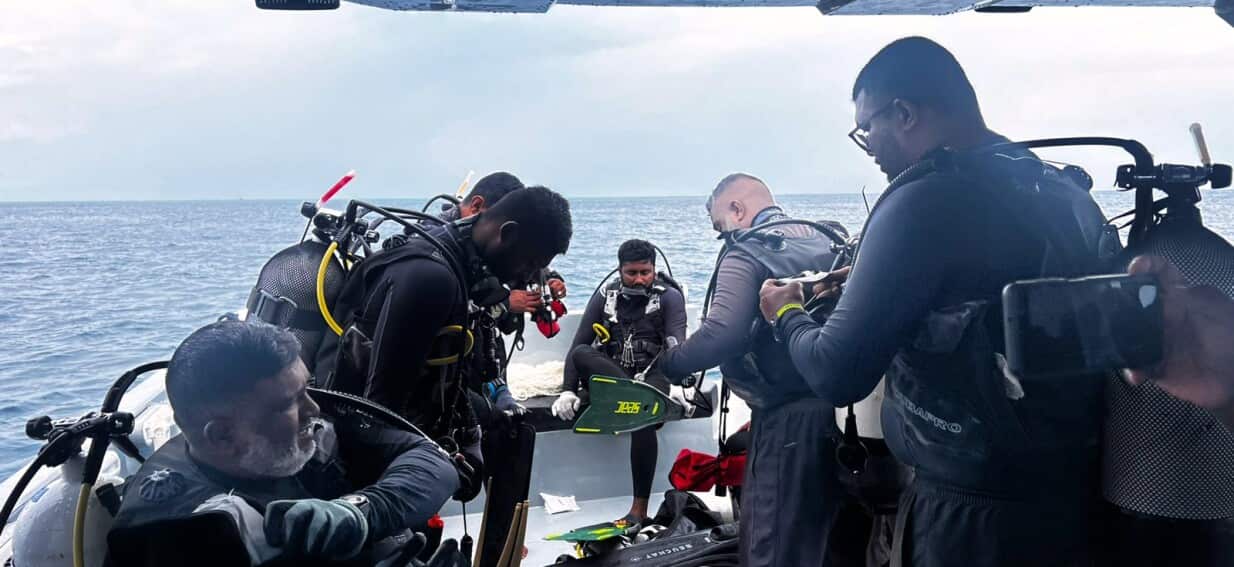
The air inside a scuba tank has a distinct taste. It is completely dry, scrubbed of moisture to protect the steel cylinders from rusting from the inside out, and it carries the faint, metallic whisper of the compressor that pumped it there. To anyone who has ever stood on the deck of a boat, pulling a regulator into their mouth before dropping backward into the blue, that dry air is the literal taste of anticipation. It is the threshold between the noisy, sun-blinded world of the surface and the weightless, cathedral quiet of the deep.
When four Italian scuba divers geared up off the coast of the Maldives, they were breathing that exact air. They were chasing the ultimate escape. The Maldives, an archipelago of nearly twelve hundred coral islands scattered across the Indian Ocean, is marketed to the world as paradise perfected. It is a place of postcard-perfect atolls, luxury overwater bungalows, and water so clear it looks like liquid glass. But beneath that glass lies an environment that does not care about vacation itineraries.
The ocean has a way of erasing human presence with terrifying speed. One moment you are part of a group, watching the sunlight fracture through the water column, and the next, you are entirely alone in a current that moves with the force of a freight train.
The Illusion of the Living Room
We treat the ocean like a tourist attraction. We pay for the boat charter, strap on the high-tech gear, and log our hours in neat little books, convincing ourselves that we have domesticated the wild. It is a comforting lie.
Consider the anatomy of a drift dive, which is the signature experience in the deep channels of the Maldives. These channels, known locally as kandus, are cuts in the reef where the open ocean meets the shallow lagoons. When the tide changes, millions of gallons of water rush through these narrow gaps. For a diver, it feels like flying. You drop in, find your buoyancy, and let the current carry you past walls of soft coral, gray reef sharks sleeping on the sand, and schools of eagle rays hovering effortlessly in the torrent.
It feels effortless because the technology works. Modern dive computers calculate your nitrogen absorption in real-time. Buoyancy compensators inflate with the touch of a button. Regulators deliver air smoothly regardless of your depth. Because the gear is so good, we forget where we are. We treat a dive site at ninety feet like a living room with a slightly lower ceiling.
But the margin for error at that depth is razor-thin.
When something goes wrong underwater, it rarely happens with a theatrical explosion. It happens in increments. A strap slips. A current shifts by two degrees. A diver panics, inhales sharply, and takes a lungful of dry tank air that suddenly feels like it isn't coming fast enough. In that single breath, the living room vanishes, replaced by a vast, indifferent wilderness.
The Search at the Edge of the Atoll
The news arrived in the dry, detached language of official reports: the bodies of four missing Italian citizens had been recovered from the waters of the Maldives. They had gone out for a dive and simply failed to return.
To the global news cycle, it was a tragic headline to be read, registered, and forgotten before the next commercial break. To the families waiting in Italy, it was the beginning of an agonizing, lifelong silence. To anyone who has ever loved the sea, it was a cold reminder of the tax the ocean occasionally demands from those who trespass in its depths.
When a diver goes missing, the search is an exercise in bleak mathematics. Coast Guard officials and local boat captains map the currents, calculating wind speed, tidal shifts, and the rate of drift. They draw grids on digital maps, trying to predict where a human body, suspended in a massive column of moving water, might end up.
In the Maldives, those grids quickly bleed into the abyss. Just outside the protective ring of the atolls, the ocean floor drops away precipitously. It plunges from twenty meters to thousands of meters into the dark of the Indian Ocean basin.
The search vessels cut their engines, the crews scanning the surface for the bright orange flare of a signaling tube or the flash of a strobe light. You look for anything that breaks the endless, undulating pattern of the waves. Hours turn into days. The tropical sun beats down on the decks, burning the skin, while underneath, the water remains dark, cold, and silent.
The recovery of the four bodies was not a miracle; it was a grim closure. They were found within the waters of the central atolls, brought back to the surface by teams who knew exactly what they were looking for and dreaded finding it.
The Anatomy of the Depths
To understand what happened, one must understand the invisible physics that govern every second of a deep dive. When you submerge, the weight of the water presses against your body. At thirty meters—roughly one hundred feet, the typical limit for recreational diving—the pressure is four times greater than it is on land.
Every breath you take at that depth delivers four times as many gas molecules as a breath at the surface. The nitrogen in your tank, normally inert and harmless, begins to dissolve into your bloodstream and tissues. It acts like a slow, chemical sedative.
Divers call it nitrogen narcosis, or "the rapture of the deep."
It feels like mild intoxication. The world becomes beautiful, distant, and remarkably uncomplicated. Your reaction times slow down. Your ability to solve simple problems degrades. If a piece of equipment malfunctions when you are nitrogen-narcotic, your brain has to fight through a thick, velvet fog just to realize you are in danger.
If a current catches you and begins to pull you down into the blue, your instinct is to fight it. You swim against the flow. Your heart rate spikes. Your breathing becomes rapid and shallow. This is the trap.
The more air you consume, the faster your supply drops. The rapid breathing causes carbon dioxide to build up in your lungs, which triggers a primal, hardwired panic response in the human brain. The urge to bolt for the surface becomes overwhelming.
But you cannot bolt.
If you ascend too quickly from ninety feet, the nitrogen dissolved in your blood doesn't have time to escape through your lungs. It forms bubbles in your arteries and joints, acting like shaken soda inside your veins. It is a condition known as decompression sickness, or the bends, and it can paralyze or kill a diver long before they reach the sunlit surface.
You are caught between two distinct versions of the end: stay down and run out of air, or fly up and let your own blood betray you.
The Shared Liability of the Buddy System
Every certified diver is taught the foundational rule of the sport before they ever dip a toe into open water: never dive alone. You have a buddy. You check each other's gear before the splash. You monitor each other's air gauges during the dive. You stay within an arm's reach, operating as a single, redundant biological unit.
It is a beautiful concept. It is based on mutual trust and shared responsibility.
But the buddy system possesses a hidden vulnerability that instructors rarely discuss in detail. In moments of extreme crisis, the buddy system can turn a single tragedy into a double one.
Imagine two people underwater. One diver encounters a problem—perhaps a trapped valve or a sudden, debilitating case of narcosis. They begin to sink. The second diver notices, swims down, and attempts to assist. Now, both are working harder, consuming air at an accelerated rate, and moving deeper into the zone of narcosis.
If the first diver panics, they become dangerous. A panicking person underwater will instinctively claw at anything that promises air, often ripping the regulator out of their partner's mouth or tearing at their mask. The rescuer is suddenly forced to make an unthinkable calculation in a fraction of a second: do I stay and risk dying with my friend, or do I push them away and save myself?
We do not know the exact sequence of events that took place in the waters off that Maldivian atoll. We do not know who ran out of air first, or if a sudden downward current caught all four of them simultaneously, dragging them into the depths before they could inflate their vests.
What we do know is that they stayed together. They were found together. In the final, terrifying moments when the dry air ran out and the ocean closed in, they remained a group, bound by the choices they made and the environment they chose to explore.
The Quiet That Remains
The tourists will keep coming to the Maldives. The boats will continue to head out to the channels every morning, their decks crowded with people laughing, checking their cameras, and smearing sunscreen onto their shoulders. The dive guides will brief them on the currents, telling them to hold onto the reef hooks and enjoy the ride.
The ocean will look exactly the same as it did the day those four Italians went under. It will be blue, clear, and seemingly infinite.
There is a profound loneliness to a tragedy that happens underwater. On land, a disaster leaves wreckage. There are broken trees, twisted metal, charred earth—physical markers that say something important happened here.
The sea leaves no scars. The water heals its own wounds instantly, closing over the space where a life ended without leaving so much as a ripple. The gray reef sharks will continue to cruise the channels, the soft corals will sway in the current, and the sunlight will still dance through the top thirty feet of the water column.
The families of the four divers will eventually receive the personal belongings left behind in the resort rooms. The dry clothes. The sunglasses. The logbooks with the final pages left blank.
Those who continue to dive will return to the water, carrying the memory of the four from Italy like an invisible weight in their gear bags. They will pull the regulators into their mouths, taste that dry, metallic air, and step off the boat into the silence. They will look down into the deep blue, knowing with absolute certainty that paradise is just a thin coat of paint on a world that has no room for human mistakes.