The fluorescent lights of the grocery aisle have a way of flattening reality. Under their steady, unblinking buzz, a carton of eggs is no longer just breakfast. It is a data point. A receipt is no longer a slip of thermal paper; it is a battle report.
For months, the national conversation around the economy has been anchored to a single, visual marker: the glowing numbers on the digital signboards of gas stations. We watch them climb and fall like a fever chart of the American psyche. When the price of a gallon of unleaded drops by twenty cents, a collective, silent sigh echoes through commuter traffic. We tell ourselves that the bleeding has stopped.
But the real problem lies elsewhere. It sits quietly in the shopping carts, the utility bills, the daycare invoices, and the streaming subscriptions that sneakily tick upward by two dollars a month.
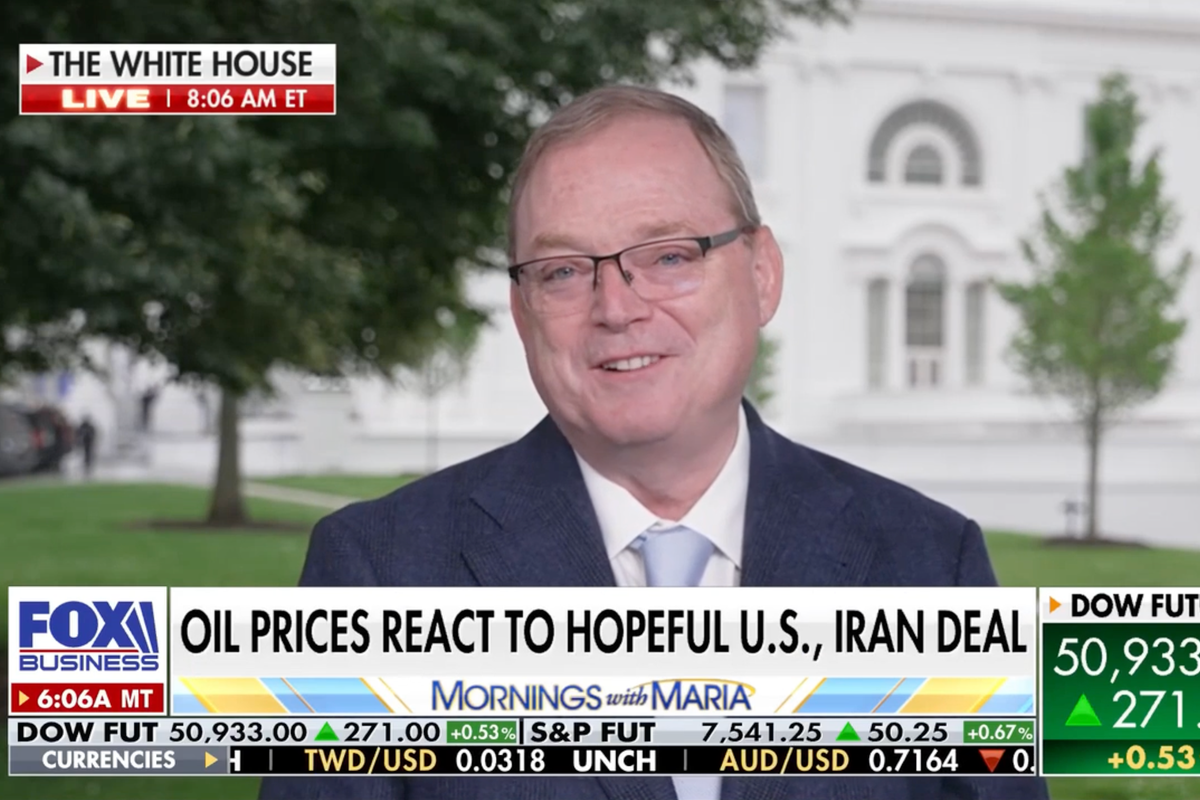
Recently, Stephen Moore, a senior economic adviser aligned with the Trump administration’s financial philosophy, made headlines by pointing out this exact phenomenon. Yet, he did so with a tone that felt entirely detached from the kitchen tables where these numbers actually clash with human lives. He didn't just acknowledge that Americans are spending more across the board; he framed it as a metric of success, a sign of a robust consumer engine firing on all cylinders. He noted that people are spending more on everything—not just at the pump.
To a statistician, higher spending looks like demand. It looks like velocity.
To a person trying to balance a checking account, it feels like quicksand.
The Illusion of the Full Cart
Consider a hypothetical shopper. Let's call her Elena. She is a graphic designer, a mother of two, and a master of the spreadsheet. She represents millions of middle-class Americans who find themselves trapped in a strange, psychological twilight zone.
Elena’s income hasn't dropped. In fact, on paper, she received a modest three percent raise this year. If you looked at her bank statements from an aerial view—the view favored by policymakers and talking heads on cable news—you would see that her total expenditure has increased. She is contributing to the GDP. She is buying the shoes, the organic milk, the mid-tier car insurance.
According to the macro-economic script, Elena is thriving. She is the very proof of the brag.
But let us zoom in closer. Look at the lines around her eyes as she stands in front of the dairy case. The organic milk is no longer a casual choice; it is a calculated sacrifice. To keep it in the cart, she has quietly excised the artisanal coffee she used to enjoy. The shoes were bought because her youngest blew through the toe of his sneakers two months ahead of schedule, not because she wanted to indulge in retail therapy.
This is the invisible tax of modern inflation. It is the substitution effect taken to its logical, exhausting extreme. When the cost of core necessities rises, spending increases because survival is non-negotiable.
To brag about record-high consumer spending in an era of persistent inflation is to misunderstand the difference between a choice and an ultimatum. A nation spending more because it wants more is wealthy. A nation spending more because it requires more just to stay in place is weary.
The Language of the Disconnected
Why is there such a massive chasm between the language of economic theory and the reality of lived experience?
The answer lies in the metrics we choose to celebrate. For decades, economic health has been measured by growth, spending, and production. If the numbers go up, the graph is green, and green means good. When an economic guru looks at data showing that Americans are spending money on restaurants, travel, and retail at higher rates than last year, they see a confident public. They see liquidity.
What the data fails to capture is the emotional currency being spent alongside the dollars.
Money is emotional. It is a proxy for security, for autonomy, for the ability to look at the future without a knot tightening in your stomach. When every single transaction—from a haircut to a head of lettuce—requires a mental calculation, a slow-burning fatigue sets in. This fatigue doesn't show up in the Gross Domestic Product. It doesn't register in the consumer confidence index, which often lags behind the actual mood of the street.
It shows up in the quiet anxieties of late-night conversations. It shows up in the decision to delay a dentist appointment, to skip a weekend trip to see family, or to put a minor car repair on a credit card, hoping the interest won't swallow next month's surplus.
The disconnect becomes toxic when political figures use these inflated spending numbers as a trophy. It feels like a gaslighting mechanism. The average citizen is told they are participating in a booming economy, while their own bank account tells them they are running a marathon just to stay on the starting line.
The Rebalancing Act
We have reached a point where the traditional indicators of economic prosperity need a human-centric overhaul. If we continue to measure success purely by how much money changes hands, we will remain blind to the structural cracks forming beneath our feet.
What if we measured the economy by the stability of the average household savings account? What if the benchmark of a successful policy was not the total volume of retail sales, but the percentage of families who can handle a five-hundred-dollar emergency without going into debt?
If you speak to small business owners—the local bakers, the independent mechanics, the boutique owners—they will tell you a very different story than the one coming out of Washington or Palm Beach. They see the spending, yes, but they also see the hesitation. They see customers looking at the menu just a little longer, opting for the appetizer instead of the entree, or asking if a part can be patched up rather than replaced.
These are not the behaviors of an extravagant, carefree consumer base. These are the defensive maneuvers of a population trying to survive a prolonged economic siege.
The numbers don't lie, but they can be coached into telling a partial truth. Yes, Americans are spending more on everything. We are spending more because the price tags have changed, not because our fortunes have. We are spending more because we have to.
The sun sets outside the grocery store, casting long shadows across a parking lot filled with people loading bags into trunks. Inside those plastic sacks are fewer items than there would have been three years ago, bought with more money, earned with more effort.
The engine is humming, the wheels are turning, and the spending continues. But as the receipts print out, longer and more expensive than ever before, the true cost is measured in the quiet, heavy realization that the American Dream is becoming an increasingly expensive subscription model—one that fewer and many can no longer afford to maintain.