The fracturing of Indonesia’s labor movement is driven by a deep structural divide between union elites seeking state patronage and independent grassroots activists demanding systemic reform. This split has rendered Southeast Asia's largest workforce politically toothless. While major confederation bosses trade millions of worker votes for lucrative government appointments and cabinet influence, rank-and-file laborers continue to suffer under the erosion of workplace protections. The consequence is a deeply compromised labor ecosystem incapable of presenting a unified front against anti-worker legislation.
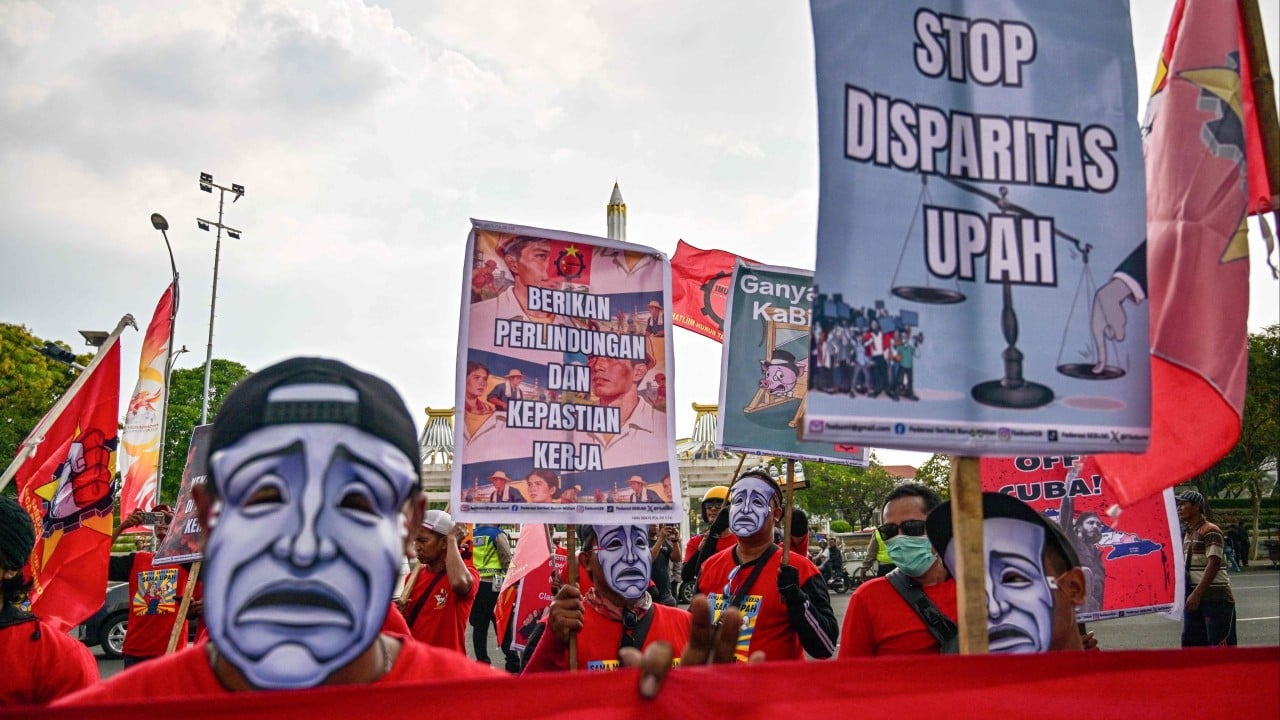
This internal crisis was fully exposed during recent May Day mobilizations in Jakarta, where the movement split into two completely separate realities. At the National Monument, major establishment confederations gathered to share a stage with state officials, trading compliant applause for vague promises of government task forces and minor regulatory tweaks. Miles away, a smaller, more militant coalition of independent unions and grassroots activists held a counter-rally, denouncing the establishment leaders as corporate collaborators who have sold out the working class. This is not a temporary tactical disagreement. It is a fundamental civil war over the soul and strategy of Indonesian organized labor.
The Ghost of the New Order
To understand why Indonesian labor is so easily compromised today, one must trace the roots of its current leadership back to the authoritarian regime of President Suharto. During the New Order era, the state maintained strict control over the working class by permitting only a single, state-sanctioned union entity: the All-Indonesian Workers' Union. This organization was explicitly designed not to fight for workers, but to contain political dissent, control labor unrest, and ensure a compliant workforce for state-led economic development.
When the regime collapsed in 1998, the sudden arrival of democracy triggered an explosion of new, independent trade unions. However, the bureaucratic elite trained under the old state-sanctioned system did not disappear. Instead, they adapted to the new electoral environment. They rebranded themselves as democratic leaders while maintaining the exact same top-down, transactional approach to labor organizing that they had practiced for decades.
This historical baggage created a permanent, structural division within the modern movement, splitting organized labor into two distinct streams.
- The Bureaucratic Establishment: Represented by massive organizations like the Confederation of All-Indonesian Workers' Union and the Indonesian Trade Union Confederation. These groups prioritize top-down command structures and focus heavily on backroom negotiations with political elites.
- The Independent Left: Represented by smaller, more aggressive entities such as the Confederation of United Indonesian Workers and various grassroots labor NGOs. These groups trace their lineage back to the pro-democracy underground movements of the 1990s and completely reject any cooperation with the ruling political class.
The Transactional Electoral Machine
Indonesian political parties are largely empty ideological vessels controlled by wealthy oligarchs. Because these parties lack genuine grassroots networks or deeply held policy platforms, they treat elections as purely transactional affairs built on patronage and material payouts. Organized labor should theoretically serve as a powerful counterweight to this oligarchic power. Instead, the leaders of the major labor confederations have turned their memberships into a commodified voting bloc, selling endorsements to the highest political bidder.
The mechanics of this co-optation follow a predictable pattern during every major election cycle. A union boss pledges the collective voting power of hundreds of thousands of factory workers to a presidential or gubernatorial candidate. In exchange, the candidate promises vague policy concessions or future political appointments. When the candidate wins, the union leader is rewarded with a seat on a state advisory board, a high-level position within the Ministry of Manpower, or a commissioner role at a lucrative state-owned enterprise.
This dynamic has triggered an institutional rot inside the major confederations. The elite leadership becomes structurally dependent on the very government they are supposed to be challenging. They begin to view their union positions not as a mandate to protect the working class, but as a stepping stone to personal political advancement.
When union officials rely on state patronage for their own wealth and status, they lose all incentive to launch aggressive, sustained industrial actions that could disrupt the economic interests of their political masters. The rank-and-file workers are left entirely unrepresented, their collective leverage spent to secure a government office for a bureaucrat.
The Omnibus Law Betrayal
The catastrophic cost of this political transactionalism became undeniable during the passage of the controversial Omnibus Law on Job Creation. Pushed aggressively by the state to attract foreign direct investment, the legislation effectively dismantled decades of hard-won worker protections. It introduced highly flexible short-term contracts, vastly expanded the legal parameters for third-party outsourcing, reduced severance pay metrics, and stripped away mandatory rest days.
The introduction of the Omnibus Law was a defining existential crisis for the country's labor movement. A unified, uncompromising national strike could have crippled industrial production and forced the government to rewrite the legislation. Instead, the structural fractures within the labor movement crippled the resistance from the inside.
While independent unions and militant factory workers took to the streets in intense, spontaneous clashes with riot police, the establishment union leadership engaged in a strategy of calculated hesitation. Fearing that total opposition would permanently sever their access to presidential palace patronage, major confederation leaders watered down their demands. They pulled their organizations out of broader civil society coalitions, chose to pursue lengthy and ultimately compromised legal challenges, and actively discouraged their members from participating in wildcat strikes.
This compliance paid off handsomely for the union elites, several of whom were promptly appointed to prestigious government committees tasked with drafting the very regulations that implemented the worker-cutting laws. For the ordinary assembly-line worker in Bekasi or Tangerang, however, the result was a permanent reduction in job security and a dramatic decline in real wages.
The Constitutional Court Illusion
In late 2024, the Indonesian Constitutional Court delivered a seemingly monumental victory to the working class by ordering the removal of the manpower cluster from the Omnibus Law framework, directing the government to draft an entirely new, separate labor law within two years. Establishment union leaders immediately claimed total victory, using the ruling to justify their long-standing strategy of elite legalism and backroom diplomacy.
This celebration is dangerously premature and fundamentally misunderstands how power operates in Jakarta. The ruling did not automatically restore worker protections; it merely shifted the battlefield back to the parliament and the executive branch, where oligarchic influence remains absolute.
The state has already proven its willingness to bypass judicial roadblocks through emergency decrees and administrative maneuvers. Without a unified, disruptive mass movement capable of enforcing the court's decision through industrial leverage, the process of drafting a new labor law will simply be hijacked by corporate lobbying groups and compliant political parties.
By channeling all worker energy into faith in judicial institutions, establishment union leaders have successfully demobilized the street-level resistance, leaving workers vulnerable to a rebranded version of the exact same deregulatory policies.
The Rise of Grassroots Defection
The rank-and-file workforce is beginning to notice that their leaders' political access has delivered nothing but material losses. A quiet but significant rebellion is currently taking place across Indonesia’s industrial zones, characterized by a steady wave of defections away from the traditional, compromised confederations. Entire local factory chapters are dissolving their affiliations with the major establishments, choosing instead to join smaller, independent federations or to form localized, unaffiliated company unions.
These independent groups are pioneering entirely new forms of labor resistance that bypass elite patronage completely. They are moving away from the traditional model of the mass rally—which has largely been transformed by establishment bosses into a controlled, ritualistic spectacle—and are focusing heavily on localized industrial sabotage, wildcat strikes, and international supply chain pressure.
Furthermore, these grassroots organizations are expanding their scope beyond traditional factory workers to organize the rapidly growing, highly exploited gig economy, mobilizing app-based delivery drivers and ride-hailing workers who have been completely ignored by the old union bureaucracy.
This shift has made the workplace landscape significantly more volatile and unpredictable for international corporations and domestic factory owners. Employers who once relied on a cozy, corrupted relationship with a single establishment union boss to maintain labor peace are finding that those leaders can no longer control the factory floor.
When a major confederation signs a compliant collective bargaining agreement, the rank-and-file workers are increasingly rejecting it, organizing wildcat walkouts that completely ignore the directives of their official union leadership.
The Core Illusion of the Labor Party
In a desperate bid to regain their slipping political relevance and co-opt this rising grassroots anger, several establishment union bosses spearheaded the revival of the Indonesian Labour Party to contest the recent general elections. The party was marketed as a historic turning point that would finally give the working class a direct voice in the national legislature.
The project was fundamentally flawed from its inception. The party’s executive board was dominated by the exact same establishment bureaucrats who had spent the previous decade trading worker endorsements for personal state patronage.
This leadership hypocrisy created a deep, immediate crisis of trust. Militant independent unions and critical factions within the party openly revolted, pointing out the absurdity of asking workers to fund and support an electoral machine run by leaders who spent their weekends golfing with corporate executives and state ministers.
The internal infighting paralyzed the party's campaign apparatus. Lacking a genuine grassroots infrastructure, and utterly outspent by the massive financial networks of oligarchic parties, the Labour Party failed to clear the strict electoral threshold required to enter parliament.
The entire electoral experiment served only to further divide the movement, diverting scarce financial resources and organizational energy away from vital factory-floor organizing into a failed, top-down political vanity project.
The Fractured Path Forward
The fundamental lesson of the last decade of Indonesian labor history is that access to the halls of political power is entirely distinct from actual class power. The establishment strategy of trading labor compliance for a seat at the political table has failed completely, resulting in the steady dismantling of worker protections and the deep alienation of the rank-and-file membership.
Indonesian labor will remain weak, divided, and easily ignored until the movement undergoes a thorough internal purge of its bureaucratic elite. The path to a genuine revival of the working class does not run through presidential palace dinners, legislative committee seats, or compromises with political parties. It rests entirely on the difficult, unglamorous work of rebuilding independent, democratic organizational power from the factory floor upward, entirely outside the corrosive influence of elite patronage.