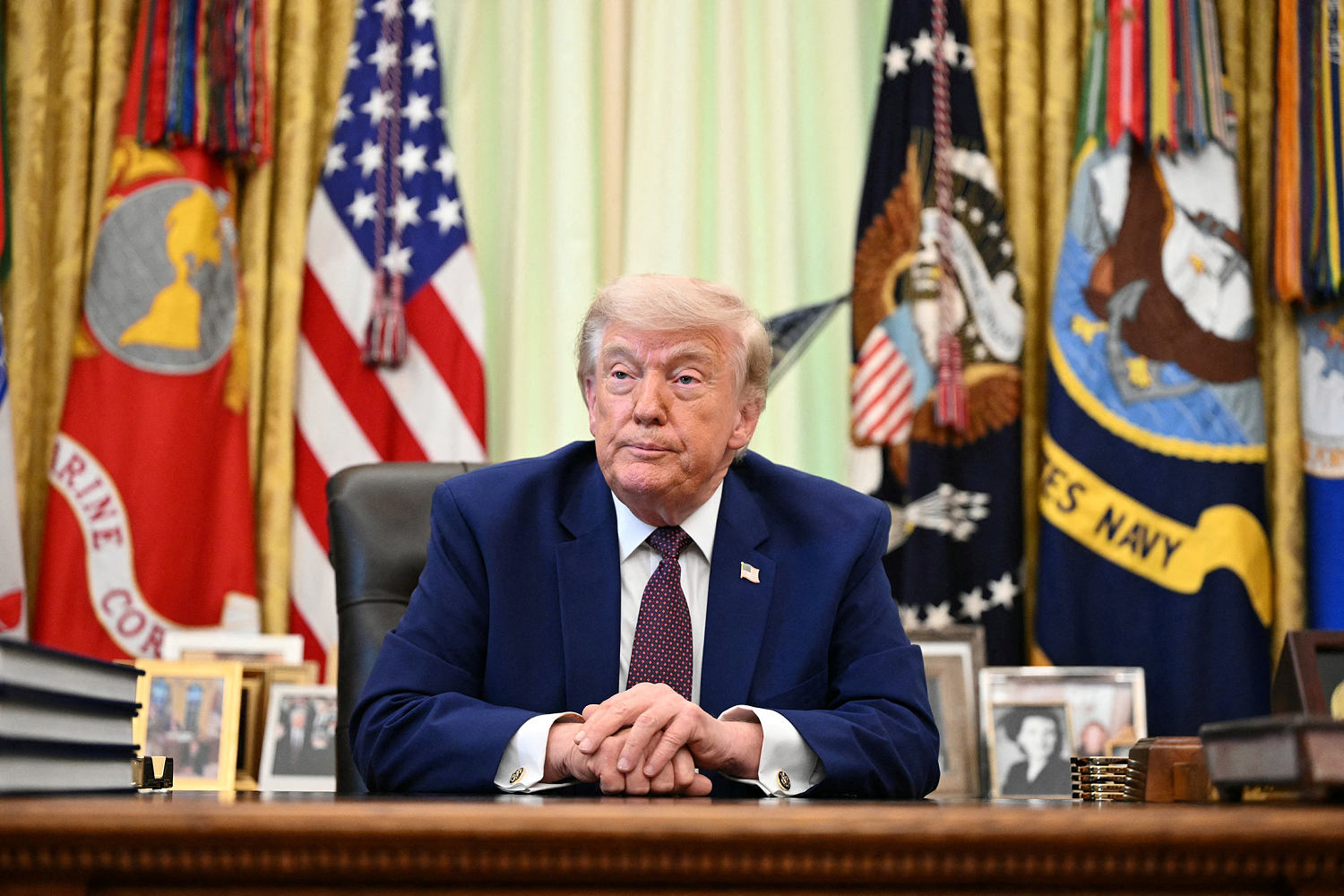
The rain outside the Mar-a-Lago resort didn’t care about politics. It just slicked the palm fronds and blurred the lines between the Atlantic Ocean and the manicured lawns. Inside, under the heavy crystal chandeliers, the air was different. It smelled of expensive cologne, old money, and the distinct, electric ozone of ambient anxiety. Donald Trump leaned slightly forward at the table, his eyes scanning a room filled with donors, aides, and the ubiquitous, quiet men with earpieces.
Someone raised a question about the "anti-weaponization" fund. It was a pool of money, a legal shield, a conceptual war chest designed to protect allies from what his circle viewed as a politically motivated justice system.
Trump paused. The bravado, the absolute certainty that defines his public persona, flickered for a fraction of a second.
"I’d have to ask the lawyers," he said.
It was a rare admission of bureaucratic friction from a man who prides himself on cutting through red tape with a single sentence. In that one phrase, the grand narrative of political warfare dissolved into the mundane, terrifying reality of modern governance. The machinery of law is too vast, too complex, even for the people who seek to dismantle or weaponize it.
The Legal Labyrinth
To understand why a billionaire former president has to defer to a huddle of men in dark suits, you have to look at how power actually functions in America. We like to think of power as a sledgehammer. It isn't. It is an infinite web of fine print.
Imagine a small-town business owner. Let's call her Sarah. Sarah doesn't exist in the court transcripts, but her reality is duplicated thousands of times across the country. She runs a mid-sized logistics firm. One day, a federal regulatory agency serves her with a compliance audit. It isn't a criminal charge. It is just a demand for ten years of emails, financial records, and server logs.
Sarah cannot fight the federal government. The cost of just assembling the paperwork would bankrupt her company before she ever saw a judge. This is what the Trump campaign refers to when they use the term "weaponization." It is the idea that the process itself is the punishment.
The proposed fund was supposed to be the antidote to Sarah’s problem—or, more accurately, the antidote for high-profile political figures facing similar administrative avalanches. It was conceived as a financial fortress, a way to level the playing field against an adversary with infinite time and taxpayer money.
But the law has a funny way of eating its own children.
When Trump muttered that he needed to consult his legal team, he was acknowledging a hard truth. You cannot create a massive pot of money to fight the legal system without running face-first into the very legal system you are trying to fight. Campaign finance laws, tax codes governing non-profits, and transparency statutes are not just hurdles. They are landmines.
The Invisible Stakes
The debate over this fund isn't really about line items or legal definitions. It is about trust. Specifically, the total collapse of it.
When we watch the news, we see the talking heads shouting about precedents and constitutional crises. But underneath the noise, the average person is feeling a quiet, steady erosion of certainty. If the laws of the land can be twisted to target political enemies—or if the defense against those laws requires a multi-million-dollar private fund—then the average citizen is left completely exposed.
Consider the mechanics of a legal defense fund. It requires a structure. It needs trustees, compliance officers, and a clear definition of who qualifies for aid.
- Who decides which target is "political" and which is just a criminal?
- How do you prevent the fund from becoming a tool for bribery or undue influence?
- What happens when the donors who filled the chest demand a say in how the defense is conducted?
These are not abstract ethical questions. They are practical nightmares that keep defense attorneys awake at 3:00 AM, staring at the ceiling while their laptops hum on the nightstand.
The reality of legal defense is unglamorous. It is boxes of documents in a windowless room in lower Manhattan. It is a paralegal drinking cold coffee at midnight, looking for a single discrepancy in a chain of custody report. When a politician promises a grand solution to this grind, the lawyers in the back of the room start to sweat. They know the math doesn't work.
The Machinery Never Stops
There is a temptation to view this entire saga as a theatrical performance. Trump speaks, the media reacts, the donors write checks, and the cycle repeats. But the theater has real-world consequences.
The concept of an anti-weaponization fund changes the vocabulary of American justice. It normalizes the idea that the court system is just another partisan arena, no different than a congressional committee or a cable news talk show. Once that idea takes root, the damage is done. It doesn't matter if the fund is legally viable or if it dies a quiet death in a compliance office. The narrative has already shifted.
The real problem lies elsewhere, far away from the cameras of Mar-a-Lago.
It rests in the federal courts where public defenders are overwhelmed, where prosecutors use the threat of mandatory minimums to secure plea deals, and where the average citizen cannot afford a single hour of a top-tier defense attorney's time. The system is broken, but not in the way the political class suggests. It isn't broken because it is targeted; it is broken because it is indifferent.
Trump’s hesitation to declare the fund alive or dead reveals the friction between political rhetoric and systemic reality. A leader can rally a crowd of thousands with promises of protection and retribution. The crowd roars. The flags wave. The energy in the arena is palpable.
Then the leader walks off the stage, sits down in a quiet room, and the lead attorney slides a two-hundred-page brief across the mahogany table. The brief explains, in agonizing, dry detail, why the promise made on stage is a violation of section 501(c)(4) of the Internal Revenue Code.
The momentum stops. The grand gesture is reduced to a bureaucratic shrug.
The rain stopped outside the resort, leaving the air thick and humid. The dinner continued, forks clinking against china, conversations moving on to the next crisis, the next poll number, the next fundraising target. The question of the fund remained dangling in the air, unanswered, a monument to the gray area where political will collides with legal reality.
Power, in its truest form, is not the ability to make things happen. It is the ability to navigate the constraints of what is allowed to happen. As the waiters cleared the tables, the realization settled over the room, silent and heavy: the system always wins, if only because it wrote the rules of the game.