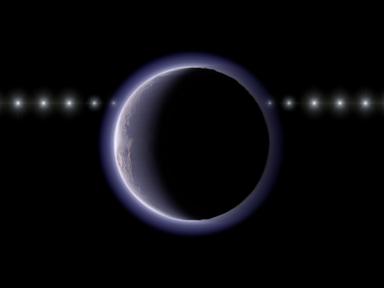
Astronomers just found something that shouldn't exist. Out in the freezing, dark outskirts of our solar system, a tiny world named Quaoar seems to have its own atmosphere. This isn't supposed to happen. Quaoar is a dwarf planet roughly half the size of Pluto. At that size, and at those temperatures, gravity usually isn't strong enough to hold onto a gas envelope for long. Yet, the data suggests otherwise.
You're looking at a rock sitting 4 billion miles away from the Sun. It’s so cold there that nitrogen and methane—the stuff that makes up atmospheres on bigger worlds—should be frozen solid on the surface. But new observations using the European Space Agency's Gaia mission and ground-based telescopes tell a different story. This discovery changes how we think about the "neighborhood" past Neptune. It turns out the Kuiper Belt isn't just a graveyard of frozen leftovers. It's a place where even the small players have secrets.
Why Quaoar shouldn't have an atmosphere
Physics is usually pretty stubborn about these things. To keep an atmosphere, a planet needs a "Goldilocks" balance of mass and temperature. If a world is too small, its gravity is too weak to stop gas molecules from flying off into space. If it’s too hot, those molecules move too fast to be caught. Quaoar is tiny. We’re talking about a diameter of roughly 700 miles.
Normally, a body that small loses its gas almost instantly. Astronomers previously thought Pluto was the cutoff for this kind of thing. Even Pluto’s atmosphere is weird—it expands and contracts as the planet moves closer to or further from the Sun. But Quaoar is significantly smaller than Pluto. For it to hold onto any kind of gaseous shroud, something strange must be happening. Maybe the gas is being replenished from the inside. Or maybe our models of how "volatile" chemicals behave in deep space are just wrong.
The trick to seeing the invisible
You can't just point a camera at Quaoar and see a hazy sky. It’s too far and too dim. Instead, scientists used a method called stellar occultation. It's basically a cosmic shadow play.
Imagine a distant star. Now imagine Quaoar passing directly in front of that star from our perspective on Earth. If Quaoar was just a dead, airless rock, the star’s light would blink out instantly and then pop back on. It would be a sharp, "on-off" switch.
But that's not what happened. During recent observations, the light from the star didn't just vanish. It faded out slightly before disappearing and brightened gradually as it reappeared. That "fading" effect is the smoking gun. It happens because a thin layer of gas—an atmosphere—is bending and absorbing the starlight before the solid rock blocks it.
This wasn't a one-off lucky guess. Scientists used the incredibly precise star maps from the Gaia satellite to predict exactly when and where Quaoar would pass in front of a star. They had teams across the globe ready to watch. When multiple telescopes see the same "soft" dip in light, you know you aren't looking at a fluke. You're looking at an atmosphere.
A world of weird rings and frozen gases
Quaoar was already a bit of a rebel before this atmosphere news broke. Just last year, researchers found a ring system around it. Rings aren't rare—Saturn has them, obviously—but Quaoar’s rings are in the "wrong" place.
Most rings sit inside the Roche limit. That’s the distance where a planet’s gravity is strong enough to rip a moon apart or prevent space dust from clumping together into a moon. Quaoar’s rings sit way outside that limit. By all laws of orbital mechanics, those rings should have gathered together and formed a tiny moon ages ago. They didn't.
Now, add a thin atmosphere to that mix. We’re starting to see a profile of a dwarf planet that behaves more like a gas giant's moon than a stray asteroid. This suggests that the outer solar system is far more geologically active than we ever dared to guess. If Quaoar has enough internal heat to vent gases and maintain an atmosphere, what about the hundreds of other objects out there we haven't checked yet?
What this means for our solar system history
We used to think the solar system was neat and tidy. Inner rocky planets, outer gas giants, and then a bunch of boring ice cubes at the edge. That view is dead.
The presence of an atmosphere on Quaoar suggests that "volatile" ices like methane and carbon monoxide are much more resilient than we thought. It also means the Kuiper Belt is a treasure trove of complex chemistry. If these small worlds can hold onto gases, they might be preserving the same materials that formed the Earth and the other planets billions of years ago.
It’s like finding a time capsule that’s still slightly warm. Studying Quaoar gives us a direct look at the raw materials of our origin. If a rock this small can keep its "breath," then the potential for complex environments in the deep dark of space is huge.
The challenge of deep space observation
Let's be real about the difficulty here. Quaoar is roughly 43 times further from the Sun than Earth is. Sunlight there is a weak glimmer. The fact that we can detect a thin layer of gas from billions of miles away is a testament to how far telescope tech has come.
But we need more than just ground-based data. Missions like New Horizons, which flew by Pluto and Arrokoth, showed us that "up close" is the only way to really know what’s going on. We saw mountains of water ice and plains of frozen nitrogen on Pluto. Quaoar is screaming for a dedicated mission.
Until then, we’re stuck with these brief glimpses during occultations. Every time Quaoar crosses a star, we get a few more seconds of data. It’s a slow, painstaking way to build a map of a world, but it’s all we have. And honestly, it’s enough to tell us that we’ve been drastically underestimating the "little guys" in our solar system.
Better ways to track these icy worlds
If you're interested in how these discoveries happen, don't just wait for the headlines. The world of citizen science and professional astronomy is more open than it used to be. You can actually follow the occultation predictions yourself.
- Watch the Gaia Mission updates. The data from Gaia is what makes these predictions possible. Their public releases often include "impact" stories about how their star maps are used to find atmospheres on dwarf planets.
- Follow the Lucky Star project. This is a European-led effort specifically focused on occultations by Trans-Neptunian Objects (TNOs). They’re the ones doing the heavy lifting on worlds like Quaoar and Haumea.
- Check out raw telescope data. If you have a background in data or just a lot of patience, sites like the Planetary Data System (PDS) host actual mission data that anyone can look at.
The discovery of Quaoar's atmosphere isn't a fluke. It's a signal. The edge of our solar system is crowded, active, and full of surprises that don't care about our current textbooks. We’re just beginning to see the real picture. Get used to it—the outer rim is where the real action is now.


