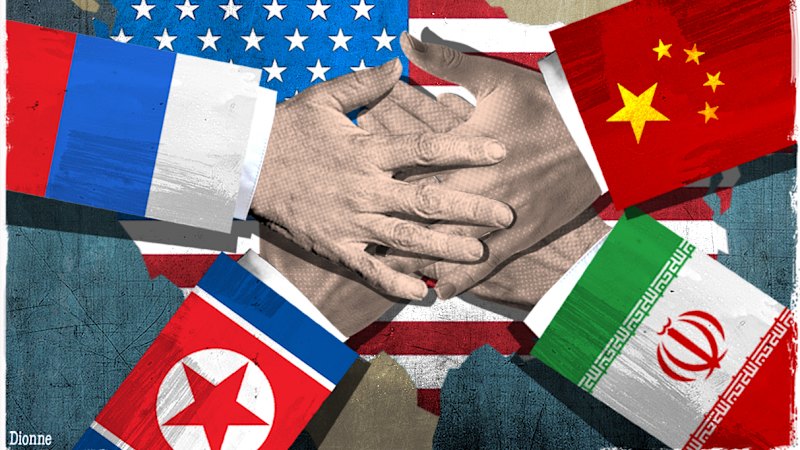
The modern geopolitical landscape is no longer defined by the friction of competing ideologies, but by a cold, hard mathematical reality. For decades, the West relied on the assumption that economic isolation would force authoritarian regimes to heel. That assumption has shattered. Today, a consolidated bloc of adversaries—China, Russia, Iran, and North Korea—has formed a functional, self-sustaining ecosystem that renders traditional Western leverage obsolete.
This is the "Axis of Upheaval," a term that has moved from think-tank white papers into the brutal reality of global conflict. While critics often dismiss Donald Trump’s erratic foreign policy as a series of "madcap follies," the truth is more structural and far more dangerous. The shift toward a transactional, "America First" posture didn't just annoy allies; it provided the final piece of the puzzle for a new world order that doesn't need Washington’s permission to exist.
The Myth of Isolation
For thirty years, the United States used the dollar and the global banking system as a velvet-covered hammer. If a nation stepped out of line, they were cut off from the SWIFT network, their assets were frozen, and their economy was left to wither. This worked when there was only one game in town.
It fails when there is a viable alternative.
China provides the capital and the high-tech manufacturing. Russia provides the energy and the raw minerals. Iran offers a proving ground for asymmetrical warfare and drone technology, while North Korea supplies the sheer industrial volume of "dumb" munitions—the artillery shells and short-range missiles that still decide the fate of trenches in Eastern Europe.
When the Trump administration accelerated the use of aggressive tariffs and pulled out of multilateral agreements like the JCPOA, it didn't just isolate Iran; it signaled to the rest of the world that American commitments have an expiration date. This unpredictability acted as a catalyst. It forced these four disparate powers to stop flirting and start building a permanent infrastructure of resistance.
The Mechanics of the New Entente
This isn't a traditional alliance. There is no "Article 5" equivalent where an attack on Pyongyang is an attack on Beijing. Instead, it is a marriage of convenience built on three pillars:
- Sanction Immunity: By trading in yuan and local currencies, and using "dark fleets" of tankers to move Russian and Iranian oil, the bloc has built a shadow economy that the U.S. Treasury cannot see or stop.
- Technological Cross-Pollination: We are seeing a terrifying speed of iteration. Iranian drone designs are refined by Russian battlefield experience in Ukraine, then mass-produced using Chinese components.
- Diplomatic Shielding: In the UN Security Council, the veto has become a permanent wall. Any attempt to penalize one member of the axis is immediately neutralized by the others, creating a zone of total legal impunity.
The Failure of Transactionalism
The fundamental flaw in the current U.S. approach—one that spans administrations but was hyper-charged under Trump—is the belief that every geopolitical problem is a "deal" waiting to be made.
In June 2025, during the "12-Day War" involving Iran, the world saw this strategy hit a dead end. The administration’s attempt to use "Operation Epic Fury" as a bargaining chip backfired. While the U.S. and Israel targeted Iranian missile sites, they underestimated the speed of the "Axis" response. Within weeks, Chinese HQ-9B surface-to-air missile batteries were arriving in Tehran. Russia provided real-time intelligence from its Khayyam satellite to help Iranian proxies track Western assets.
The "madcap" element isn't just the rhetoric; it's the failure to recognize that these nations are no longer looking for a deal with the West. They are looking to replace it.
The Resource Trap
Consider the math of a modern conflict. In 2024 and 2025, the disparity in industrial capacity became the defining metric of the Ukraine-Russia theater. While the U.S. struggled with Congressional gridlock to authorize aid, North Korea shipped over five million artillery shells to Moscow.
The West is playing a game of high-tech precision, which is expensive and slow. The Axis is playing a game of attrition and volume. This shift is not a temporary fluke. It is a deliberate strategic choice. By flooding the market with cheap, effective weaponry—like the Shahed drones or basic ballistic missiles—the Axis forces the West to spend millions on interceptors to shoot down targets that cost $20,000.
It is a slow-motion economic bleed.
Why Alliances Are Drifting
Traditional U.S. allies in Europe and Asia are watching this play out with a growing sense of dread. When Washington treats trade deals and defense treaties as conditional, transactional items, it creates a "security vacuum."
Middle-tier powers—nations like Brazil, Turkey, or even India—are no longer picking sides. They are "multi-aligning." They see a U.S. that might change its entire global strategy every four years based on a few thousand votes in the Midwest. In contrast, they see an Axis that, for all its brutality, offers a consistent, long-term alternative to Western hegemony.
China’s "anti-alliance" strategy doesn't require these countries to become communists. It only requires them to become neutral. Every time a U.S. leader threatens an ally with tariffs or suggests they shouldn't bother defending a "small country far away," Beijing wins a victory without firing a single shot.
The Brutal Reality
The Axis of Upheaval is not a "folly" that will go away with the next election cycle. It is a structural shift in how power is distributed on the planet. The West is no longer the only supermarket in the global village.
If the goal is to dismantle this bloc, military strikes and 10% tariffs will not suffice. Those tools belong to a bygone era of total dominance. The new reality requires a recognition that the "Axis" has already achieved something the West thought impossible: they have built a world where the U.S. dollar is no longer the ultimate authority.
The focus must shift from "punishing" these actors to out-competing them. This means rebuilding the industrial base that can match the sheer volume of the Axis, and re-establishing a diplomatic consistency that makes "America First" look like a strategic dead end rather than the future of global politics.
The clock is ticking, and the Axis is already moving at full speed.


:strip_icc()/pic2513216.jpg)