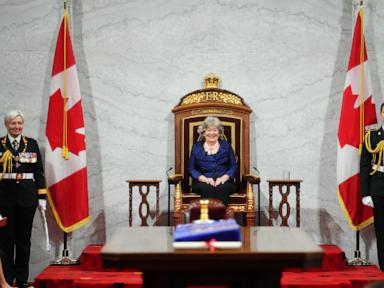
The marble of the Supreme Court of Canada is notoriously cold. It echoes. For decades, her life was measured by that silence, by the heavy weight of wool robes, and by the crushing responsibility of having the final word on the law of the land.
Now, she steps into a different kind of quiet.
When a retired Supreme Court justice transitions from the bench to Rideau Hall, becoming the Governor General and the official representative of King Charles III, it looks like a mere bureaucratic reshuffle from the outside. The news wires run dry headlines. They list the titles. They note the constitutional technicalities. They treat the moment like a chess piece being moved across a board of glossy oak.
But look closer. This is not a promotion. It is a profound reinvention of power.
The Invisible Anchor
Most people do not think about the fire department until their kitchen is full of smoke. Constitutional monarchies function the exact same way.
To the average citizen rushing through a morning commute in Toronto or grabbing a coffee in Vancouver, the Governor General is a figure reserved for secondary school civics textbooks or evening news clips featuring ceremonial medals. The role seems theatrical. It feels like a leftover fragment of an empire that the modern world outgrew.
That interpretation is wrong.
In a constitutional democracy, power is a dangerous, volatile gas. If you leave it in the hands of career politicians, it can ignite. The entire architecture of the Canadian system relies on a brilliant historical trick: separating the exercise of power from the source of power. The Prime Minister runs the government, but the Governor General embodies the state.
Think of it as a political circuit breaker. If a crisis hits—if an election delivers a deadlocked parliament, or if a leader attempts to bypass democratic norms—the Governor General holds the constitutional keys. They have the power to appoint governments, to dissolve parliament, or, in extraordinary circumstances, to say no.
Choosing a retired Supreme Court justice to hold those keys is a deliberate message to the nation. It signals that the rule of law is not just a concept written on parchment in Ottawa. It is a living, breathing shield.
From the Gavel to the Crown
The transition requires a strange, psychological shift.
A judge spends a lifetime train-bound to neutrality. They exist in a vacuum of evidence, fact, and precedent. They do not wave flags. They do not cheer. They do not take sides. To suddenly step into the role of the King’s representative means trading the absolute isolation of the judiciary for the highly visible, deeply symbolic world of national identity.
Consider the contrast. On the bench, she was an analyst of conflict. Her job was to dissect the bitterest arguments of society—corporate greed, human rights violations, constitutional battles—and render a cold, immutable decision.
Now, her mandate is unity.
The Governor General must represent everyone: the oil worker in Alberta, the fisherman in Nova Scotia, the tech founder in Waterloo, and the Indigenous communities seeking justice and reconciliation. It is an impossible tightrope. The red chamber of the Senate, where the Governor General delivers the Speech from the Throne, is a long way from the stark impartiality of a courtroom. It is a place of theater, politics, and historical gravity.
Yet, the expertise required for both roles is identical. It is the art of listening to what is not being said.
The Quiet Power of the Crown
There is a common misconception that the Governor General is simply a rubber stamp for the government of the day. It is an easy assumption to make. Day after day, bills are passed, documents are signed, and the routine of governance grinds on without a hitch.
But the real work happens behind closed doors, away from the cameras and the press gallery.
Every week, the Prime Minister arrives for a private audience with the Governor General. No staff are present. No minutes are taken. No recording devices are allowed. In these meetings, a Governor General with a deep legal background becomes a formidable presence. They possess what constitutional experts call the three classic rights of the sovereign: the right to be consulted, the right to encourage, and the right to warn.
Imagine a Prime Minister pitching a controversial policy or a complex legislative maneuver. Across the table sits a person who spent twenty years identifying the hidden flaws, the constitutional vulnerabilities, and the human consequences of the law.
The conversation changes. The scrutiny intensifies.
This is not partisan politics. It is constitutional stewardship. A justice turned Governor General does not care about polling numbers or the next election cycle. They care about the enduring integrity of the system. They understand that a democracy is only as strong as the invisible boundaries its leaders refuse to cross.
The Human Weight of the Office
It is easy to get lost in the grandeur of the position—the historic residence at Rideau Hall, the guards in scarlet tunics, the royal protocols. But beneath the pageantry lies an exhausting, deeply human reality.
The Governor General is the nation’s consoler-in-chief.
When tragedy strikes—a natural disaster, a national act of violence, a moment of collective grief—it is the Governor General who must find the words to heal. A judge is trained to speak to the intellect; a Governor General must speak to the heart. They must comfort grieving families, honor fallen soldiers, and validate the pain of a community.
This requires a vulnerability that the legal profession usually beats out of you. It requires trading the armor of legal jargon for simple, raw empathy.
The appointment of a former justice reminds us that our institutions are not automated machines. They do not run on autopilot. They are sustained by flawed, dedicated individuals who agree to carry the weight of our collective history, our current anxieties, and our future hopes.
The robes change from black to red. The setting moves from a courtroom to a palace. But the duty remains exactly the same: guarding the fragile, precious experiment we call a free society.
The ink on the appointment papers dries quickly, but the chapters written by this transition will shape the nation for years to come, long after the ceremonies have ended and the crowds have gone home.