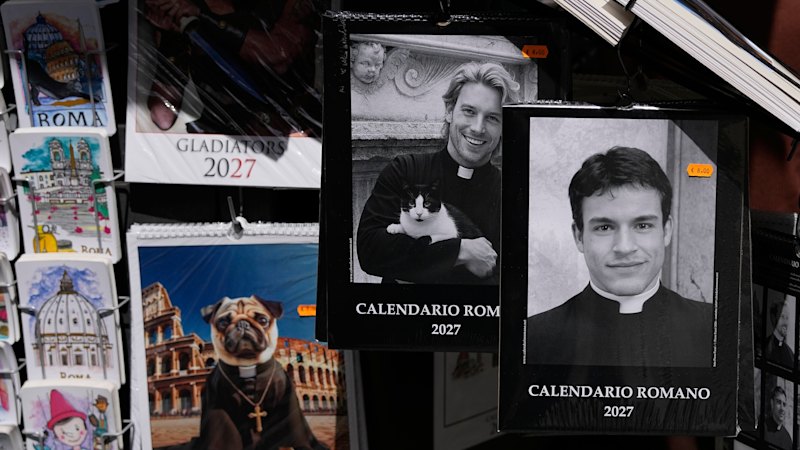
You have seen his face if you have ever spent more than five minutes browsing the souvenir kiosks near the Vatican. He has an enigmatic, slightly shy smile. He wears a sharp clerical collar. He is leaning against a rustic stone church wall in beautiful black-and-white. For over two decades, this exact image has served as the ultimate cover shot for the Calendario Romano, famously known worldwide as the "sexy priest calendar."
Tourists buy thousands of copies every year for around 8 to 10 euros, giggling at the idea that the Catholic Church holds a secret stash of incredibly handsome, young clergymen.
It turns out the joke is on the buyers. The iconic cover star has never been a priest. He never even set foot in a seminary.
An explosive revelation published by the Rome daily La Repubblica blew the lid off the city’s favorite cheeky memento. The calendar star is actually Giovanni Galizia. Today, he is a 39-year-old flight attendant instructor for a Spanish airline living a quiet life in Verona. When that world-famous photo was taken, he was just a clueless 17-year-old kid pulling a prank with his friends.
The Palermo Prank That Fooled Millions
Let's look at how a teenager managed to pose as a Vatican-adjacent religious icon for 23 years without anyone noticing. It happened back in 2004. Galizia was hanging out in his native Palermo when mutual friends introduced him to photographer Piero Pazzi. Pazzi was working on a series of photography projects aimed at capturing the distinct vibe of various Italian cities. He did a calendar for Venice featuring handsome gondoliers, so for Rome, he decided to focus on priests.
Pazzi had the entire outfit ready to go. He asked Galizia if he wanted to participate, and the teenager figured it was just a fun game.
That Mona Lisa smile everyone raves about? It wasn't holy serenity or smoldering sensuality. It was pure embarrassment. Galizia admits he was smirking because all his friends were standing right behind the photographer, laughing out loud at him dressed up like a priest. He signed a quick release form, never asked for a single euro, and went about his life. He had no clue his face would be printed on thousands of glossy pages every single year for decades.
The calendar operates completely independently from the Holy See. The Vatican has always declined to comment on its existence, mostly because they have absolutely nothing to do with it. Pazzi compiles the pages, pockets the royalties, and throws in a few pages of basic factual information about the Vatican at the back to make the whole package look official to unsuspecting tourists.
Art vs Deception in the Souvenir Kiosks
Is it a malicious scam or just clever marketing? That depends entirely on who you ask. Galizia himself does not think he defrauded anyone. He views the calendar through an artistic lens, comparing it to watching a TV drama or a movie. When you see an actor playing a priest on screen, you don't automatically assume they went to seminary and took holy vows. You accept the fiction.
To him, the calendar simply plays with the tension between the sacred and the profane. Seeing a fresh-faced, attractive young man in an ecclesiastical world naturally creates a strange sense of dissonance that catches the eye.
The photographer also claims that the calendar is not a complete work of fiction. Pazzi defended his project by stating that at least one-third of the men featured in the upcoming 2027 edition are genuine, ordained priests. He conveniently declined to provide any specific names or details to back that up, leaving buyers to guess which month features a real man of God and which month features a random Italian guy Pazzi found on the street.
Why Everyone Sells Beauty Short
The cultural impact of the Calendario Romano says a lot about how we look at images today. Galizia expresses genuine bewilderment that his awkward teenage smile has been labeled "sexy" for a quarter of a century. He argues that modern society is so hyper-sexualized that people can no longer separate pure aesthetic beauty from sensuality. If something looks good, we automatically assume it is meant to be seductive.
Even so, he takes the label as a compliment. Managing to look appealing while wrapped up to the chin in a rigid clerical collar is a pretty tough fashion challenge to pull off.
Surprisingly, the calendar has fans within the actual Church. Real clergymen walking the streets of Rome don't seem particularly offended by the fake priests sharing shelf space with rosaries and pope magnets. Father Domenico, a Catholic priest from South Korea visiting the Vatican, noted that the calendar is incredibly famous among young people back in his home country.
People frequently assume that priests are stiff, ancient, and completely distant from the real world. When they see a calendar like this, even if it is a bit tongue-in-cheek, it humanizes the priesthood. It makes the concept of a priest feel familiar and funny rather than unapproachable.
Spotting the Reality Behind Rome's Tourism Industry
If you are planning a trip to Italy, this calendar controversy serves as a great reminder that the souvenir industry thrives on manufactured reality. Kiosks around the Colosseum and St. Peter's Basilica are packed with items designed to sell an idealized, cinematic version of Italian culture.
When you shop for mementos in Rome, keep these rules in mind to avoid buying into cheap gimmicks.
First, look past the packaging. Items like the Calendario Romano include real educational text about the Vatican to mimic official guidebooks. Always check for official institutional logos or copyright notices if you actually care about buying authentic religious or historical items.
Second, support real local craft over mass production. The shops lining the main tourist drags sell identical trinkets imported by the container load. If you want a genuine piece of Rome, step away from the Vatican walls. Seek out independent artisan workshops in neighborhoods like Trastevere or Monti, where local painters, leatherworkers, and printers create authentic pieces.
The fake priest calendar is still going strong, selling out its print runs to tourists who just want a funny story to take home. Galizia's cousins even bought a copy years ago and gave it to their grandmother as a joke. The entire family died laughing. Now that the secret is out, the calendar might actually become more popular than ever. Buyers will just be looking at those handsome faces with a much more cynical eye.