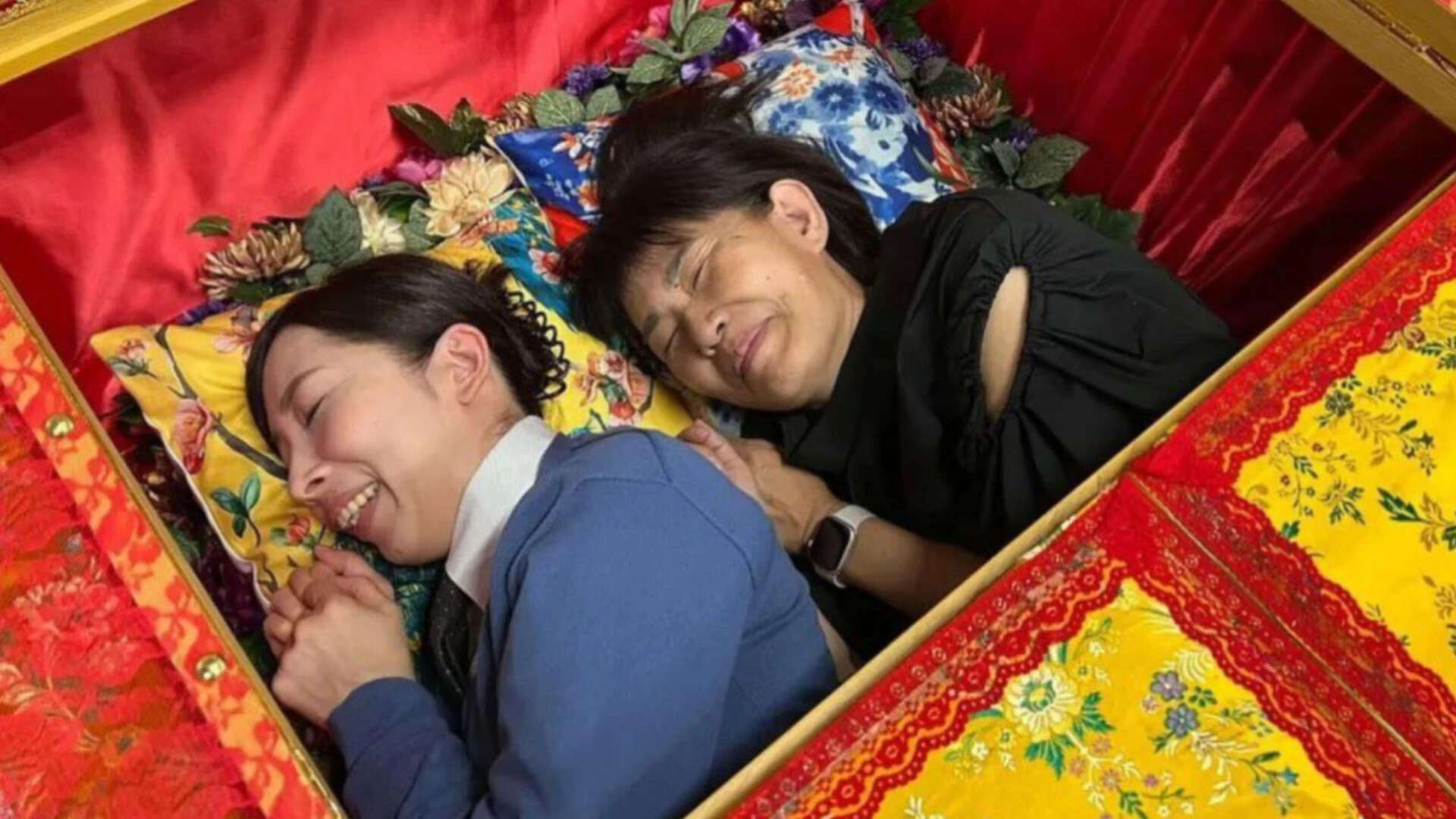
The wood is surprisingly cool against the back of your skull. It is high-quality Japanese cypress, sanded to a finish so smooth it feels almost like skin. Then the lid slides shut.
There is a specific, heavy click as the latch meets the frame. In that heartbeat, the world ends. The neon hum of Tokyo’s Shibuya Crossing, the relentless ping of Slack notifications, and the low-grade anxiety of a calendar filled with "syncs" and "touchpoints" vanish. You are lying in a coffin. You are very much alive. But for the next sixty minutes, you are practicing being dead.
This is not a scene from a horror film or a fringe cult ritual. It is a booming wellness trend in Japan known as kurayami meditation—or more literally, "coffin bathing." In a country where the work culture is so intense it birthed the word karoshi (death by overwork), people are now paying for the privilege of climbing into a casket to find the peace they cannot find in a five-star spa or a yoga studio.
The Weight of an Uninterrupted Silence
Consider a woman we will call Hana. She is thirty-four, a middle manager at a logistics firm, and she hasn't turned her phone off in three years. Not really. Even in sleep, the device sits on her nightstand like a small, glowing parasite, feeding on her attention. Hana represents a generation of urban professionals who have reached a saturation point. They are not just tired; they are spiritually frayed.
When Hana visits a coffin meditation salon in the heart of the city, she isn't looking for a macabre thrill. She is looking for a boundary. In the modern world, boundaries are porous. Work follows us home. Social media follows us into the bathroom. The coffin, however, is a hard boundary. It is six slabs of wood that say: Nothing can get to you here.
The psychological mechanics are simple yet profound. When we are placed in a confined, dark space, the brain's sensory input drops to near zero. This isn't just relaxation; it's a sensory reset. Without the visual clutter of the world, the mind is forced to turn inward. At first, this is terrifying. Your heart hammers against your ribs. You notice the sound of your own saliva swallowing. You realize how loud your thoughts actually are when they don't have a screen to distract them.
But then, something shifts.
The Architecture of the Final Exit
The Japanese relationship with death is historically more fluid and integrated than the sanitized, distant version found in the West. Shinto and Buddhist traditions view the transition not as a sheer cliff, but as a change in state. By stepping into the coffin, participants are engaging in a "dry run" of the inevitable.
Statistics from the Japan Wellness Association suggest a 30% increase in unconventional meditation bookings over the last two years. While traditional seated meditation requires a level of discipline many find impossible to maintain after a ten-hour workday, the coffin forces the issue. You don't have to try to clear your mind. The environment does the heavy lifting for you.
There is a biological imperative at play here as well. In the dark, the pineal gland begins to secrete melatonin more effectively. The restricted space can trigger a proprioceptive response similar to a weighted blanket, lowering cortisol levels and slowing the heart rate. It is a return to the womb by way of the tomb.
The Mirror in the Dark
Why does it have to be a coffin? Why not just a dark room or a sensory deprivation tank?
The answer lies in the metaphor. A coffin is the ultimate symbol of finality. When you lie down in one, you are confronted with the "invisible stakes" of your life. We spend our days obsessing over trivialities—an email tone that seemed slightly curt, a missed promotion, a delayed train. Inside the box, those stressors appear absurd. You cannot answer an email when you are pretending to be a corpse.
This is the "Perspective Filter." By simulating the end of life, participants often experience a rush of clarity regarding their priorities. It is a psychological palate cleanser.
Hana, lying in the dark, finds that her mind eventually stops racing about tomorrow's logistics. Instead, she remembers the smell of rain on hot pavement from her childhood. She thinks about her mother. She realizes she hasn't breathed deeply—truly, down into the belly—in weeks. The coffin isn't a place of gloom; it is a laboratory for radical honesty.
Beyond the Novelty
Critics often dismiss these trends as "gimmick wellness," a way for companies to monetize the very burnout they help create. There is some truth to that. The cost of a session can be upwards of 8,000 yen (about 55 USD). It is an expensive way to sit in the dark.
However, to dismiss it as a fad is to ignore the underlying crisis. We have built a world that is so loud and so demanding that we require the most extreme symbols of silence just to feel human again. If we need to climb into a box meant for the dead to remember how to live, that says more about our "living" spaces than it does about the meditation itself.
The trend is expanding. Some salons now offer "funeral rehearsals" where you can write your own eulogy before stepping inside. It sounds morbid until you speak to someone who has done it. They describe a feeling of immense lightness afterward. By facing the thing we fear most—the end—the middle part of the story suddenly feels much more manageable.
The Resurrection Effect
When the lid finally slides back open, the experience is described by many as a "second birth." The light of the room, even if it is just a dim lamp, feels miraculous. The air tastes different.
The goal of coffin meditation isn't to make you fall in love with death. It is to make the world outside the box feel vivid again. When Hana emerges, her phone is still in the locker. It is still filled with messages. But she doesn't reach for it immediately. She stands for a moment, feeling the weight of her feet on the floor, the miracle of air moving in and out of her lungs.
The city is still there. The noise is still there. The deadlines haven't moved. But the person walking back into the neon light of Tokyo is no longer the same person who climbed into the wood an hour ago. She has seen the end, and found it wanting.
She walks toward the train station, moving a little slower than the crowd, carrying the silence of the cypress box like a hidden treasure beneath her coat.
You don't need to stay in the dark forever. You just need to stay there long enough to remember why you wanted to leave.