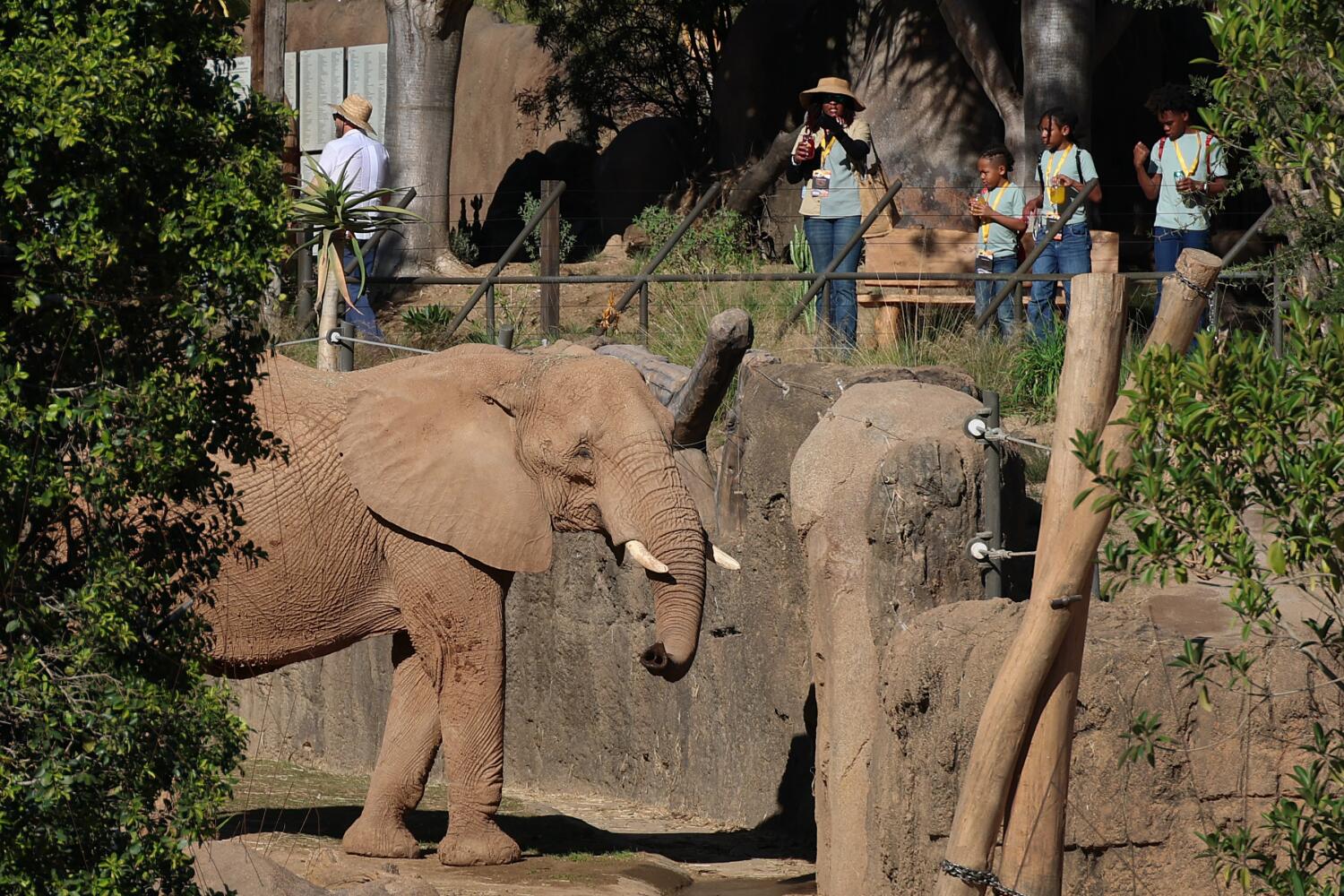
Distance is the only thing keeping wildlife wild.
The travel industry is currently obsessing over San Diego’s "Elephant Valley," a reimagined habitat designed to bring humans within whispering distance of the world's largest land mammals. The marketing copy promises intimacy. It promises "eyelash-level" detail. It promises a connection that supposedly inspires conservation.
It’s a lie.
What it actually provides is a high-end voyeurism that prioritizes human ego over biological integrity. If you can see an elephant’s eyelashes, you aren't witnessing nature. You are witnessing a curated performance in a gilded cage. We’ve reached a point where we value the "Gram-worthy" zoom lens shot more than the actual autonomy of the species we claim to protect.
The Proximity Paradox
The common consensus among zoo enthusiasts is that proximity equals empathy. The logic goes: if a child sees an elephant up close, they will grow up to save the savannah.
I’ve spent fifteen years tracking the intersection of captive wildlife management and public perception. Here is the reality: proximity doesn't breed empathy; it breeds entitlement. When we bridge the gap between "us" and "them" to the point of physical intimacy, we strip the animal of its majesty and turn it into a prop.
True conservation requires a healthy dose of awe, and awe requires scale. You cannot feel the true scale of an elephant when it is standing in a paddock designed to look like a boutique hotel lobby. By shrinking the distance, we shrink the animal. We turn a $6,000$ kg force of nature into a set piece.
The Bio-Mechanical Cost of "Experience"
Let’s talk about the math of space. An African elephant in the wild may traverse $50$ to $150$ kilometers in a single day. They are nomadic by design. Their joints, their digestive systems, and their complex social hierarchies are all predicated on movement.
When a facility optimizes for "guest visibility"—which is exactly what these "valleys" and "vistas" do—they are inherently compromising the animal’s ability to retreat. In the wild, if an elephant doesn't want to be seen, it isn't seen. In a billion-dollar "immersive" habitat, the elephant has nowhere to go where a telephoto lens won't find it.
We call this "environmental enrichment," but it’s often just high-concept landscaping.
- The Sightline Trap: Designing habitats for "optimal viewing" often means removing the very brush and topography that animals use for psychological security.
- The Acoustic Nightmare: Sound travels. The "oohs" and "aahs" of five hundred tourists a day create a constant low-frequency hum that interferes with the infrasonic communication elephants use to speak to one another across distances.
- The Food-to-Face Ratio: To keep elephants near the "eyelash-viewing" areas, keepers often use strategic feeding stations. This isn't foraging; it’s a scheduled appearance.
Stop Asking if the Enclosure is "Natural"
The most common question I see on travel forums is: "Is the habitat naturalistic?"
This is the wrong question. A concrete bunker painted green is still a concrete bunker. The term "naturalistic" is a marketing word used to soothe the conscience of the visitor, not to improve the life of the resident.
An elephant doesn't care if the rocks are made of fiberglass or granite. It cares about the complexity of its social group and the ability to make choices. When we build these "Elephant Valleys," we are building them for the human eye. We use African flora (or lookalikes), we use "invisible" barriers, and we use red dirt to satisfy a cinematic expectation of what Africa looks like.
If we were actually building for the elephants, the viewing platforms would be two miles away, and the visitors would be lucky to see a grey speck through a pair of high-powered binoculars. But you can't charge $100$ a ticket for a grey speck.
The Myth of the "Ambassador" Animal
The "Ambassador" argument is the ultimate shield for the zoo industry. It suggests that these specific elephants are "working" to save their wild cousins.
Show me the data.
There is no empirical evidence that seeing a captive elephant leads to a statistically significant increase in pro-conservation behavior compared to watching a high-quality documentary. In fact, a study published in Conservation Biology suggests that seeing animals in controlled, comfortable environments can actually lead to "conservation complacency." The visitor thinks, "Oh, look how well they are doing! They have plenty of hay and a pool. The species is fine."
Meanwhile, in the Kavango-Zambezi Transfrontier Conservation Area, the real struggle is happening over water rights and human-wildlife conflict—realities that are completely sanitized in a San Diego park. You aren't seeing an "ambassador." You’re seeing a sanitized version of a crisis.
The Cost of Living in a Fishbowl
Imagine your life lived entirely within the confines of a beautifully landscaped shopping mall. You have food. You have medical care. But every single day, thousands of giants stare at you, hoping to see your eyelashes.
- Stereotypic Behavior: Even in the best "valleys," elephants often display rhythmic swaying or head-bobbing. This isn't "dancing." It’s a neurological coping mechanism for boredom and confinement.
- Social Fragmentation: Captive herds are often "manufactured." We move elephants around like chess pieces for breeding programs, ignoring the deep, multi-generational matriarchal bonds that define their existence in the wild.
- The Infrastructure Lie: Facilities brag about "state-of-the-art" barns. A barn is a box. No matter how much it cost to build, it’s where a wide-ranging mammal spends its nights because we haven't figured out how to keep them safe and visible simultaneously.
The Hard Truth About Your Vacation Photos
You want the photo. I get it. We’ve been conditioned to believe that travel is about collection. We collect "experiences," we collect "encounters," and we collect "moments."
But your desire for a close-up photo is directly at odds with the dignity of the animal. Every time a park promotes a "closer-than-ever" experience, they are moving the goalposts of what is acceptable treatment of wildlife. They are telling the public that animals exist for our inspection.
I’ve stood in the middle of the Chobe National Park in Botswana. I’ve seen a herd of sixty elephants cross a river. I was three hundred yards away, in a boat, with the engine off. I couldn't see their eyelashes. I could, however, see their power. I could see the way the matriarch signaled the group. I could see the raw, unscripted chaos of a species that didn't know I existed—and didn't care.
That is the experience we should be hungry for. The one where we are irrelevant.
Why We Need to Distance Ourselves
If we actually care about elephants, we need to stop demanding "intimacy." We need to start demanding "sovereignty."
The future of wildlife tourism shouldn't be about bringing the animals to the people; it should be about protecting the spaces where animals can be animals, far away from our prying eyes. If that means you don't get your selfie, that is a price you should be willing to pay.
- Fund In-Situ Conservation: Instead of spending $500$ on a VIP "behind the scenes" tour at a zoo, send that money to the Mahenye Project or the Big Life Foundation.
- Reject the "Close-Up" Narrative: When you see an advertisement promising "eyelash-level" access, recognize it for what it is: an admission of ecological failure.
- Value the Unknown: Accept that some of the most beautiful things on this planet are things you will never see in person.
The Industry’s Dirty Secret
The reason "Elephant Valleys" are popping up isn't because the science of elephant care has suddenly evolved. It’s because the business of zoos is failing. With growing public awareness of the ethics of captivity, parks have to "up the ante" to keep the gates turning. They have to make it more "immersive," more "interactive," and more "unforgettable."
They are stuck in an arms race of spectacle.
They are building bigger pools, more "natural" rocks, and closer walkways because they are terrified that if you actually saw how little an elephant does in captivity, you’d never come back. They have to distract you with the "beauty" of the eyelashes so you don't notice the tragedy of the perimeter fence.
Stop falling for the "naturalistic" rebranding. An elephant in a valley in Southern California is an elephant in a prison, no matter how much money they spent on the landscaping. If you want to save the elephants, stay away from their eyelashes. Give them the one thing they actually need: the space to be invisible.
Delete the ticket app. Buy a pair of binoculars. Get comfortable with the distance.


