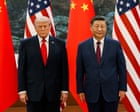
Political commentators love a superficial narrative. When Donald Trump and Xi Jinping stood side-by-side in Beijing, the media immediate latched onto the identical dark suits and red ties. They called it the "chameleon effect." They spun a cozy tale of psychological mirroring, suggesting that matching outfits signaled a mutual desire for harmony, a subconscious olive branch woven from Italian wool.
It is a comforting theory. It is also completely wrong.
The idea that global superpowers signal geopolitical alignment through accidental wardrobe synchronization is a fairy tale for analysts who spend too much time reading pop-psychology books and not enough time understanding the cold, calculated mechanics of statecraft. Tailoring is not a psychological mirror. It is a weapon.
To look at two world leaders wearing the same uniform and conclude they are trying to blend in with each other misses the entire point of power dressing. This was not a moment of optical harmony. It was a high-stakes game of visual erasure, where both men used the absolute standardization of the modern business suit to mask deep, structural hostility.
The Myth of the Chameleon Effect
The lazy consensus states that mirroring behavior—copying someone's posture, gestures, or dress—builds rapport. In interpersonal psychology, this is true. If you mirror a potential client's body language at a coffee shop, you might close a deal.
But global hegemony does not operate like a mid-level sales meeting.
When the leaders of the world’s two largest economies meet, every square inch of fabric is negotiated, vetted, and deployed with intent. Assuming Trump and Xi dressed similarly because they fell prey to an involuntary psychological quirk underestimates the machinery behind both administrations.
The dark lounge suit with a white shirt and a solid red tie is the undisputed global uniform of authority. It is not an invitation to dance; it is the default armor of the modern executive state. When both leaders wear it, they are not trying to match each other. They are both trying to claim ownership of the exact same archetype of supreme power. It is a collision of identical branding, not a symbiotic merging.
Imagine a scenario where two rival tech conglomerates release products with identical minimalist packaging. No serious market analyst would claim, "Look, they are learning to love each other!" They would recognize it for what it is: a brutal fight to capture the definitive standard of the industry.
The Standardization of Beijing’s Visual Protocol
To understand why the "chameleon" narrative fails, you have to understand the specific sartorial psychology of the Chinese Communist Party.
Western pundits often view clothing through the lens of individual expression. They ask, "What is Trump trying to say with his oversized tie?" or "What does Xi’s button posture communicate about his mood?" This individualistic framework collapses when applied to Beijing.
For the Chinese political elite, the dark suit is an instrument of absolute uniformity. It was adopted deliberately to replace the Mao suit, signaling to the global market that China was open for business, predictable, and bureaucratically disciplined. Within the party, variance is dangerous. Deviation from the established dress code implies factionalism or personal vanity, both of which are political liabilities in Zhongnanhai.
Xi Jinping does not dress to match his guest. He dresses to represent the unyielding permanence of the state.
When a Western leader arrives in a near-identical outfit, the optical result is not a bridge between East and West. For the domestic Chinese audience, it looks like the Western leader has conformed to the local standard. The matching outfits do not elevate Trump to Xi's level, nor do they pull Xi toward Trump; they flatten the visual field, removing any stylistic leverage the visiting diplomat might think they possess.
The Red Tie Delusion
Then there is the obsession with the red tie. Media outlets scrambled to declare the shared choice of a red tie as a deliberate nod to China’s national color, or a shared symbol of populist energy.
Let us dismantle this immediately. Donald Trump has worn a long, bright red tie as his personal trademark for decades. It is his visual anchor, a piece of branding as immutable as the gold lettering on his buildings. He did not change his tie to honor his host in Beijing; he wore the tie he always wears.
Conversely, red is the foundational color of the Chinese Communist Party. Xi Jinping wears a red tie because it symbolizes the revolutionary legitimacy of his regime.
To suggest that these two men shared a color out of a desire for mutual accommodation is absurd. They wore the same color for entirely contradictory reasons. Trump’s red is the red of American capitalist showmanship; Xi’s red is the red of state-directed socialism. The identical color palette is a semantic collision, a homonym where two people say the same word but mean completely different things.
By focusing on the superficial similarity, commentators missed the profound divergence in execution.
The Anatomy of the Power Cut
If you want to know what is actually happening in a diplomatic meeting, stop looking at the colors and start looking at the construction. The real story is written in the shoulders, the break of the trousers, and the choice of canvas.
Trump’s tailoring is famously rooted in an older, American corporate aesthetic. His suits are cut exceptionally full, with heavy shoulder padding and wide legs. It is a style designed to project physical mass, a throwback to the 1980s New York real estate boom where sheer volume equaled dominance. It ignores modern tailoring trends entirely because its purpose is to occupy maximum physical space in a room.
Xi’s tailoring follows a completely different logic. His suits are meticulously clean, structured but unflashy, designed to minimize the individual and maximize the institutional. There are no billowing trousers or exaggerated ties. It is a style that emphasizes stability, control, and lack of excess.
When you place these two execution styles side by side, the "chameleon effect" evaporates. You are left with two fundamentally opposed philosophies of power:
- The American Approach: Individualistic, loud, oversized, and anchored in personal branding.
- The Chinese Approach: Institutional, precise, unyielding, and anchored in bureaucratic permanence.
The media saw a duet. The reality was two monologue artists shouting over each other at the exact same frequency.
The High Cost of Aesthetic Misreading
Does this distinction actually matter? Absolutely. I have seen corporations botch cross-border acquisitions worth hundreds of millions because their executive teams read the room using the same superficial metrics as the political press. They mistake a counterpart's formal compliance with cultural etiquette for strategic submission.
When you assume that a foreign competitor is mirroring you to build rapport, you become blind to their actual positioning. You let your guard down. You assume a level of comfort that does not exist.
The identical suits in Beijing were not a sign of nascent trust. They were the ultimate expression of diplomatic neutrality—a mutual agreement to wear the standard armor so that the real battle could happen entirely behind closed doors, away from the cameras. It was a refusal to give away a single inch of visual intelligence.
The next time two world leaders appear on stage looking like they walked out of the same catalog, ignore the pundits talking about subconscious mirroring. The uniformity isn't a sign that they are getting along. It is proof that the stakes are too high for either side to risk showing their real hand.
True power doesn't need to dress up, and it certainly doesn't need to match. It simply waits for the opponent to mistake a uniform for a white flag.