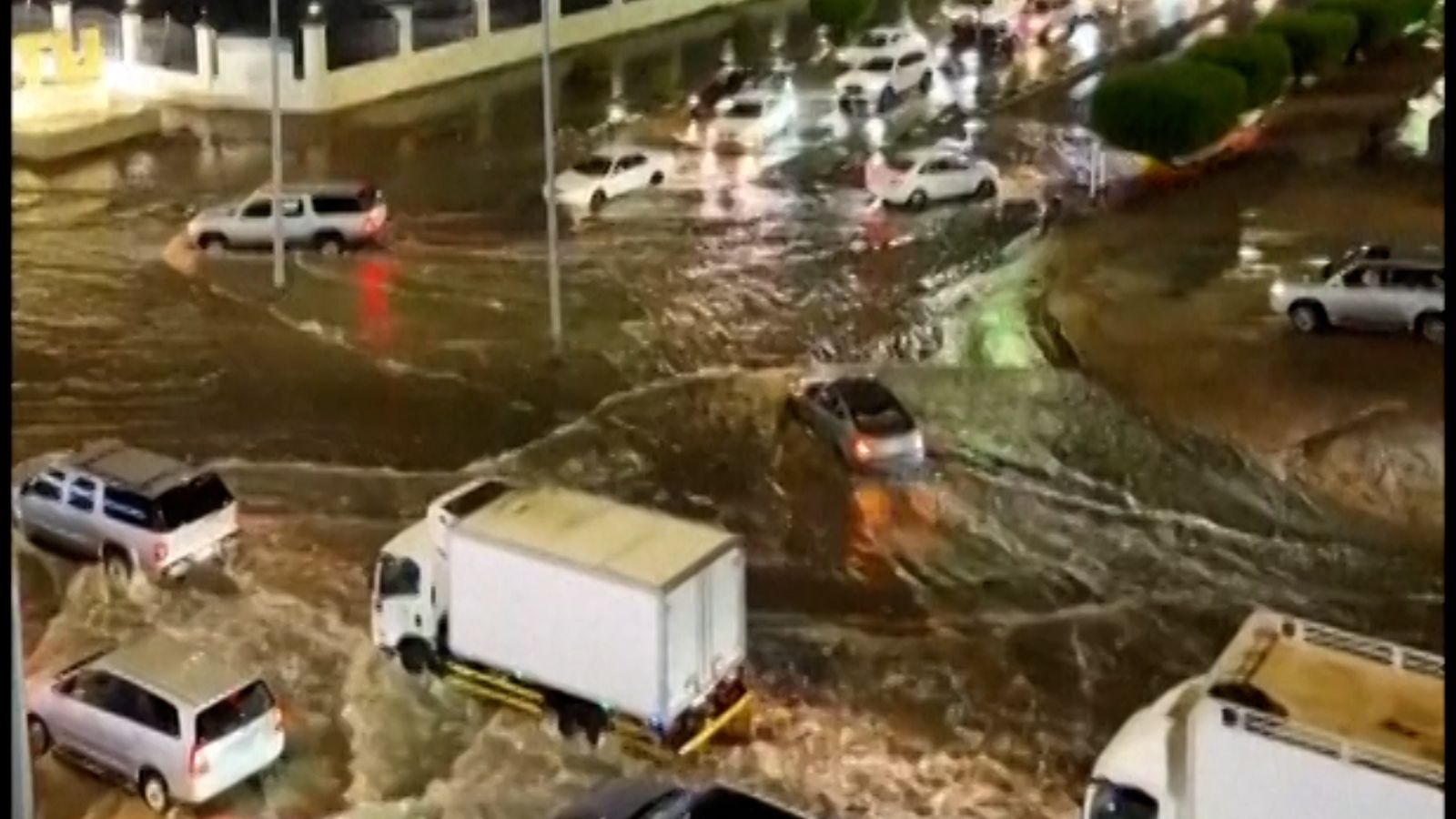
The headlines are predictable. Dark clouds gather over Riyadh and Jeddah, the heavens open for forty-eight hours, and suddenly the media is awash with footage of submerged SUVs and shuttered schools. The lazy consensus immediately pivots to a "natural disaster" narrative or a vague hand-waving gesture toward global climate shifts.
They are wrong.
This isn't a story about the sky falling. It is a story about the ground failing. When schools close in Saudi Arabia due to rain, it isn't an "act of God" that we should treat with helpless resignation. It is a massive, systemic failure of urban engineering and a refusal to respect the literal geography of the desert. We are watching the collision of 21st-century architectural ambition with 20th-century drainage indifference.
The Mirage of Dryness
Urban planners in the Gulf spent decades operating under the delusion that the desert is static. Because it only rains a handful of times a year, the infrastructure was built on the assumption that water is a guest that never visits.
In a temperate city like London or Seattle, the ground is an active participant in the water cycle. It breathes. It absorbs. In a desert megacity, the ground has been choked by asphalt and concrete. We have created massive, impermeable heat sinks that offer no place for water to go. When the rain hits, it doesn't soak in; it slides.
The competitor articles love to show you the "severe" flooding. What they won't show you is the map of the wadis—the natural dry riverbeds—that have been paved over to make room for luxury villas and shopping malls. We didn't just build in the path of the water; we erased the water’s only exit strategy and then acted surprised when it knocked the door down.
The Math of Flash Floods
To understand why a few inches of rain paralyzes a G20 economy, you have to look at the fluid dynamics of a desert environment. In a typical Mediterranean or temperate climate, rain is often distributed. In the Arabian Peninsula, the rainfall profile is "pulsed."
$$Q = CiA$$
In the Rational Method formula for peak storm water runoff, $Q$ is the peak discharge, $C$ is the runoff coefficient, $i$ is the rainfall intensity, and $A$ is the drainage area.
In Saudi cities, the runoff coefficient $C$ is nearly 1.0 because of the sheer density of non-porous surfaces. There is zero infiltration. When $i$ (intensity) spikes, the discharge $Q$ becomes a literal wall of water. Standard drainage systems in these cities were often designed for "once-in-ten-year" events based on data from the 1980s. That data is obsolete.
I have watched engineers in the region struggle with the reality that you cannot "drain" a flat city that sits mere meters above sea level without massive, aggressive pumping stations that run 365 days a year just to be ready for the three days they are actually needed. Most municipalities simply won't foot that bill. They would rather close the schools for two days than maintain a multi-billion dollar subterranean river system that stays dry 95% of the time.
The School Closure Cop-Out
Closing schools is the ultimate bureaucratic band-aid. It is framed as "safety first," but it is actually a confession of infrastructure bankruptcy.
The authorities aren't worried about kids getting wet. They are worried about the fact that the roads are death traps because the grading is wrong. If the road isn't pitched perfectly, a two-inch accumulation becomes a three-foot pool. When you see a video of a bus stranded in a tunnel, don't blame the rain. Blame the civil engineer who forgot that gravity exists.
We see this same pattern in Dubai, Doha, and Kuwait City. The "shock" of the flood is a manufactured crisis. It allows the government to trigger emergency protocols rather than addressing the hard, expensive truth: we need to rip up the streets and install high-capacity storm sewers that should have been there thirty years ago.
The Sponge City Fallacy
Now, the "experts" will come in and talk about "Sponge Cities." They will suggest planting trees and creating green belts to absorb the water.
This is a beautiful dream that dies in the desert heat.
You cannot maintain a "sponge" in a climate where the evaporation rate exceeds 2000mm per year. The water required to keep those "sponges" alive during the dry season would deplete the very aquifers we are trying to protect. It is a circular logic that fails the moment it hits the ground.
Instead of trying to mimic the wetlands of the Netherlands, Saudi Arabia needs to embrace "Hard Engineering" for a "Hard Climate." This means deep-bore tunnels—massive, cavernous arteries like the SMART tunnel in Kuala Lumpur—that can dual-purpose as traffic relief or water storage.
The Cost of Apathy
The economic drain of these "minor" floods is staggering. When schools close, parents stay home. When parents stay home, productivity craters. When the logistics hubs in Jeddah are underwater, the supply chain for the entire Kingdom stutters.
We are talking about billions of SAR in lost GDP every time there is a "severe weather warning." The irony is that the cost of fixing the drainage is often cited as "prohibitive."
Imagine a scenario where a tech giant loses 2% of its annual uptime because they didn't want to buy a backup generator. Shareholders would revolt. Yet, we accept that major global cities will simply "turn off" because of a predictable weather pattern.
Stop Calling it "Extreme"
Stop using the word "extreme" to describe these weather events. If it happens every year, it is the baseline.
The media loves the drama of the "unprecedented" storm. It sells clicks. It justifies the failure of the infrastructure. If the storm is "unprecedented," then no one is to blame. But these storms are entirely precedented. The historical record of the Peninsula is full of flash floods that moved mountains of sand.
The failure is a lack of imagination. We built cities for a version of the desert that only exists in travel brochures—a place of eternal sunshine and static dunes. The real desert is a place of violent, sudden shifts.
If Saudi Arabia wants to realize its Vision 2030 goals of becoming a global hub for tourism and investment, it has to stop being a country that is defeated by a Thursday afternoon thunderstorm.
The schools aren't closed because of the rain. They are closed because the city is a bowl with no hole in the bottom.
Fix the bowl. Stop blaming the clouds.