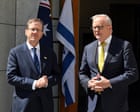
The air in Canberra has a specific, thin stillness when the heavy hitters arrive. It is the kind of quiet that doesn’t suggest peace, but rather the frantic muffled energy of a hundred high-frequency radios working just out of earshot. When Isaac Herzog, the President of Israel, touched down on Australian soil, the public itinerary was a predictable sequence of handshakes, floral tributes, and carefully scripted calls for unity. But the most important conversation of the trip happened in a space where the microphones were stripped, the windows were reinforced, and the guest list was never meant for the morning papers.
Herzog wasn't just there to discuss trade or tourism. He sat down with Kerri Hartland, the Director-General of the Australian Security Intelligence Organisation (Asio).
It was a meeting of shadows.
On one side of the table sat a man representing a nation that exists in a permanent state of high-alert, a country where the line between civilian life and military intelligence is blurred by necessity. On the other sat the woman tasked with keeping Australia’s domestic secrets locked tight in an era where the threats are no longer just physical, but digital, psychological, and borderless.
The Weight of the Unspoken
Security intelligence isn't about the cinematic explosion or the high-speed chase. It is about the accumulation of whispers. When the head of a foreign state meets a domestic spy chief, they are trading in a currency more valuable than gold: actionable foresight.
Asio eventually confirmed the meeting took place, a rare admission that underscores the gravity of the current global climate. We often view these high-level summits as bureaucratic boxes to be checked. We see the black SUVs and the earpieces and think of them as props. They aren't. They are the physical manifestations of a world that is becoming increasingly unstable.
Imagine a hypothetical analyst working late in a windowless room in Canberra. Let’s call him David. David doesn’t see faces; he sees data points. He sees the rise in encrypted chatter, the sudden spikes in foreign interference, and the subtle shifts in how extremist groups are utilizing new technologies to radicalize the lonely and the lost. For someone like David, a meeting between Herzog and Hartland is the "North Star." It provides the high-level strategic alignment that tells him which shadows to chase and which ones to ignore.
The reality of 2026 is that the battlefield has moved into our pockets. The hardware of war is still relevant, but the software of influence is where the real victories are won. Israel has long been the global laboratory for these technologies. From Pegasus to advanced biometric tracking, their intelligence apparatus is the most battle-tested on the planet. When Hartland sits with Herzog, she isn't just asking about regional stability in the Middle East. She is looking for the blueprint of what is coming to Australia's shores next.
The Invisible Threads of Influence
Australia is currently grappling with a surge in domestic tensions that mirror global conflicts. The social fabric is stretching. We feel it in our social media feeds, in the heated arguments at dinner tables, and in the increased police presence at community gatherings. This isn't accidental. It is the result of what intelligence agencies call "foreign interference"—the deliberate stoking of internal fires by outside actors to weaken a nation from within.
Herzog’s presence in Australia was a lightning rod. To some, he represented a beacon of resilience; to others, a symbol of systemic conflict. But for Asio, his presence was a logistical and intelligence puzzle. The secret meeting was the center of that puzzle.
They discussed the "how." How do you protect a democracy from the poison of misinformation? How do you track a threat that doesn't use a bomb, but a botnet?
The stakes are personal for everyone reading this, even if it feels distant. Every time a foreign entity successfully manipulates a local protest or hacks into a critical infrastructure network, the cost is borne by the citizen. The cost is a loss of trust. Once trust in our institutions—and in each other—evaporates, the job of an intelligence agency becomes nearly impossible.
The Technology of the Silent Watch
The partnership between these two nations is often described in the dry language of "bilateral cooperation." Let's translate that. It means sharing the keys to the digital kingdom.
Australia’s intelligence community is increasingly reliant on AI-driven analytics to sift through the billions of data points generated every hour. Israel provides the lived experience of using those tools in a high-stakes environment. They know what happens when the algorithm gets it wrong. They know the cost of a false positive.
Hartland’s role is to ensure that as Australia adopts these aggressive new defense postures, they don't inadvertently sacrifice the very civil liberties they are trying to protect. It is a razor’s edge. Herzog, coming from a nation that has struggled with this balance for decades, is perhaps the only person who can speak to that tension with absolute, bruising honesty.
The meeting wasn't just about catching terrorists. It was about the architecture of the future. It was about how a middle power like Australia survives in a world where the giants are starting to stumble and the rules of the old world no longer apply.
The Human Echo
We tend to think of leaders like Herzog as untouchable figures, but the pressure of these meetings is immense. There is a specific kind of exhaustion that comes from knowing that a single lapse in judgment, or a single missed piece of intelligence, can lead to the loss of life. That weight was in the room.
The confirmation of the meeting by Asio served a dual purpose. It was an exercise in transparency, yes, but it was also a signal. A signal to adversaries that the walls are high and the watchmen are talking to one another. It was a reminder that while the public sees the handshake, the real work is being done in the silence that follows.
The sun sets over the Brindabella Ranges, casting long, distorted shadows across the capital. The motorcade has long since moved on. The President has returned to a country that remains at the center of the world's most volatile storm. But the echoes of that conversation remain in Canberra. They are in the new protocols being drafted, the new algorithms being tested, and the heightened awareness of the men and women who watch the screens while the rest of the country sleeps.
Security is an illusion we all agree to believe in so we can go about our lives. On a quiet afternoon in Australia, two people met in secret to make sure that illusion holds for just one more day.
The silence wasn't empty. It was full of everything they couldn't afford to say out loud.