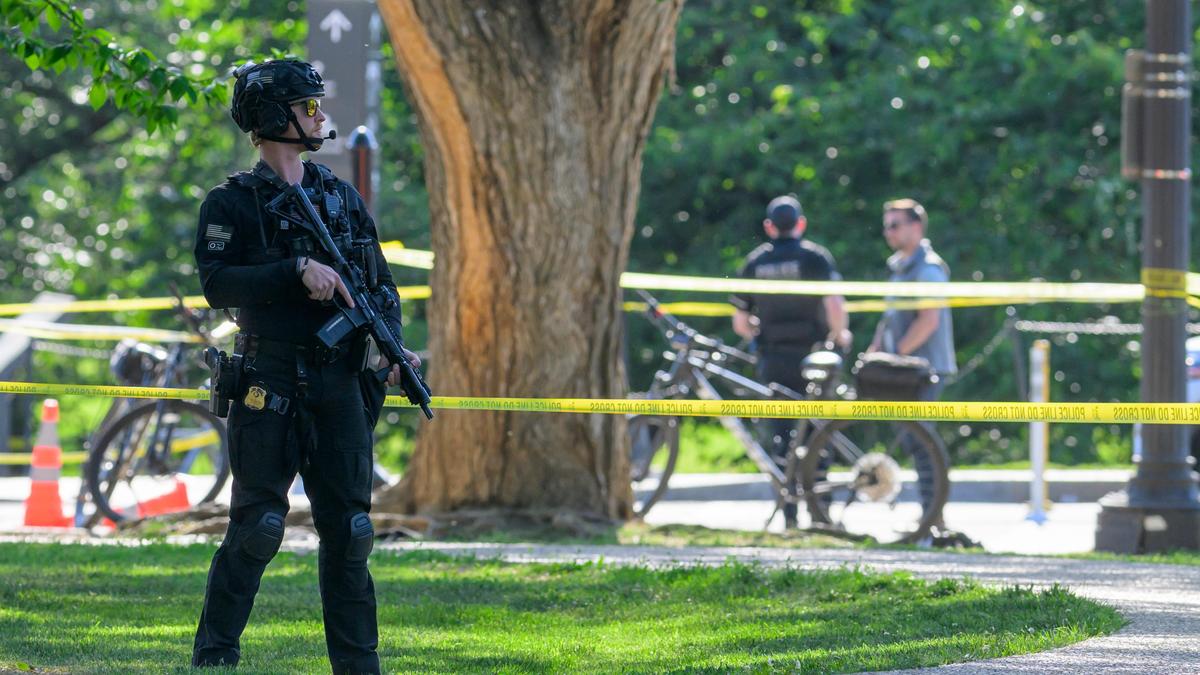
A man with a firearm approached a Secret Service checkpoint near the White House, and within seconds, the situation turned from a tense standoff into a shooting. This isn't a movie scene. It happened in one of the most heavily surveilled patches of land on Earth. When an armed man was shot by the U.S. Secret Service, it wasn't just a local police matter; it was a massive breach of the invisible bubble that protects the Executive Branch. Most news reports give you the "who, what, where" but they rarely talk about the split-second mechanics of how these encounters actually go down or why the "perimeter" is a lot more porous than you think.
The incident occurred at the intersection of 17th Street and E Street NW. If you've ever walked past the Ellipse, you know this area is a constant swarm of tourists, joggers, and lobbyists. It’s a soft target area leading into the hardest target in the world. When a person pulls a weapon here, the Secret Service Uniformed Division doesn't have the luxury of a long negotiation. They operate on a razor-thin margin of error.
The Checkpoint Chaos and How It Escalated
Security at the White House isn't just about the guys on the roof with long rifles. It's a layered system. The outer perimeter consists of checkpoints where visitors are screened before they even get close to the fence line. On the day in question, the suspect reportedly brandished a firearm at one of these outer posts. He didn't just have it on him; he made sure the officers saw it.
I’ve seen how these agents train. They aren't looking for a reason to shoot, but they’re hardwired to stop a threat before it crosses a specific threshold. The moment that weapon was displayed and the suspect refused to drop it after multiple verbal commands, the situation was already over. The agent fired a single shot, striking the suspect in the abdomen. It was fast. It was clinical. And it was exactly what they're paid to do.
You’ll often hear people ask why they didn't "aim for the leg" or "use a Taser." That's not how high-stakes protection works. When someone is armed near the President’s home, the goal is to neutralize the threat immediately. A Taser has a high failure rate, especially if the person is wearing heavy clothing or is in a state of high adrenaline. A missed Taser shot means the suspect has time to pull the trigger. In the world of the Secret Service, a one-second delay can mean a dead officer or a dead civilian.
Why This Specific Spot Matters for Security
The 17th and E Street location is significant because it borders the South Lawn. It’s a primary entry point for staff and visitors. If someone gets past that point with a gun, they have a straight line of sight to the White House building itself.
- The Proximity Factor: The distance from that checkpoint to the residence is less than a few hundred yards.
- The Crowd Risk: This area is almost never empty. Firing a weapon in a crowded tourist zone is a nightmare for law enforcement because of the risk of stray bullets.
- The Response Time: From the moment the "shots fired" call went out, the entire White House complex went into lockdown.
During the lockdown, the President—who was reportedly in the building at the time—was moved to a secure location. This is standard protocol, but it underscores the gravity. They don't just lock the doors; they move the "Asset." It’s a choreographed dance of armored cars, secure rooms, and tactical teams moving into position.
What Most People Get Wrong About Secret Service Tactics
There's a common misconception that the Secret Service is just a more elite version of the local police. That's wrong. Their mission is entirely different. While a police officer’s primary job is public safety and law enforcement, a Secret Service agent’s primary job is "protection through prevention."
When that man pulled a gun, the agents weren't thinking about making an arrest. They were thinking about the perimeter. If you threaten that perimeter, you become a variable that needs to be removed. Honestly, it’s a brutal way to look at it, but it’s why the President is still alive despite dozens of threats every single year.
The suspect was transported to a local hospital in critical condition. No agents or bystanders were injured. By any professional metric, that's a successful outcome for the Service. They ended the threat with zero "collateral damage."
The Mental Health Element Nobody Talks About
We see this pattern over and over. Many individuals who attempt to breach the White House perimeter aren't part of some grand conspiracy. They’re often people experiencing severe mental health crises or individuals seeking "suicide by cop."
The Secret Service has an entire department, the Protective Intelligence Division, dedicated to tracking these individuals long before they ever reach the fence. They monitor social media, letters sent to the White House, and local police reports. Yet, even with all that data, someone can still slip through the cracks, hop a bus to D.C., and pull a gun on 17th Street. It shows that no matter how much tech you have, the human element is always the weakest link.
The Immediate Fallout and Security Changes
Whenever a shot is fired near the White House, the "after-action" report is grueling. They’ll look at everything. Was the agent's positioning correct? Did the radio comms work perfectly? Could the suspect have been spotted earlier on CCTV?
You can expect to see a few things happen in the wake of this:
- Increased Perimeter Depth: You might see the "soft" perimeter pushed back another block, making it harder for vehicles or pedestrians to get close without initial screening.
- Visible Force Multipliers: More Uniformed Division officers on mountain bikes and on foot in the Ellipse area.
- Tech Upgrades: Likely more AI-driven facial recognition and "gait analysis" cameras that flag suspicious behavior before a weapon is even drawn.
The White House is a symbol of democracy, but it's also a fortress. This shooting was a reminder that the fortress is only as strong as the people standing at the gate. If you're planning on visiting D.C., don't let this scare you off, but do realize that the rules around that fence are absolute. There is no "oops" when you're dealing with the Secret Service.
If you find yourself near the White House and see an incident unfolding, do not stop to film. Get behind hard cover immediately. The Secret Service will be moving with a level of aggression you aren't used to seeing from local cops. Your priority is to get out of their line of fire. Stay aware of the "No Go" zones, which are often marked by simple movable bollards or even just a line of officers. Respect the perimeter, because as this incident proved, the people guarding it don't hesitate.