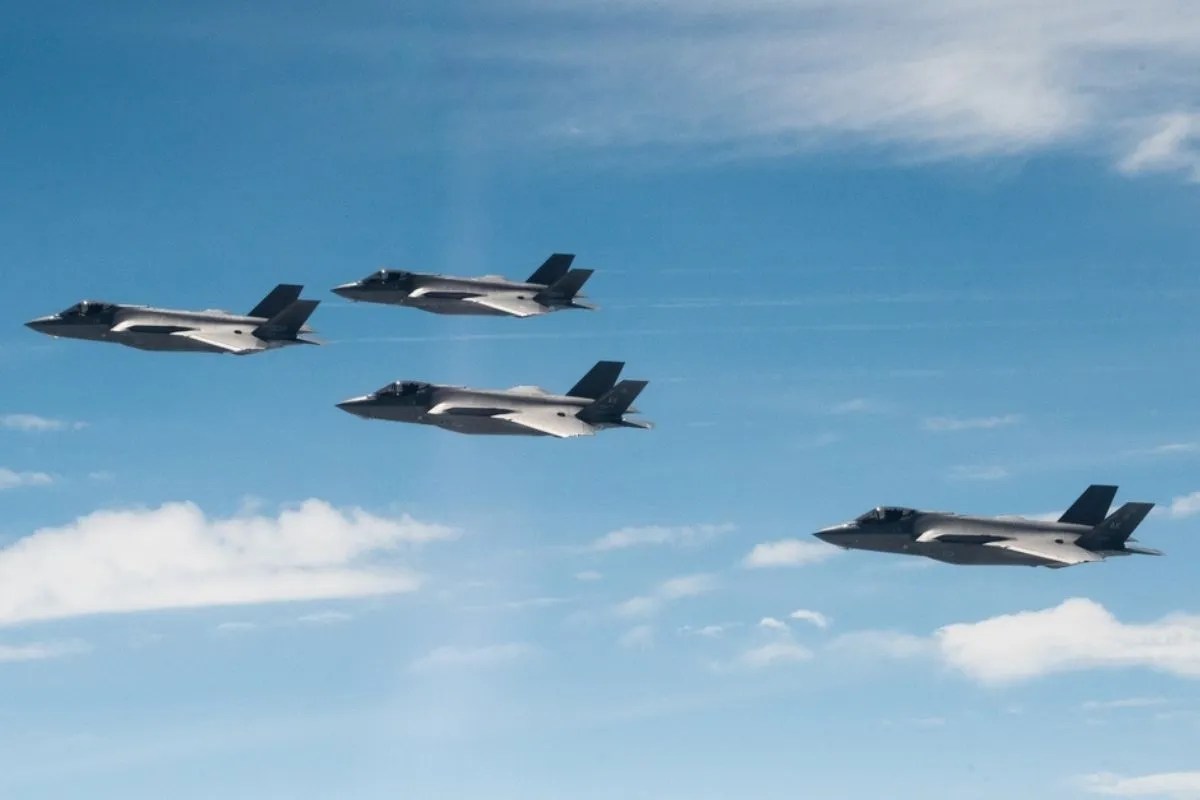
When a routine freight consignment of military hardware vanished into the logistics web of East Asia, it exposed a vulnerability far more dangerous than any surface-to-air missile. A shipment of F-35 Lightning II spare parts, dispatched from Australia for heavy maintenance in the United States, was mistakenly rerouted through Hong Kong. Instead of crossing the Pacific under secure military oversight, the components drifted straight into a commercial transit node controlled by Beijing. Australian Defense Minister Richard Marles faced difficult questions as details emerged of the monumental oversight, while panic rippled through the Pentagon over how sensitive stealth technology components could take such an errant detour.
The incident is not merely an administrative hiccup. It represents a profound breakdown in the supply chain security of the most expensive weapon system in human history. To understand how a multi-million-dollar defense supply chain failed so completely, one must look past the immediate diplomatic embarrassment and examine the structural decay of military logistics.
The Route That Should Never Have Happened
Global logistics networks rely on automated sorting, barcode scanning, and digital manifests. Yet when human error intersects with complex military supply lines, the consequences carry geopolitical weight. The components in question were packed up in Australia, slated for specialized repair facilities operated by Lockheed Martin or certified defense contractors within the United States. Somewhere between the departure tarmac and the trans-Pacific flight path, a misdirection occurred.
A worker using commercial courier channels allegedly missed an alert warning against unauthorized diversions. Instead of flying directly toward North America, the cargo containers slipped through commercial hubs. Hong Kong ports and airports operate under legal and administrative frameworks heavily influenced by mainland Chinese authorities. Once military hardware touches down in such a jurisdiction, the physical security guarantees evaporate.
Defense analysts quickly pointed out the absurdity of moving sensitive military assets through commercial shipping conduits without constant monitoring. While prime contractors routinely utilize commercial express services to cut costs and expedite delivery times for non-lethal unserviceable parts, the lack of an immediate electronic override or fail-safe protocol is striking. When the mistake was identified, the trail had already gone cold, leaving defense officials scrambling to determine whether foreign intelligence agencies had accessed the crates before anyone noticed the missing inventory.
The operational reality of fifth-generation aircraft maintenance requires specialized components to travel thousands of miles across international borders. However, treating these movements with the casual attitude of commercial e-commerce parcels invites catastrophic security breaches. The fact that an ordinary sorting error could route classified or restricted military hardware through a foreign intelligence hotspot highlights an astonishing degree of institutional complacency.
How Commercial Couriers Became Defense Liabilities
Modern defense procurement prides itself on adopting commercial best practices. Just-in-time delivery models, pioneered by automotive and retail giants, were imported wholesale into military sustainment programs. The logic seemed sound on paper. Why maintain massive warehouses of expensive spare parts when global shipping firms can move components across oceans in hours?
The reality proved punishing. Military supply chains are prime targets for foreign espionage. Unlike commercial merchandise, a box containing structural frames, wiring harnesses, or electronic assemblies for a stealth fighter holds immense intelligence value. Even unserviceable parts carry proprietary metallurgy, chemical compositions of radar-absorbent skins, and manufacturing tolerances that take decades to replicate.
When prime contractors outsource transportation to commercial couriers, they introduce vulnerabilities that military logicians cannot easily control. A low-wage contractor employee handling packages at a sorting facility has no intrinsic reason to recognize the geopolitical gravity of a customs label or a secondary routing code. A single missed keystroke or ignored email confirmation can divert millions of dollars worth of restricted military property into an adversarial zone.
Australian officials found themselves on the defensive as international media dissected the timeline. Richard Marles, serving as Australia's Defense Minister, had to address mounting queries from allied lawmakers about how Canberra's logistics chain allowed the shipment to leave its secure perimeter without strict tracking validation. The official line emphasized that the parts were unserviceable and presented low operational risk, but intelligence specialists dismissed such reassurances as dangerous damage control. When radar-absorbent materials or structural components fall into the hands of foreign technicians, even damaged items can yield vital reverse-engineering clues.
The Pentagon Supply Chain Blind Spot
The Hong Kong diversion is a glaring symptom of a chronic malady plaguing the United States Department of Defense. Watchdog reports published by the Government Accountability Office have repeatedly laid bare the chaotic state of military property accountability. The numbers defy belief. The F-35 enterprise involves an estimated twenty-six million individual spare parts spread across hundreds of government installations and contractor facilities worldwide.
Valued at tens of billions of dollars, this sprawling inventory suffers from outdated tracking systems, manual record-keeping, and missing oversight mechanisms. Millions of components sit unaccounted for, while thousands of parts sent in for specialized repairs simply vanish from electronic registers. When an entire weapons program operates with such foundational accounting deficits, unauthorized diversions cease to be anomalies. They become inevitable outcomes of a broken administrative architecture.
Congressional committees on Capitol Hill expressed bipartisan outrage following the disclosure. Lawmakers demanded answers from both the Pentagon and major defense contractors regarding why tracking systems failed to flag an unauthorized flight path into a Chinese territory in real time. The answers offered little comfort. Defense officials admitted that visibility over assets in transit remains fragmented, dependent on disparate databases that rarely communicate effectively with one another.
This lack of visibility creates an environment where malicious actors do not even need to hack secure military networks. They simply wait for human error to deliver the hardware directly to their doorstep through commercial logistics pipelines.
What Australian Defense Leadership Missed
For Canberra, the incident triggered an urgent internal review of how foreign military sales and maintenance pipelines are managed. Australia operates a growing fleet of advanced combat aircraft, making it a critical anchor for allied power projection in the Indo-Pacific region. Maintaining operational readiness requires a constant flow of components moving between domestic bases and overseas repair depots.
Minister Richard Marles emphasized that Australia takes security protocols seriously, yet the episode exposed a dangerous delegation of trust. When local defense authorities hand over components to third-party logistics providers, the chain of custody breaks down the moment civilian contractors take over the handling manifests. Critics argued that Australian defense leadership failed to implement independent verification steps for high-value sensitive hardware before it cleared customs.
The diplomatic fallout extended beyond bilateral talks with Washington. Regional competitors watched closely, recognizing that Western military logistics can be exploited through administrative infiltration rather than kinetic disruption. If an adversary can passively acquire sensitive components simply by monitoring commercial freight misroutes, traditional definitions of operational security require radical revision.
Furthermore, the incident strained trust among coalition partners. When a failure in one nation's supply chain management jeopardizes the technological edge of the entire global fleet, accountability becomes a contentious diplomatic battleground. Canberra and Washington are now forced to re-evaluate every node in their joint maintenance network to ensure history does not repeat itself.
The Broader Accounting Crisis Plaguing Modern Airpower
The structural flaws exposed by the Hong Kong incident extend far beyond a single lost shipment of aircraft spares. The entire architecture of modern defense sustainment is strained under the weight of its own complexity. Software-driven fighters require constant hardware maintenance, creating an endless loop of transnational shipments involving thousands of subcontractors.
Each transfer point introduces an opportunity for loss, theft, or interception. When inventory management is treated as an administrative afterthought rather than a core pillar of national security, intelligence agencies in Beijing and Moscow reap the rewards. The reliance on commercial contractors who prioritize speed and cost-efficiency over rigorous security vetting creates persistent vectors for exploitation.
Reforming this system demands a total overhaul of military logistics doctrine. Encrypted tracking beacons, mandatory military escorts for sensitive cargo, and centralized digital ledgers that cannot be bypassed by human error are absolute requirements for protecting fifth-generation capabilities. Until such measures become standard practice across all allied nations sharing the F-35 inventory, similar incidents will continue to occur in the shadows of global trade.