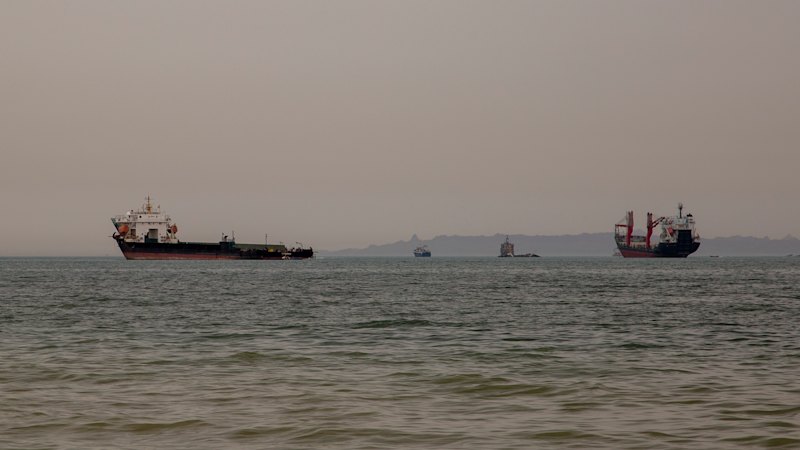
The Strait of Hormuz is not open, regardless of what the latest social media posts from the White House or the Iranian Foreign Ministry suggest. While a "ceasefire extension" dominates the news cycle, the reality on the water is a grinding, kinetic siege. On Wednesday, the Islamic Revolutionary Guard Corps (IRGC) Navy seized two more merchant vessels—the Panama-flagged MSC Francesca and the Liberia-flagged Epaminondas—escorting them to the Iranian coast under the pretext of "navigation violations."
This is the first time since the outbreak of the air war in February that Tehran has physically boarded and detained commercial ships. It is a sharp, deliberate escalation that exposes the fragility of the diplomatic vacuum.
President Donald Trump’s announcement that the U.S. will extend the ceasefire indefinitely is less a peace overture and more an admission of a strategic impasse. By demanding a "unified proposal" from a fractured Iranian leadership, Washington is gambling that economic strangulation will force a surrender. But in the shadow of the Musandam Peninsula, the IRGC is proving that if they cannot export oil, they will ensure no one else can either.
The Illusion of the Ceasefire Extension
To understand why the ceasefire is failing, one must look at the definition of the term being used by both sides. For Washington, the ceasefire applies to "Attack on Iran"—meaning the heavy aerial bombardment of infrastructure has paused. However, the U.S. naval blockade of Iranian ports remains in full effect.
Tehran views this as a distinction without a difference. Mohammad Bagher Ghalibaf, the Speaker of the Iranian Parliament, was blunt on Wednesday: "A complete ceasefire only has meaning if it is not violated through a naval blockade." To the Iranians, the U.S. Navy’s interdiction of tankers in the Indian Ocean is an act of war. Their response is the tactical "bottlenecking" of the Strait.
By seizing the MSC Francesca—a vessel linked by Tehran to "Zionist interests"—the IRGC is signaling that the truce in Lebanon does not translate to safety in the Gulf. The maritime security reality is grim:
- Physical Seizures: Two ships are now in Iranian custody.
- Direct Fire: At least three other vessels were fired upon by IRGC gunboats on Wednesday alone.
- Bridge Attacks: The Epaminondas sustained heavy damage to its bridge from small arms and RPG fire before being boarded.
The Fractured Leadership Gamble
The White House’s insistence on a "unified proposal" stems from intelligence suggests the Iranian government is paralyzed. With Supreme Leader Mojtaba Khamenei reportedly incapacitated or unreachable following the initial strikes in February, power is split between the "diplomatic" wing in the Foreign Ministry and the hardline IRGC commanders who currently control the coastline.
Trump’s strategy, encouraged by Pakistani mediators, is to wait for these factions to fight it out. It is a high-stakes waiting game that ignores the mounting costs of the blockade. Iran is losing an estimated $500 million a day in oil revenue. Their ports are ghost towns. But history suggests that a starving IRGC is more likely to lash out than to sign a comprehensive surrender.
The involvement of Pakistan as a middleman adds another layer of complexity. Prime Minister Shehbaz Sharif and Field Marshal Asim Munir have positioned Islamabad as the last bridge between the two powers. Yet, even as they thank Trump for "graciously accepting" the extension, their Iranian counterparts are refusing to show up for the second round of talks in Islamabad.
The Hidden Cost of the Double Blockade
The global economy is currently caught in a pincer movement. On one side, the U.S. Navy is redirecting Iranian-flagged tankers near Malaysia and Sri Lanka. On the other, the IRGC has turned the Strait of Hormuz into a gauntlet of gunboats and sea mines.
Shipping traffic has cratered from 130 vessels a day to a handful of high-risk transits. Insurance premiums for the region have moved beyond "war risk" into the realm of the prohibitive. When the IRGC "seizes" a ship for "tampering with navigation systems," they are often referring to the fact that many captains are turning off their AIS (Automatic Identification System) transponders to avoid being targeted—a survival tactic that Iran now uses as legal justification for piracy.
This is not a stalemate; it is a slow-motion collapse of maritime law. The U.S. claims to be protecting "freedom of navigation" while simultaneously conducting a total naval blockade of a sovereign nation. Iran claims to be "protecting maritime safety" while firing RPGs at the bridges of cargo ships.
The Tactical Shift to Gunboat Diplomacy
We are seeing a transition from the "Missile War" of February and March to a "Shadow War" of seizures and harassment. This is more difficult for the U.S. to counter with airpower alone. You cannot bomb a gunboat that is tethered to a civilian tanker without risking a catastrophic oil spill or the lives of the innocent crew.
The IRGC knows this. They are using the captured vessels as human and environmental shields. By taking the MSC Francesca and Epaminondas, they have effectively taken the global supply chain hostage to demand the lifting of the U.S. blockade.
The "unified proposal" Trump is waiting for may never arrive because the IRGC finds more utility in chaos than in a lopsided peace deal. They are proving they can still project power despite the loss of their Supreme Leader and the destruction of their traditional air defenses.
The Coming Breakdown
The current "indefinite" ceasefire is a polite fiction. It persists only because neither side is currently prepared for the next level of escalation—which would likely involve the U.S. military attempting to physically clear the IRGC from the islands of Tunb and Abu Musa, or Iran launching a final, desperate swarm of drones against regional desalination plants.
The "unified proposal" demand acts as a convenient exit ramp for Washington to avoid a full-scale ground invasion, but it offers no solution for the ships currently sitting in the water, bridges charred and crews detained.
Diplomacy is currently a theater performed for the benefit of the Pakistani mediators and the oil markets. On the water, the war has never stopped. It has only changed its methods. The siege of the Strait is now the primary theater of conflict, and as long as the U.S. blockade holds, the IRGC will continue to pluck ships from the water like ripe fruit.
The next move won't come from a boardroom in Islamabad; it will come from a gunboat in the Strait.


