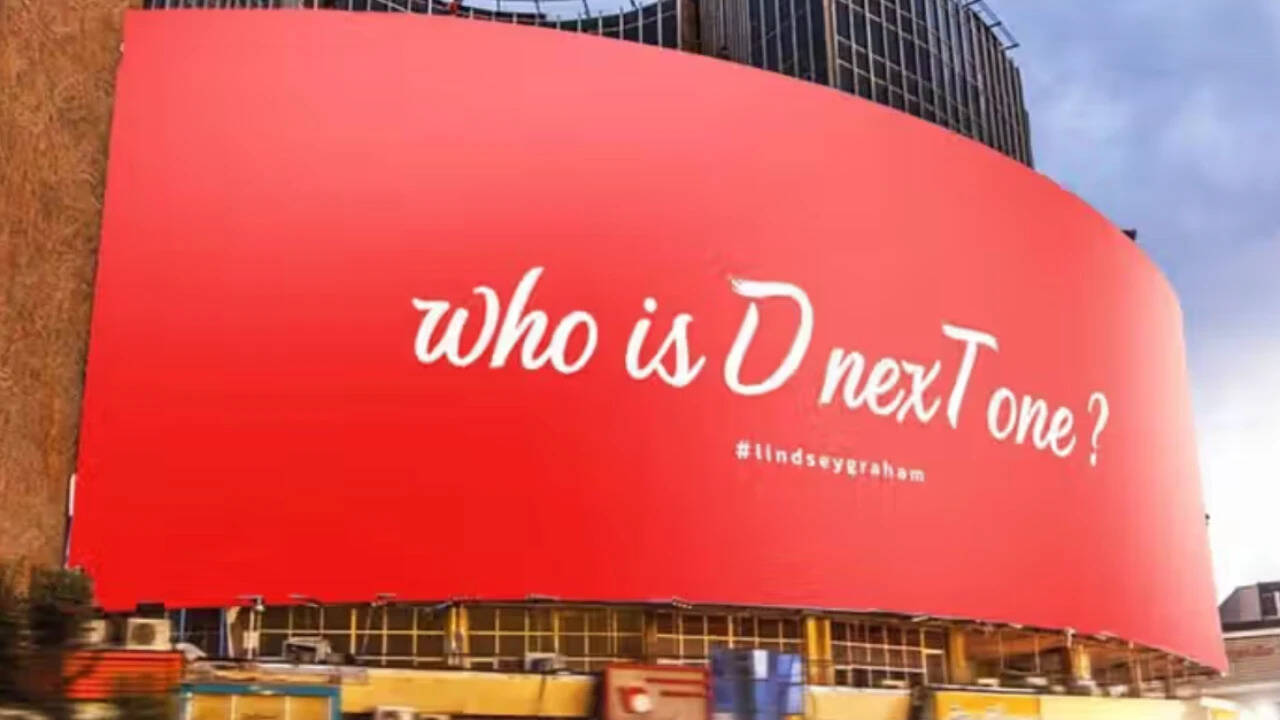
The installment of a highly specific psychological operations asset in Tehran’s Valiasr Square, following the sudden death of United States Senator Lindsey Graham, marks a calculated evolution in Iranian strategic communication. Controlled by the Owj Arts and Media Organization—an entity structurally integrated with the Islamic Revolutionary Guard Corps (IRGC)—the billboard features the English text "Who is D nexT one?" alongside a hashtag referencing the deceased senator. By distorting the typography to capitalize the letters "D" and "T," the state apparatus has signaled a direct, kinetic focus on U.S. President Donald Trump.
This deployment operates at the intersection of asymmetric deterrence, domestic political preservation, and international theater. Rather than an isolated burst of ideological aggression, the campaign functions as an explicit signal within an ongoing conflict characterized by expanding kinetic strikes and domestic economic pressures.
The Architecture of the Visual Deterrence Function
State-sponsored media maneuvers by adversary regimes are frequently miscategorized as mere ideological venting. When evaluated through structural signaling theory, the Valiasr Square campaign serves two distinct strategic functions: external psychological pressure and internal political equilibrium.
                  ┌────────────────────────────────────────┐
                  │ IRGC Owj Arts & Media Deployment       │
                  └───────────────────┬────────────────────┘
                                      │
             ┌────────────────────────┴────────────────────────┐
             ▼                                                 ▼
┌───────────────────────────┐                     ┌───────────────────────────┐
│ External Signaling        │                     │ Internal Equilibrium      │
├───────────────────────────┤                     ├───────────────────────────┤
│ • Strategic Ambiguity     │                     │ • Domestic Deflection     │
│ • Kinetic Cost Imposition │                     │ • Rhetorical Continuity   │
│ • Information Arbitrage   │                     │ • Elite Consolidation     │
└───────────────────────────┘                     └───────────────────────────┘
External Signaling and Strategic Ambiguity
The choice of imagery reveals a reliance on strategic ambiguity. Senator Graham passed away due to sudden, non-violent medical complications. By overlaying a target-based typographic mechanism ("D" and "T") onto an event driven entirely by natural causes, Tehran seeks to fabricate an illusion of reach and cosmic or operational inevitability. The primary goal is to inject psychological friction into the decision-making loops of high-value U.S. political and military leaders.
By projecting an omnipotent posture that implicitly claims credit for or capitalizes on sudden Western political shifts, the regime attempts to alter the perceived cost function of U.S. decision-makers. The implicit calculation posits that if Washington believes its individual leaders face persistent, personalized operational risk, its institutional willingness to authorize high-threshold kinetic actions will decrease.
Internal Equilibrium and Domestic Deflection
The domestic function of the campaign responds directly to current structural vulnerabilities within the Islamic Republic. Concurrently, United States Central Command has executed consecutive waves of airstrikes targeting critical Iranian transit pipelines, bridges in Hormozgan province, and maritime surveillance infrastructure at Chabahar port. These operations directly degrade the IRGC's capacity to monitor the Strait of Hormuz and disrupt domestic logistics. This military pressure coincides with deep macroeconomic volatility, as evidenced by the Iranian rial depreciating to historic lows near 1.92 million per U.S. dollar.
When an actor faces severe asymmetric degradation in tangible domains—such as infrastructure loss and currency devaluation—the utility of high-visibility symbolic victories increases. The Valiasr Square billboard functions as an internal balancing mechanism designed to:
- Coalesce core hardline factions around a narrative of continuous resistance.
- Signal to a hyper-nationalist base that the state maintains strategic initiative, despite the destruction of vital port towers and electrical networks.
- Deflect public frustration away from deteriorating domestic material conditions, including localized power rationing, toward an external existential struggle.
Operational Realities and Information Arbitrage
The divergence between public performance and operational capacity highlights a structural limitation in Iran's current asymmetric doctrine. Since the kinetic exchanges of 2025 and subsequent operations in 2026, which resulted in the elimination of over fifty senior Iranian intelligence and military personnel, Tehran’s ability to project conventional deterrence has been structurally constrained.
Consequently, the regime relies heavily on information arbitrage. This process uses high-visibility visual displays to substitute for symmetrical military capabilities. While mourners and hardline factions display crosshairs over Western figures and chant threats of lethal retaliation, the actual execution of complex operations inside the United States faces significant execution barriers.
The primary barrier stems from a severe intelligence deficit. The state’s network has struggled to penetratively counter Western protective details or overcome the logistical friction inherent in launching long-range asymmetric operations against hard targets. This reality creates an operational bottleneck where public rhetoric must scale up precisely because physical, kinetic options are restricted by Western deterrence and active counter-intelligence measures.
The visual campaign also exposes an ongoing policy debate within the Iranian leadership. Hardline media units continue to produce escalatory rhetoric, but pragmatic elements within the Iranian parliament have actively debated the limits of this posture. The removal of prominent hardline critics of diplomacy from key security panels indicates an internal recognition that unmodulated escalatory signaling can backfire. If the regime signals an immutable commitment to kinetic assassination, it risks rendering diplomatic pathways or sanction-relief negotiations structurally impossible for Washington to pursue.
Expected Outcomes and Escalation Management
The strategic utility of this symbolic escalation is bound by diminishing marginal returns. While the Valiasr Square installation serves immediate domestic propaganda needs, its external efficacy is limited by a predictable counter-escalation loop.
Western security architectures treat explicit threats against a sitting president as highly actionable intelligence indicators rather than mere rhetorical background noise. The immediate consequence will be a tightening of protective postures and an expansion of counter-threat financial and intelligence operations targeted directly at the IRGC’s external operations networks.
Furthermore, this visual strategy risks creating a commitment trap for Tehran. By repeatedly broadcasting explicit promises of high-level retribution to its domestic audience, the regime risks undermining its own legitimacy if it fails to deliver a proportional kinetic response. As U.S. airstrikes continue to pressure physical infrastructure in southern provinces, the disparity between symbolic performance in Tehran and material degradation on the coast will likely widen. This dynamic compresses the regime’s space for flexible diplomacy and increases the probability of a miscalculated escalation.
Rather than altering the strategic calculus of the United States, this signaling method likely locks both actors into a protracted, high-friction equilibrium. Washington will continue to interpret these public displays as justification for sustained containment and infrastructure interdiction, while Tehran remains dependent on increasingly aggressive visual rhetoric to manage internal stability amid mounting physical costs.