The coffee in the executive lounge at the back of the Frankfurt motor show tastes like burnt paper, but nobody is paying attention to the caffeine. They are staring at a door gap.
A man in a bespoke Italian suit, a high-ranking engineer for a prominent German automotive dynasty, leans in so close his forehead almost touches the metallic blue paint of a newly arrived hatchback. He runs a thumb over the seam where the front fender meets the A-pillar. He is looking for the micro-misalignments that used to comfort him. The two-millimeter variances that meant a car was rushed, cheap, or inferior.
He finds nothing. The gap is laser-straight, less than a millimeter wide, silent and perfect. He steps back, his face pale under the halogen lights. The car isn't German. It isn't American. It bears a logo that, five years ago, his board of directors laughed at during a quarterly review.
They aren't laughing now.
For over a century, the European continent didn’t just build cars; it defined its soul through them. The roar of a V8 on an unrestricted Autobahn, the nimble darting of a hatchback through a Tuscan village, the heavy, reassuring thud of a Mercedes door closing—these weren’t just consumer experiences. They were economic life support systems. One in ten manufacturing jobs in Europe relies on the automotive sector. When those factories hum, Europe prospers.
But a quiet capitulation is unfolding across the continent. It is not happening with a dramatic bankruptcy or a sudden factory fire. It is happening through the slow, agonizing realization that Europe has lost a war it barely realized it was fighting.
The industry has effectively abdicated to China.
The Ghost in the Assembly Line
To understand how a continent with a century-long head start threw up its hands, you have to leave the glass towers of Stuttgart and look at a hypothetical worker. Let’s call him Stefan.
Stefan is fifty-two. His father worked the forge at Wolfsburg, and his daughter is studying mechanical engineering. For thirty years, Stefan’s pride was tied to the complexity of the internal combustion engine. He understood the intricate dance of pistons, valves, turbochargers, and fuel injectors—a mechanical watch writ large, requiring thousands of perfectly synchronized moving parts. Europe mastered this complexity. That mastery created a moat so wide no outsider could cross it.
Then the rules of the game changed entirely.
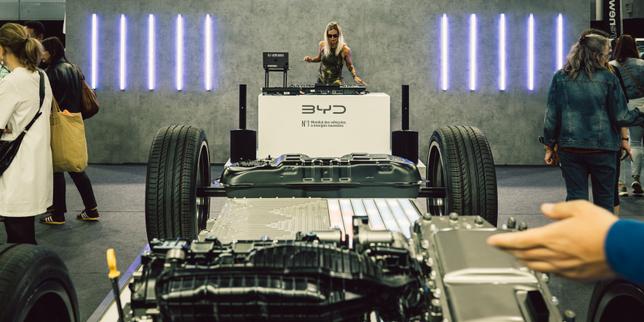
An electric vehicle does not care about your century of mechanical heritage. It is, stripped of its marketing gloss, a battery pack attached to a skateboard with a computer on top. The moat dried up overnight.
Consider the mathematics of the modern battery. China controls roughly 75% of the world’s lithium-ion battery cell production. It refines the vast majority of the world’s cobalt, nickel, and manganese. When European automakers decided to transition to electric vehicles—partly driven by climate mandates, partly by a desire to match tech-industry valuations—they discovered a brutal truth. They weren't building a new industry. They were renting one from Beijing.
Every time a European legacy brand sells a new electric model, a massive portion of the profit margin is shipped directly to battery giants in Ningbo or Shenzhen. The European car has become a beautiful, expensive shell wrapped around a Chinese heart.
The Trap of the Premium Myth
For years, the defensive strategy in Paris, Munich, and Turin was simple: hide in the high end.
Executives reassured themselves that while Chinese manufacturers like BYD, Geely, or NIO might dominate the low-margin, utilitarian segments, they could never touch European luxury. The heritage was too deep. The prestige was too sticky. A wealthy driver in Shanghai or Berlin would always prefer the three-pointed star or the four rings.
That assumption was a catastrophic error in human psychology.
The mistake lay in misunderstanding what the modern driver values. To a generation raised on smartphones, luxury is no longer defined by the suppleness of Nappa leather or the mechanical feedback of a steering column. Luxury is defined by software. It is the ability of a car to seamlessly update its suspension tuning overnight over Wi-Fi. It is an infotainment system that anticipates your route, manages your home automation, and provides a lag-free digital ecosystem.
On a rainy afternoon in Shanghai, a twenty-five-year-old tech worker sits in the back of a domestic electric sedan. She doesn't care that a German brand spent seventy years perfecting a dual-clutch transmission. She cares that her car has a voice assistant that understands her local dialect perfectly, a built-in karaoke system for traffic jams, and an autonomous driving suite that navigates chaotic urban environments without breaking a sweat.
When she looks at a European electric import costing twice as much, she doesn't see heritage. She sees an overpriced, technologically obsolete relic from a culture that refuses to move forward.
The data reflects this shift with terrifying clarity. Europe’s greatest export market—China itself—has inverted. For decades, Western automakers used their Chinese joint ventures as a license to print money, funding their domestic operations with Asian profits. Now, those domestic Chinese brands own their home market. They are no longer content staying home. They are crossing the ocean.
The Factory that Never Sleeps
The scale of the imbalance becomes visceral when you walk the floor of a modern mega-factory in Hefei or Shenzhen.
The lights are dimmed because the machines do not need human vision to see. Hundreds of orange robotic arms move with a terrifying, liquid speed, stamping out entire car chassis sections in a single piece using massive giga-presses. A vehicle rolls off the line every sixty seconds.
More importantly, the supply chain is not spread across oceans. The semiconductor fabricator is down the street. The battery assembly plant is connected by a conveyor bridge. The software engineering firm is two floors up. This is vertical integration taken to its logical, ruthless extreme.
In Europe, an engineer trying to alter a software feature on a dashboard must navigate a labyrinth of tier-one suppliers, legal frameworks, union consultations, and cross-border logistics. A change takes eighteen months. In China, that same change is coded, tested, and pushed to the production line in eighteen days.
It is an asymmetric conflict. You cannot win a race when your opponent is running at ten times your speed and owns the track.
The White Flag in the Details
The abdication isn't announced with a press release stating "We give up." It is visible in the strategic retreats happening behind closed doors.
It is visible when historic European brands quietly announce partnerships to use Chinese platforms for their upcoming models. It is visible when Western heritage names are bought out entirely, transformed into design studios for vehicles engineered and manufactured in Asia. It is visible in the desperate pleas for tariffs and trade barriers.
Tariffs are the ultimate admission of defeat. They are a confession that your domestic industry can no longer compete on price, technology, or efficiency. They are a temporary wall built around a crumbling castle. While a 20% or 30% duty might slow the influx of foreign vehicles into European ports, it does nothing to fix the underlying rot. It merely subsidizes inefficiency, making cars more expensive for the average European citizen while the rest of the world moves on.
Worse, it invites retaliation. The very factories in Europe that still rely on exporting luxury combustion-engine cars to Asia find themselves squarely in the crosshairs.
The Cost of Comfort
How did the smartest engineers on earth let this happen?
The answer is painfully human: they were too successful for too long. When an industry generates billions in guaranteed profit year after year, arrogance becomes default. Complacency disguises itself as prudence.
Every time an engineer suggested a radical departure from the status quo, the finance department countered with the immediate return on investment of another line of combustion SUVs. "The infrastructure isn't there," they said. "The consumer isn't ready," they argued. They protected the quarterly dividend at the expense of the next decade.
Meanwhile, across the Pacific, massive state-backed investments were quietly securing the mineral rights in Africa and South America. Billions were funneled into battery research facilities. The groundwork was laid while Europe was still debating the emissions standards of diesel engines.
Now, the trap has sprung. The European automotive industry is caught in a pincer movement. On one side is an aggressive, hyper-efficient manufacturing superpower that controls the raw materials. On the other is an economy that cannot afford to let its foundational industry collapse but lacks the political will to make the painful, structural changes required to compete.
The View from the Street
Go back to Stefan, standing outside the factory gates in Saxony. The evening shift is changing. The air smells of ozone and industrial grease, a scent that has defined his family’s life for three generations.
He watches the transport trucks roll out of the logistics depot. A few years ago, every truck was loaded with vehicles destined for global dominance. Today, the local dealership down the road features a prominent display of new, sleek, aggressively priced electric models from brands Stefan cannot pronounce. His neighbors are buying them. Not because they want to hurt the local economy, but because they have mortgages to pay and children to feed, and the foreign cars are simply better value for their hard-earned money.
Stefan’s daughter will graduate from her engineering program soon. She won't be designing the intricate piston heads her grandfather built, nor will she likely be pioneering the next breakthrough in solid-state battery chemistry. Those patents are already registered elsewhere.
The tragedy of the European auto industry is not that it ran out of ideas, but that it ran out of time while convinced it owned the clock. The factories will stay open for a while, turning out legacy vehicles for a shrinking market or assembling kits shipped in from overseas. The brands will survive as marketing exercises, logos attached to products designed and intellectualized thousands of miles away.
The sun sets over the industrial heartland, casting long shadows across the concrete test tracks where the world’s greatest engines were once broken in. The tracks are quiet now, save for the low, electric hum of a passing sedan, moving swiftly into a future that no longer belongs to the people who built the road.