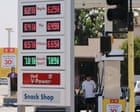
The headlines are screaming again. Panic is the only currency left in local news. "Gas hits $6.00!" "Highest prices in four years!" The implication is always the same: the sky is falling, the working class is being erased, and the state is a failed experiment.
Most of these reports are intellectually lazy. They treat the price at the pump as an isolated tragedy, a random act of God or corporate greed. They focus on the pain at the nozzle while ignoring the fundamental mechanics of the most complex energy market on the planet. If you liked this post, you should read: this related article.
Here is the truth nobody wants to hear: Six-dollar gas isn't a bug. It’s a feature. In fact, if you actually care about the long-term economic health of California, you should want it to stay right there.
The Myth of the "Gas Tax" Boogeyman
Every time prices spike, the first casualty is logic. Populist politicians immediately start hunting for the gas tax. They claim that if we just suspended the excise tax—currently sitting around $0.60 per gallon—drivers would see immediate relief. For another look on this event, refer to the latest coverage from Financial Times.
This is a fantasy.
California’s gas prices are higher than the national average not because of a single tax, but because of a deliberate, decades-long decoupling from the national energy infrastructure. We operate as an "energy island." We have no pipelines bringing refined product over the Sierras. We rely on a handful of specialized refineries that produce a unique, cleaner-burning "Carb" (California Air Resources Board) blend.
When a single refinery in Torrance or Richmond goes down for "unplanned maintenance," supply doesn't just dip—it vanishes. Suspending a tax doesn't fix a supply bottleneck; it just hands a larger margin to the distributors who are already scrambling for every available drop. If you want lower prices, you don't cut taxes; you build more refineries. But no one in California has the stomach for that conversation. So, we pay the "isolation premium."
High Prices are a Brutal Efficiency Filter
Low energy prices encourage waste. It is a basic law of economics. When gas is cheap, people buy massive SUVs they don't need to haul groceries they could have walked to get. They live 60 miles from their jobs and complain about the commute they chose.
Expensive gas is the only honest signal in a world of subsidized choices. It forces a radical reassessment of efficiency. At $6.00 a gallon, the "cost to operate" becomes a primary metric rather than an afterthought. This price pressure has done more to accelerate EV adoption and public transit interest than a thousand government rebates ever could.
We see this in the data. California accounts for roughly 25% of all EV sales in the United States. That isn't just because of "green" sentiment. It's because the math of an internal combustion engine (ICE) fails at $6.00.
Imagine a scenario where gas stayed at $2.50 indefinitely. Innovation would stagnate. We would still be driving 14-MPG tanks, stuck in a feedback loop of 20th-century technology. The high price is the catalyst for the inevitable transition. It is the friction that creates the fire.
The Refining Oligopoly and the "Price Gouging" Distraction
The state legislature loves to talk about "price gouging" penalties. It makes for a great press release. They want to investigate why profits at Chevron or PBF Energy spike when you're hurting at the pump.
But "price gouging" is a distraction for the uninformed. The real issue is the Oligopoly of the Refined. Because California’s environmental standards are so stringent, no new refineries have been built in decades. The existing ones have a captive market.
If you regulate the profit margins of these refineries too strictly, they don't lower prices—they leave. We have already seen refineries convert to renewable diesel or shut down entirely. When supply drops, prices rise. It is the most basic $S = D$ equation in existence. By attacking "greed," the state is actually tightening the noose on its own supply chain.
I’ve watched companies spend millions on "carbon compliance" only to be told they are the villains when those costs are passed to the consumer. You cannot demand the cleanest air in the country and the cheapest gas in the country simultaneously. Pick one.
The Hidden Subsidy of Traffic
There is a dark irony in the "high gas price" outcry: lower gas prices actually make your life worse.
Traffic in Los Angeles and the Bay Area is a tax on time. Time is the only non-renewable resource you have. When gas is "cheap," the roads reach a state of total paralysis. Induced demand ensures that every cent saved at the pump is spent idling on the 405.
High gas prices act as a de facto congestion charge. They thin the herd. They force carpooling. They push the marginal driver off the road and onto a bike or a train. If you value your time at more than $15 an hour, you should be praying for gas prices that keep the lanes moving.
The Brutal Reality of the Energy Transition
Transitioning a state of 40 million people off fossil fuels was never going to be "seamless." The word "seamless" is a lie sold by consultants. Transitions are jagged, expensive, and painful.
We are currently in the "valley of death" between an aging oil infrastructure and a nascent electrical grid. The high price of gas is the bridge. It provides the economic incentive to build the charging stations, to upgrade the home panels, and to densify our cities.
If we artificially lowered the price of gas today, we would be subsidizing our own obsolescence. We would be telling the world that we aren't serious about the goals we set.
Stop Asking the Wrong Question
People always ask: "When will the prices go back down?"
That is the wrong question. The right question is: "Why am I still dependent on a commodity whose price is determined by a cartel in the Middle East and a handful of aging refineries in the Central Valley?"
The "relief" people want is a return to a status quo that is fundamentally unsustainable. Cheap gas is a drug that masked the symptoms of poor urban planning and a lack of transit investment for half a century. The $6.00 price tag is just the bill finally coming due.
You can complain about the cost of a gallon, or you can realize that the era of "cheap" anything is over. The world is getting more expensive because the externalities—carbon, pollution, infrastructure wear—are finally being priced in.
California isn't "failing" because gas is $6.00. It's finally being honest about what it costs to live in the future.
Stop looking for a subsidy. Change your lifestyle or change your vehicle. The $6.00 gallon is here to stay, and it's the most effective teacher we've ever had.
Adjust your math or get left behind.


