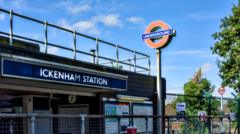
The London Underground is a marvel of clockwork precision, a subterranean circulatory system that moves five million souls a day through Victorian arteries. We treat it as a background hum, a mechanical certainty. We stand behind the yellow line, ears tuned for the low frequency vibration of an approaching train, our thumbs scrolling through digital worlds to avoid eye contact with the stranger two feet away. We trust the geometry of the tunnels. We trust that the space between the platform and the steel is a predictable, survivable void.
But geometry failed on a Tuesday morning at Waterloo.
Consider the physical reality of a Tube station. It is a world defined by narrow margins. There is the platform, the pit (the "suicide pit" or drainage invert), and the electrified third rail pulsing with 630 volts of direct current. For decades, the design of these stations included a "safe stay" area—a small, recessed ledge beneath the platform overhang. It is a claustrophobic sliver of concrete, barely wide enough for a human body to press into, but it is designed to be the difference between a terrifying story told at a pub and a coroner’s inquest.
When a person falls, the instinct is to scramble. But if the train is already screaming into the station, there is no time to climb. The only hope is the gap.
The Obstruction of Mercy
On that morning, the system encountered a variable it wasn't designed to handle. A passenger, whose name becomes a statistic in the evening papers but who lived a life of specific joys and private griefs, ended up on the tracks. In that frantic, adrenaline-soaked second where the brain screams for cover, they reached for the safe stay.
They found it blocked.
It wasn't a structural collapse or a stray piece of luggage that barred the way. It was the infrastructure itself—specifically, a series of cables and brackets installed during a "modernization" phase. These are the invisible upgrades we never notice: fiber-optic lines for better signaling, thicker power conduits to keep the air flowing, the nervous system of a digital city. To the engineers, these were necessary improvements. To the person pinned against the ballast as the headlights grew into twin suns, they were a wall.
Safety isn't just about the absence of accidents; it is about the presence of a "fail-safe." We build cars with crumple zones because we know we will crash. We put fire escapes on buildings because we know things will burn. The safe stay area is the London Underground’s ultimate fail-safe. When that space is compromised for the sake of a cable run, the entire contract of public safety is rewritten without the public's consent.
The Physics of a Near-Miss
To understand the stakes, we have to look at the math of a platform. A standard Tube carriage is roughly 2.6 meters wide. The tunnel bore is barely wider. When a train enters a station at 30 miles per hour, it pushes a wall of air ahead of it—the "piston effect." If you are on the tracks, this air hits you first, a physical blow that can disorient you before the metal does.
If you can lie flat in the invert, you might survive. If you can tuck into the safe stay, the train passes inches from your spine, a hurricane of screeching iron and heat, but you remain untouched.
Now, introduce a bundle of heavy-duty cabling.
If those cables protrude just four inches into that sanctuary, a human ribcage can no longer fit. The geometry shifts from a survivable pocket to a crushing hazard. The investigation into the Waterloo fatality revealed that this wasn't an isolated oversight. Over years of incremental "maintenance," the secret sanctuaries of the Underground have been slowly filled with the clutter of progress. We have traded the physical space required for a human to survive a mistake for the digital space required for a phone to load a video one second faster.
The Bureaucracy of the Void
Transport for London is an organization of spreadsheets and safety audits. They have "Red Zones" and "Safe Systems of Work." They have thick manuals detailing exactly how a track worker should stand when a train passes. But those rules are for the professionals. The passenger exists in a different category—the "unintended user" of the trackside.
The tragedy of the blocked safe spot reveals a chilling blind spot in urban planning. When we design for efficiency, we often forget the desperate physics of the worst-case scenario. The cables were likely installed by contractors following a blueprint that didn't mark the safe stay as "sacrosanct." It was just an empty ledge. And in a city as crowded as London, empty space is a vacuum that must be filled.
We see this in every facet of modern life. We prioritize the "flow" of the system over the "buffer" required for human error. Our highways lose their hard shoulders to create "smart lanes." Our buildings lose their wide stairwells to maximize floor-to-office ratios. We are eroding the margins of error in our physical world, assuming that the technology will prevent the crisis from ever happening.
But the crisis always happens. Someone always slips. A dizzy spell, a shove in a crowd, a momentary lapse in judgment—these are the constants of being human.
The Silent Alarms
The workers who walk these tracks at night, the "fluffers" who clean the hair and dust from the rails, and the engineers who maintain the signals, they know the gaps. They know which stations offer a hiding place and which ones are "tight." There is a subterranean map of survival known only to those who see the tunnels without the lights of a train.
After the incident, the subsequent reports didn't just point to a single cable. They pointed to a culture of "incremental encroachment." One cable doesn't kill you. Two cables don't kill you. But the tenth cable, the one added on a rainy Tuesday in 2022 to support a new CCTV camera, is the one that closes the gap.
It is a death by a thousand small decisions. No single engineer intended to create a deathtrap. They were simply doing their job, mounting a bracket where it was easiest to drill. They were solving a small problem and, in doing so, creating a terminal one.
The Geometry of Compassion
What does it mean to build a city that cares? It means acknowledging that people are fragile. It means recognizing that a "non-place"—a dark ledge under a platform—is actually one of the most important pieces of real estate in the city.
The fix isn't complicated. It doesn't require a "game-changing" invention or a massive shift in technology. It requires a return to the fundamentals of spatial awareness. It requires a policy that says: This space belongs to the person who falls. We must audit the voids. We need to treat the safe stay area with the same reverence we treat the tracks themselves. If a cable must go through, it must be recessed. If a pipe is needed, it must be diverted. We cannot allow the "nervous system" of our city to strangle the very people it is meant to serve.
As the investigation into the Waterloo death concluded, the focus shifted to "remediation." Teams were sent out in the dead of night to measure gaps, to move cables, and to restore the sanctuaries. They are working to give us back our six inches of mercy.
The next time you stand on a Tube platform, look down. Not at your phone, but at the dark space beneath the edge of the stone. Imagine the hidden complexity of that void. It is a reminder that in a world of high-speed transit and digital connectivity, our lives still depend on the simplest of things: a little bit of empty space, kept clear, just in case.
We live in the margins. We survive in the gaps. We must ensure they stay open, because the distance between a commute and a tragedy is much smaller than we care to admit.
There is a specific kind of silence that follows the roar of a train leaving a station. It is a heavy, ringing quiet. In that silence, the platform remains, the yellow line remains, and the gap remains. Whether that gap is a grave or a shelter is a matter of design, of foresight, and of how much we value the person who, for one terrible second, finds themselves on the wrong side of the ledge.


