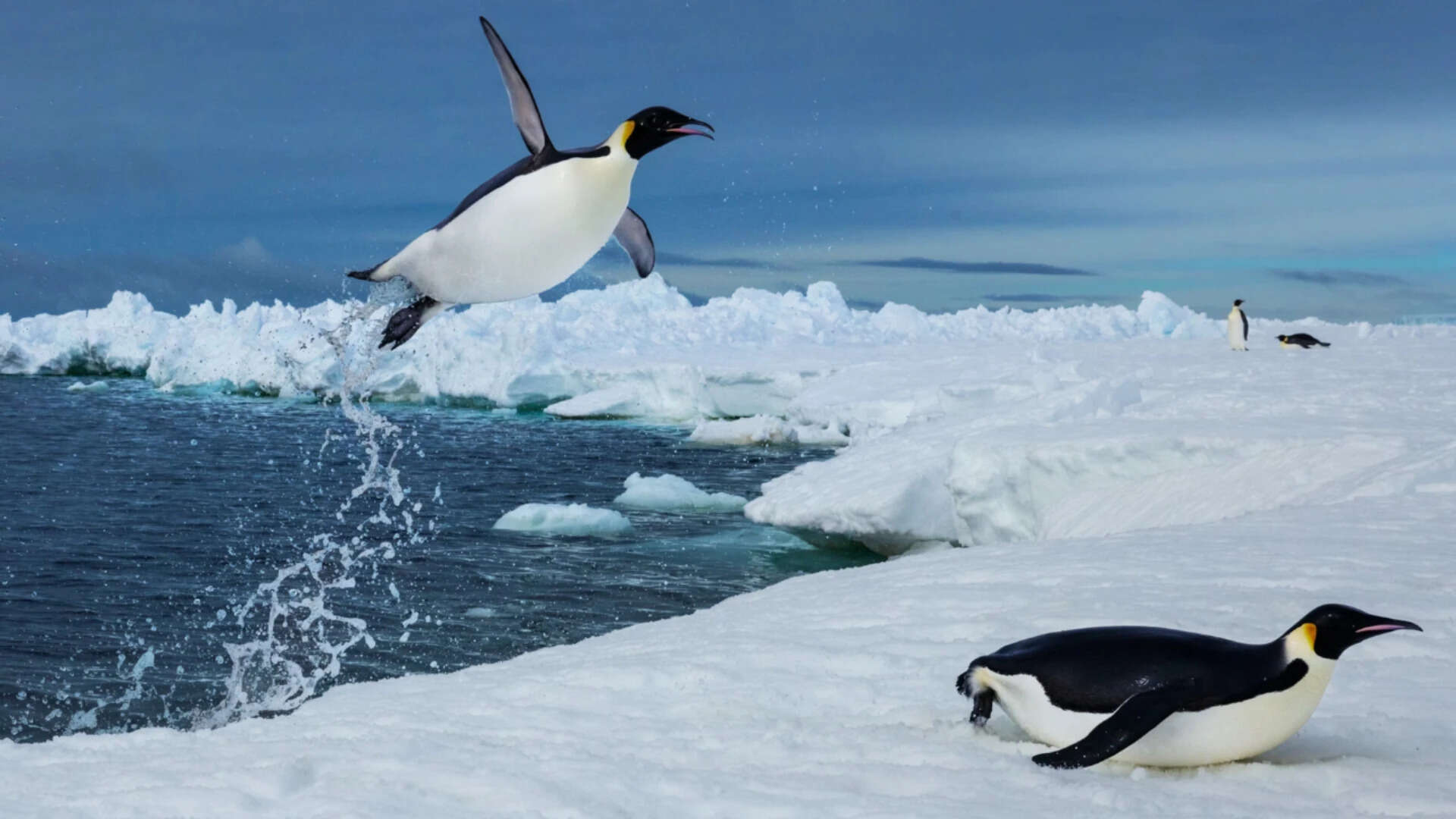
By tracking more than 6,000 individual penguin dives beneath the Antarctic sea ice, researchers have uncovered a brutal truth about polar survival. Penguins do not merely forage; they execute highly calculated, high-risk physical maneuvers where a single misjudged pocket of air or a patch of dark ice can mean starvation. The data reveals that these birds rely on incredibly precise, micro-scale physical structures on the underside of the ice sheet to trap prey. When this specific ice topography shifts due to warming waters, the energetic cost of hunting skyrockets, threatening to push these marine predators past their physiological limits.
The Brutal Efficiency of the Under Ice Hunt
To understand the scale of this survival strategy, one must look at the sheer physics of diving beneath a solid frozen ceiling. For an Adélie or Emperor penguin, the underside of the sea ice is not a flat barrier. It is a complex, upside-down mountain range of freezing ridges, slushy valleys, and pockets of trapped air.
These birds are breath-hold divers. Every second spent underwater is a ticking clock governed by their internal oxygen stores. They cannot simply surface anywhere they please to catch their breath. They must find breathing holes, cracks, or leads in the ice sheet.
Scientists equipped the birds with miniature, highly specialized bio-logging devices. These instruments included accelerometers to measure wing-stroke frequency, depth sensors to log vertical movement, and tiny point-of-view cameras. The resulting dataset of 6,000 dives paints a picture of extreme mechanical optimization.
The birds do not swim aimlessly. They target the "ice-water interface," the exact boundary where the solid ice meets the liquid ocean.
This interface is the primary feeding ground for Antarctic krill, which graze on the algae growing on the underside of the ice. To capture these krill, penguins utilize a highly specialized hunting technique. They swim upside down. By pressing their bodies close to the ice ceiling, they look upward, silhouetting the tiny translucent krill against the faint light filtering through the frozen sheet above.
This brings us to the core constraint of the hunt. It is a game of light and angles.
The Energy Audit of a Polar Hunter
Every dive is a calculated gamble against an absolute energy budget.
If a penguin spends more calories chasing a school of krill than it gains from consuming them, it loses. The bio-logging data showed that penguins constantly adjust their swimming speed and wing-beat patterns to maximize their foraging efficiency.
During the descent, they glide. This saves precious oxygen. Once they reach their target depth at the ice-water interface, they initiate rapid, high-frequency wing beats to maneuver through the jagged under-ice structures.
But this active hunting phase is highly taxing. The heart rate of a diving penguin drops dramatically to conserve oxygen, a physiological phenomenon known as the dive response. Yet, their muscles must still work at peak performance to chase down prey in near-freezing waters.
The tracking data revealed that the most successful dives occurred where the ice was moderately thick and structurally diverse.
Deep ice ridges create localized turbulence in the water currents. This turbulence traps concentrations of krill, turning these specific spots into high-yield feeding zones. The penguins know this. They return to the exact same underwater pressure ridges dive after dive, exploiting these biological hotspots until the food supply is exhausted.
But what happens when those ridges disappear?
Light and Shadow as Biological Coordinates
Light is the invisible thread holding this entire system together.
Antarctic sea ice acts as a giant, dynamic filter. Thick snow cover on top of the ice blocks almost all light, plunging the world beneath into absolute darkness. Thin ice, or ice clear of snow, allows a soft, blue-green light to penetrate the depths.
Penguins use this light to navigate and to hunt.
The 6,000 dives tracked by researchers demonstrated a direct correlation between light penetration and hunting success. The birds achieved their highest catch rates during hours of peak daylight when the contrast between the krill and the ice ceiling was sharpest.
They also used the light filtering through cracks to find their way back to safety.
Imagine diving hundreds of feet beneath a solid sheet of ice. You are running out of oxygen. Your muscles are burning. You must find a tiny crack in the ice to breathe, or you will drown.
Penguins use the bright, glowing patterns of open water leads to guide their return path. It is a visual map written in light.
When the ice becomes too thick or is covered by heavy, unseasonal snowfall, this map goes dark. The birds are forced to make shorter, shallower dives closer to known breathing holes. Their foraging range is drastically restricted, and their access to high-density krill patches is cut off.
Conversely, if the ice melts entirely, they lose their hunting platform.
The Breakdown of the Ice Factory
The Southern Ocean is undergoing rapid changes. Sea ice extent is highly volatile, with recent years showing historic lows in many sectors of the Antarctic coastline.
This is not just an aesthetic change. It is a structural collapse of a massive biological engine.
Without sea ice, the algae that feed the krill cannot grow. Without the ice-water interface, krill disperse into the vast, open water column rather than concentrating in predictable, shallow layers.
For a penguin, hunting in the open ocean is vastly different from hunting under ice.
In the open sea, they must dive deeper and search wider. They no longer have the physical barrier of the ice to pin their prey against. The energy required to capture a single gram of krill increases exponentially.
The tracking data shows that when penguins are forced to hunt in open water, their dive durations increase, but their catch per unit of effort drops. They are working harder for less food.
This is a classic ecological trap. The birds are locked into a physiological cycle designed for a stable ice environment. Their bodies are built for short, intense bursts of under-ice maneuvering, not endless, deep-water endurance swimming.
The Cost of Adaptive Failure
Many argue that animals will simply adapt to changing conditions.
But evolutionary adaptation operates on a timescale of millennia. The physical changes occurring in the Antarctic are happening in decades.
The physiological limits of a diving bird are hard-coded into its biology. They cannot change their lung capacity, their oxygen-carrying blood chemistry, or their metabolic rates overnight.
When we look at the 6,000 dives documented by scientists, we are not just looking at a fascinating biological study. We are looking at a warning system.
The data shows that these birds are already operating close to their metabolic ceiling. There is very little margin for error. A minor decrease in ice quality, a slight dispersion of the krill population, or an increase in the distance between breathing holes can tip the balance from a sustainable lifestyle to a rapid population decline.
We must view the Antarctic sea ice not as a static block of frozen water, but as a dynamic, living structure that supports one of the most specialized hunting strategies on Earth. The survival of these iconic polar predators depends entirely on the preservation of this frozen ceiling. Without it, the complex, upside-down world they have spent millions of years mastering will simply vanish.