The hum of a neighborhood at dusk is a predictable symphony. It is the sound of garage doors sliding shut, the distant rattle of a lawnmower finishing its final lap, and the invisible buzz of high-voltage lines carrying the lifeblood of the city. We don’t notice the grid until it screams.
High above the palm trees of Los Angeles, a small aircraft began its descent. To the pilot, the city is a map of lights and shadows. To the people on the ground, the plane is a passing drone of an engine, a common enough occurrence in a city where the sky is just another freeway. But gravity and geometry were about to collide in a way that turns a Tuesday evening into a local legend.
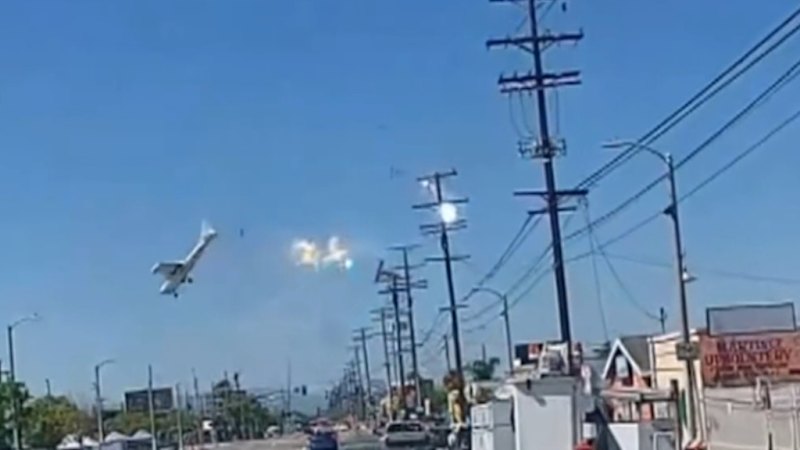
The snap was audible. Metal met copper. A Cessna-style light plane didn't just fly; it stumbled. It clipped the power lines, those sagging black veins that crisscross our suburbs, and for a heartbeat, the physics of flight gave way to the physics of tension.
The Moment the Lights Flickered
Imagine you are sitting in your kitchen. Maybe you’re arguing about the electric bill or wondering why the Wi-Fi is lagging. Then, a shudder. Not an earthquake—those are rolling, rhythmic terrors that Southern Californians know by heart. This was different. This was a sharp, electrical gasp.
Outside, the wires danced.
When a plane hits power lines, it isn't like the movies. There is rarely a massive fireball that consumes the neighborhood in a cinematic bloom. Instead, there is the terrifying reality of live wires whipped into a frenzy. A single downed line can carry enough voltage to turn the asphalt beneath it into glass. It hums with a predatory energy, snapping at the air, while the aircraft, now crippled, lurches toward the earth.
The pilot’s world shrunk in that second. Gone was the grand overview of the Los Angeles basin. In its place was a frantic cockpit, the smell of ozone, and the sudden, heavy realization that the ground was coming up to meet him far too quickly. This wasn't a mechanical failure in the traditional sense; it was an environmental entanglement. He was a fly in a very large, very dangerous web.
The Invisible Infrastructure
We live in a world defined by what we ignore. We walk under transformers every day without considering the sheer volume of energy suspended ten feet above our heads. We watch planes bank toward Van Nuys or Burbank and assume the sky is empty.
It isn't.
The "wire strike" is one of the most persistent hazards in general aviation. Low-altitude flight is a minefield of man-made obstacles. Power companies spend millions trying to make these lines visible with those large, orange balls—aerial marker spheres—but in the shifting light of a California sunset, even the obvious can disappear.
Consider the statistics of the grid. Los Angeles County is draped in thousands of miles of conductor cables. When an aircraft interferes with this network, it triggers a cascading failure. Circuit breakers at substations miles away trip instantly to prevent a fire, plunging entire blocks into a sudden, eerie silence. In that darkness, the neighborly chatter stops. Everyone looks out their window at once, united by a shared, primal confusion.
The Anatomy of a Rescue
The plane didn't fall out of the sky like a stone. It fought. It clipped the lines, shed pieces of its soul in the form of twisted aluminum and frayed wiring, and eventually came to rest in a way that felt both miraculous and violent.
First responders in Los Angeles are used to chaos. They deal with high-speed pursuits and brush fires that eat hillsides whole. But a plane in the wires is a delicate puzzle. You cannot simply rush in. The ground itself might be energized. The fuselage of the plane could be acting as a conductor, waiting for a human hand to complete the circuit to the earth.
Firefighters stood back, their silhouettes illuminated by the strobing lights of their engines, waiting for the utility crews to confirm the "kill." It is a grueling wait. Every second feels like an hour when there is a soul trapped inside a crumpled cockpit. The pilot, suspended in a cage of metal and potential electricity, becomes a spectator to his own survival.
They used to say that any landing you can walk away from is a good one. This wasn't a good landing. It was an escape.
The Fragility of Our Routine
What makes this more than just a news blip is what it says about our precarious relationship with our own inventions. We built a city that requires constant, uninterrupted current. We built machines that defy gravity. And we put them in the same narrow band of atmosphere.
The "invisible stakes" here aren't just about a pilot’s license or a downed pole. They are about the thin veneer of safety we take for granted. We assume the sky is clear. We assume the lights will stay on. When a small plane clips a line, it shatters that illusion. It reminds us that we are always just one stray gust of wind or one momentary lapse in judgment away from a total system failure.
The power came back on eventually. The plane was hauled away on a flatbed, a broken toy stripped of its dignity. The lines were re-strung, tightened, and sent back to work.
But for the people on that street, the hum of the neighborhood sounds different now. They look up more often. They notice the wires. They realize that the sky isn't just a backdrop for their lives—it’s a workspace, a highway, and occasionally, a trap.
Night fell over Los Angeles. The grid resumed its silent work. Somewhere in the distance, another engine droned, a tiny spark moving through the dark, navigating the treacherous, invisible web we've woven above our heads.


