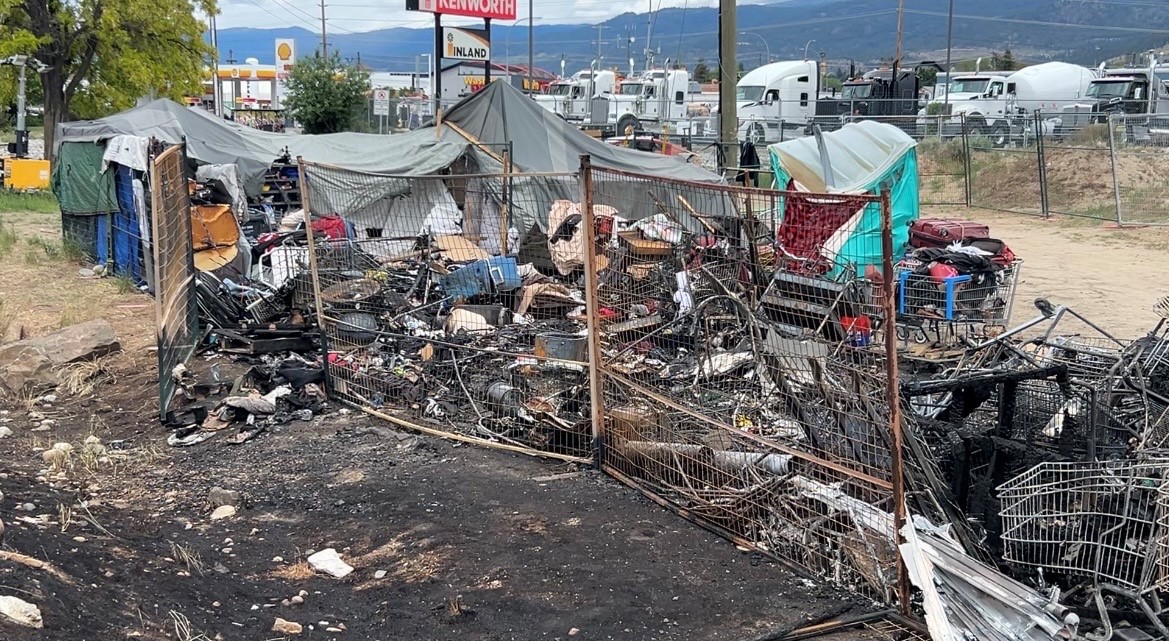
The black smoke didn’t rise slowly. It punched into the Okanagan sky, a thick, greasy column that twisted over the bypass and forced drivers to roll up their windows against the smell of burning plastic and acrid nylon.
For the people commuting through Penticton, it was a sudden, jarring disruption to a Tuesday morning. For the people living in the weeds and gravel along the industrial edge of town, it was just Tuesday. Another tent gone. Another collection of a life’s few remaining fragments reduced to toxic ash in a matter of minutes.
When an encampment fire breaks out, the immediate reaction from the community follows a predictable, well-worn script. The sirens wail. The local Facebook groups light up with a mixture of fury, fear, and frustration. People demand to know why nothing is being done. They talk about property values, safety, and the visible degradation of public spaces.
But if you stand close enough to the charred earth after the fire trucks leave, when the water is soaking into the dirt and turning the soot to ink, you realize we are asking all the wrong questions. We treat these fires as isolated emergencies—flukes of bad luck or individual carelessness.
They aren't.
They are the inevitable, mathematical outcomes of systemic neglect. When you push human beings to the absolute margins of survival, the laws of thermodynamics don't suddenly pause out of compassion.
The Anatomy of a Flame
To understand why a thin strip of land between a highway and a fence line becomes a tinderbox, you have to look at the geometry of survival.
Let us use a hypothetical composite figure to ground this. We will call him David. David isn't a statistic; he is the guy you see pushing a shopping cart past the car wash, the one whose eyes never quite meet yours.
David sleeps in a nylon tent purchased from a department store. The fabric is designed for backyard summer camping, not the biting chill of an Okanagan spring night. When the temperature drops toward freezing, survival instinct takes over. You do whatever it takes to stay warm.
You bring a small propane heater inside a space no larger than a walk-in closet. Or you light a candle. Or you improvise a stove out of a tin can and rubbing alcohol.
Now look at the environment. The tent is surrounded by everything David owns. Extra clothing to layers against the cold. Cardboard boxes used as insulation from the damp earth. Tarps pulled taut to keep out the rain. Every single item is highly flammable.
Space is tight. A single misstep, a moments drowsiness from exhaustion or substance use, or a sudden gust of wind ripping through a tear in the rainfly, and the heater tips over.
Nylon doesn't just burn. It melts. It turns into a liquid fire that drips like boiling wax, catching on the blankets, the dry grass, the propane canisters. Within sixty seconds, the temperature inside that small nylon dome exceeds five hundred degrees. Within two minutes, the entire structure is gone, leaving behind nothing but a skeletal frame of melted fiberglass poles and a patch of scorched earth.
This isn't a hypothetical disaster. It happens dozens of times a year in communities across British Columbia. Penticton is just the latest canvas for a national crisis.
The Cost of the Invisible Wall
The debate that follows these fires almost always centers on public safety. Merchants worry about their storefronts. Parents worry about the parks. Fire crews worry about the volatile nature of propane tanks exploding in uncontrolled environments. These are valid, understandable fears. No one wants to live in a city where walking down a public path feels like navigating a hazard zone.
But there is an invisible wall built around our perception of these events. On one side of the wall is the "public"—the housed, tax-paying citizens who view the fire as a threat to their peace of mind. On the other side are the unhoused, who are often viewed not as victims of a fire, but as the cause of it.
Consider what happens next for someone like David after the smoke clears.
When a house burns down, the community rallies. Neighbors bring food. Insurance adjusters cut checks. Red Cross vouchers provide hotel rooms. There is a collective cocoon of sympathy that wraps around the survivors.
When an encampment tent burns down, there is no insurance. There is no backup storage unit. Every piece of identification, every cherished photograph of a child from a past life, every dry pair of socks, and every life-saving medication vanishes in the blaze.
The survivor is left standing in the ashes, often wearing nothing but the clothes on their back, facing a community that is more angry about the smoke than heartbroken over their loss. They are expected to clean up the mess, move along, and somehow find another place to exist in a town that has made it abundantly clear there is no room for them.
The real danger isn't just the fire itself. It is the profound isolation that follows it.
The Mirage of the Simple Fix
We love simple solutions because they don't require us to change. The most common refrain heard in the wake of an encampment fire is straightforward: Just clear them out.
It sounds logical on the surface. If there are no tents, there are no tent fires.
But human beings do not dissolve into thin air when a bulldozer removes their shelter. They scatter. They move into deeper brush, into more hidden alleys, further away from the eyes of outreach workers and the reach of emergency services.
By dispersing people, you don't eliminate the risk; you simply hide it until it becomes worse. A fire in a prominent, visible encampment is spotted quickly by a passing driver. A fire deep in a wooded ravine or tucked behind an abandoned commercial warehouse burns longer before anyone notices, increasing the likelihood that a tragedy becomes fatal.
The other side of the simple-fix coin is the demand for more shelter beds. "Why don't they just go inside?" is a question asked with genuine confusion by people who have never seen the inside of a low-barrier emergency shelter.
The reality is complicated, messy, and deeply frustrating.
Shelters are often at capacity. Even when a bed is available, the rules required to maintain order can sometimes conflict with the realities of severe trauma or addiction. Some shelters don't allow pets, leaving people to choose between a warm bed and the only companion that has shown them unconditional loyalty in years. Others don't have space for a person's entire life's possessions, meaning entering a shelter requires abandoning everything you own to the scavengers or the city cleanup crews.
For many, the autonomy of a freezing tent, despite the terrifying risk of fire, feels safer than the chaotic vulnerability of a crowded shelter floor. It is a choice born not of stubbornness, but of a calculated survival logic that most housed people cannot begin to comprehend.
The Friction of Two Realities
Penticton is a place defined by its beauty. It is a tourist gem wedged between two spectacular lakes, a place of vineyards, sun-drenched beaches, and a relaxed, enviable lifestyle. That is the identity the city markets to the world, and it is an identity the locals fiercely protect.
But there is a second reality that exists concurrently on the exact same streets. It is the reality of a soaring cost of living, a vacancy rate that hovers near zero, and a mental health and addiction crisis that has outpaced the capacity of every social safety net we have constructed.
When these two realities collide, the friction creates sparks. Literally.
The encampment fire is the physical manifestation of that friction. It is the moment the hidden crisis refuses to stay hidden any longer, forcing its way into the consciousness of people who would rather look at the lake.
We cannot deport this problem. We cannot fine it out of existence. We cannot build fences high enough to keep the human collateral of an economic system from seeking a place to lay their heads.
The response to these fires cannot merely be an increase in bylaws or a more aggressive policy of displacement. If we treat the fire as the problem, we are merely painting over the rust on a bridge that is structurally failing. The fire is the symptom. The problem is that we have allowed a reality to exist where a nylon tent next to a roaring highway is considered a viable residential option for hundreds of our neighbors.
The next time you see that black column of smoke rising against the Okanagan hills, don't just look at the traffic delay. Don't just type out an angry comment on your phone.
Look at the space where the tent used to be. Think of the man standing there in the cold, watching the last remnants of his existence smolder into nothingness, wondering where he will go when the sun sets and the temperature begins to drop again.