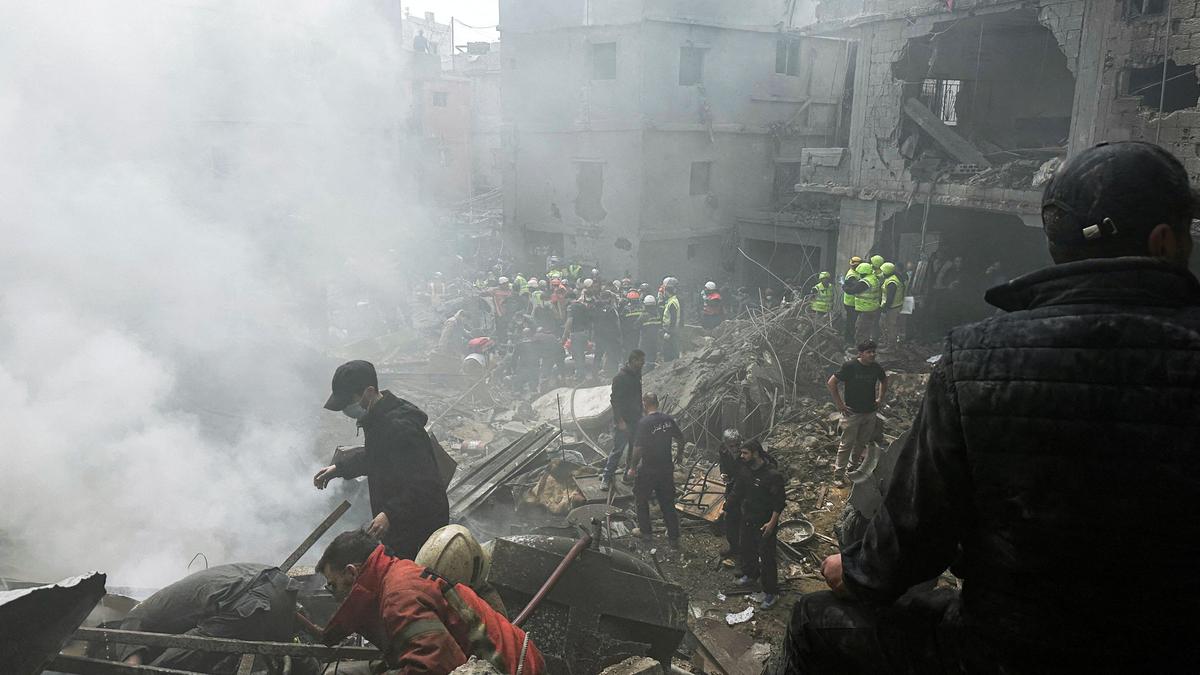
The air in southern Lebanon does not carry the normal weight of a spring evening anymore. It is thick with a specific, sharp tension that presses against your eardrums before any actual sound arrives. People here have developed a second sense for it. You can be pouring tea or tying a child’s shoe, and suddenly the atmosphere shifts. The birds go quiet first. Then comes the low, tearing rip of metal moving faster than sound.
We talk about conflicts in numbers. Eleven dead. Dozens wounded. A set of strikes on a Tuesday or a Thursday. But numbers are a defense mechanism. They are clean. They fit neatly into a push notification on a phone screen and allow the rest of the world to swipe them away. They do not tell you about the smell of pulverized concrete, which gets into the back of your throat and stays there for days, tasting like dry chalk and old iron.
Living through this is not a series of isolated, dramatic events. It is a chronic condition.
Let us ground this in the reality of a single, ordinary room. Imagine a woman named Farah—this is a composite of several people I have spoken with to protect their safety, but her circumstances are entirely real. Farah is sitting in a kitchen in a small village outside Tyre. She is thirty-four. In her mind, she is constantly calculating. If the strike hits the road, the glass will fly inward. If she moves the children to the hallway, they are safer from glass, but the ceiling is heavier there if the structure fails. This is the geometry of survival. It is a math problem no person should ever have to solve while trying to decide what to make for dinner.
The recent renewal of strikes, which claimed at least eleven lives in a single afternoon, did not happen in a vacuum. It is part of a relentless rhythm that has taken hold of the borderlands and reached deeper and deeper into the country.
To understand how we got here, you have to look past the immediate headlines and see the geography of the fear. The border between Israel and Lebanon has always been a fault line, but now it is an active volcano. When the fighter jets come over, they leave long, white scars across the blue Mediterranean sky. On the ground, those scars turn into rubble.
The strategy behind these actions is always framed in the language of precision and military necessity. Command centers. Launch sites. Infrastructure. But precision is a cold word when you are standing in the dust of what used to be a living room. Even when a strike hits its intended target with absolute accuracy, the shockwave does not discriminate. It shatters the windows of the school down the street. It stops the heart of an elderly neighbor who survived three previous wars only to succumb to the sheer terror of the fourth.
Consider what happens after the smoke clears.
The immediate aftermath is oddly quiet. There is a ringing in the ears that blocks out the shouting. Then the dust begins to settle, coating everything in a uniform, ghostly gray. The bright red of a plastic truncheon or the floral pattern of a sofa cushion looks strange sticking out from the gray mass. It takes a moment for the brain to categorize what it is seeing. That pile of stones was the bakery. That twisted metal was the car that belonged to the man who sold watermelons.
This is the hidden cost that never makes it into the international news briefs. It is the destruction of the mundane. When you destroy a market or a residential block, you aren't just taking out physical structures. You are erasing the places where people anchor their lives. You are destroying the backdrop of their memories.
I remember talking to a man who had lost his shop in an earlier round of bombing. He didn't talk about the money or the inventory. He talked about the threshold. He had swept that threshold every morning for twenty-two years. He knew exactly which paving stone was slightly loose and would click when a customer stepped on it. "Now," he told me, "there is no stone. There is no click. There is just air where my life used to be."
There is a profound exhaustion that sets in. It is not the kind of tiredness that a good night's sleep can fix, because sleep is the most dangerous time. Sleep is when you cannot listen for the sky.
The world looks at these events and sees a political chess game. Pieces are moved. Retaliations are measured. Statements are issued from glass towers in New York and reinforced bunkers in Tel Aviv and Beirut. They use words like "measured response" and "deterrence."
But deterrence has a human face. It is the face of a child who refuses to go to school because the sound of the school bus door slamming shut sounds too much like an explosion. It is the face of a farmer who watches his olive trees burn from white phosphorus strikes, knowing it takes a generation for those trees to mature and yield fruit. Olive trees are not just crops in this part of the world; they are family members. They have names. They have lineages. To burn an olive grove is to burn a family tree.
The reality of the situation in Lebanon right now is that the line between civilian and combatant has been rubbed out by the sheer scale of the violence. When strikes hit densely populated areas, the math of "acceptable collateral damage" becomes a moral atrocity.
Let us look at the logic often presented: the strikes are necessary to stop future attacks. It is a circular argument that feeds on itself. Every strike creates a new set of orphans, a new set of grieving parents, a new wave of fury that guarantees the cycle will continue. We are not watching a military operation with a defined beginning and end. We are watching the self-perpetuation of trauma.
It is difficult to convey the sensory overload of a strike zone to someone who has never experienced it. The television cameras always arrive late. They show the smoke rising against the sunset, which can look strangely beautiful on a high-definition screen. They do not show you the smell. They do not show you the way the ground continues to shake slightly for minutes afterward, as if the earth itself is shivering with fear. They do not show you the frantic, bare-handed digging through the concrete, the dust turning to mud on people's faces as they sweat and weep.
The number eleven will be replaced by another number tomorrow, or next week. The news cycle will move on to a political scandal elsewhere or a fluctuating stock market.
But for the families of those eleven people, time stopped at the moment of impact. Their world has contracted to a single point of grief. They are not thinking about regional hegemony or geopolitical leverage. They are wondering who will tell the grandmother that her son is not coming home, or how they are going to find enough intact wood to make a coffin.
We have become experts at consuming tragedy without digesting it. We read the reports, we feel a brief pang of sympathy, and we go back to our coffee. We treat these events as if they are natural disasters—unfortunate, unavoidable acts of God like earthquakes or floods.
But these are not natural disasters. These are choices. Every missile fired is a choice made by a human being. Every target selected is a calculation made on a computer screen by someone sitting in a climate-controlled room. The disconnect between the person making the choice and the person feeling the impact of that choice is the true tragedy of modern warfare.
The sky over Lebanon is beautiful this time of year, or it should be. The light has a golden, honey-like quality as it hits the mountains. But no one is looking up to admire the view anymore. They are looking up to see if the streak of white is a cloud or a promise of destruction.
A small girl in a village near the Litani River was asked by a reporter what she wanted to be when she grew up. She didn't say a doctor or a teacher. She looked at the microphone, then up at the empty sky, and said she wanted to be a bird. Because birds can fly away when the noise starts.