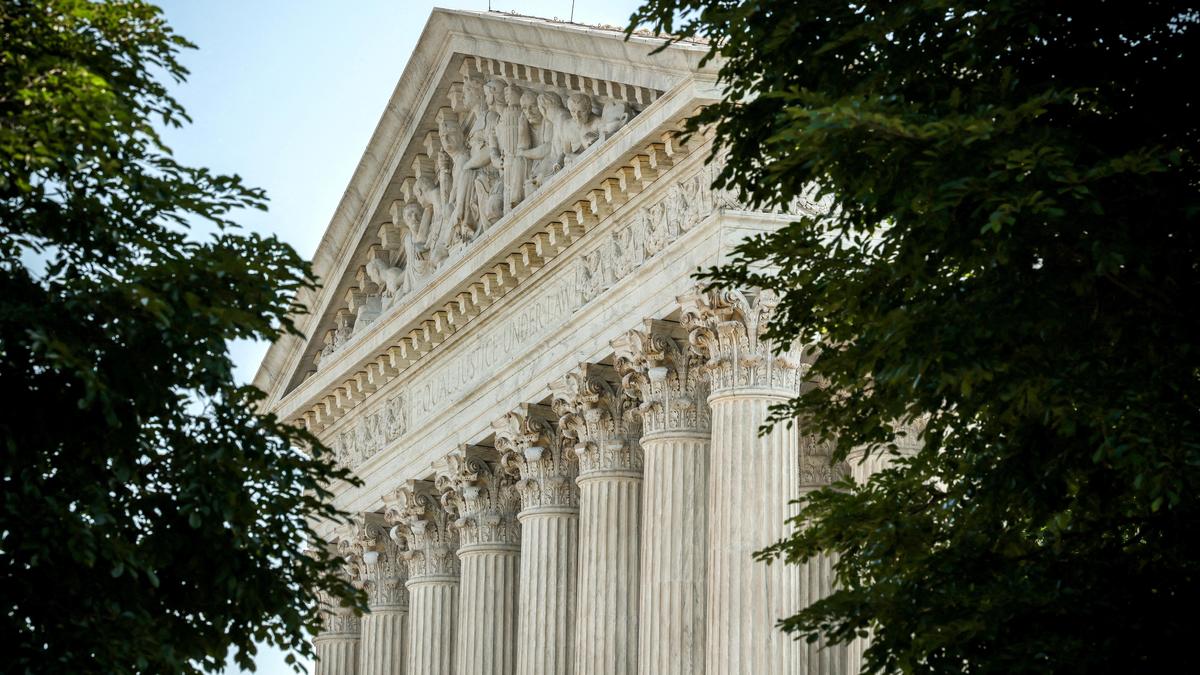
The U.S. Supreme Court has effectively greenlit racial voter dilution in the Deep South, reversing its own recent precedent to hand the Republican Party a crucial lifeline in its battle to retain control of the House of Representatives. In an unsigned 6-3 per curiam decision, the high court’s conservative majority blocked a lower federal court order that had thrown out Alabama's racially discriminatory congressional map. By reinstating a map that slashes the state's Black-majority districts from two back down to one, the Court has not only introduced structural chaos into the imminent midterms but has quietly dismantled the last remaining enforcement mechanisms of the Voting Rights Act of 1965.
To understand how we arrived here, one must look past the dry legalese of the Court’s order and examine the raw math of partisan survival.
Alabama’s population is roughly 27% Black. Under the map used during the 2024 cycle—a map drawn by a federal court after lawmakers initially refused to comply with the law—the state featured two districts where Black voters had a realistic opportunity to elect their preferred candidates. Unsurprisingly, both districts sent Black Democrats to Washington. The reinstated Republican map compresses that representation into a single, packed district, turning the newly minted second district back into safely conservative territory.
The immediate political consequence is stark. Republicans are now heavily favored to flip a crucial congressional seat in November, an asset for a party clinging to a razor-thin majority in the House.
The Shell Game of Legislative Good Faith
The legal path the majority used to justify this flip-flop relies on an engineered loop of judicial deference. The conservative majority chided the three-judge lower court panel—which notably included two appointees of Donald Trump—for failing to show a "presumption of legislative good faith."
This rationale strains credulity when viewed against the timeline of the case. In 2023, the Supreme Court ruled in Allen v. Milligan that Alabama’s original 2021 map violated Section 2 of the Voting Rights Act by systematically "cracking and packing" the historic Black Belt region. The state was ordered to draw a second opportunity district. Rather than comply, the Republican-led legislature openly defied the directive, passing a map that changed almost nothing. It was this defiance that forced the federal court to step in and draw an equitable map for the 2024 elections.
The landscape shifted permanently in April with the Supreme Court’s ruling in Louisiana v. Callais. That decision fundamentally changed the rules of engagement for voting rights litigation by dramatically raising the evidentiary bar required to prove intentional racial discrimination. The Court ruled that if voters of different races simply happen to vote for different political parties, that polarization cannot automatically be used as proof of racial animus by the mapmakers.
Armed with the Callais precedent, Alabama lawmakers did something unprecedented. They resuscitated their previously invalidated 2023 map in the middle of an active election cycle, forcing a special legislative session to delay congressional primaries in four districts to August 11.
When the lower federal court panel looked at the evidence and concluded that the state was merely using partisan labels to mask blatant racial discrimination, the Supreme Court stepped in to slap them down. According to the high court’s majority, the lower court failed to understand that the state's legal disagreement with prior court orders did not equal discriminatory intent.
The Purcell Double Standard
Beyond the rewriting of civil rights law, the decision exposes a glaring double standard in how the Supreme Court regulates the timing of election disputes. For years, the conservative majority has leaned heavily on the Purcell principle, a judicial doctrine stating that federal courts should not alter state election rules close to an election because doing so causes voter confusion and administrative chaos.
In this instance, the majority flipped the doctrine on its head.
The three-judge lower court panel had argued that keeping the 2024 court-approved map in place was the only way to ensure an orderly election, given that candidates had already been campaigning under those boundaries. The Supreme Court rejected this, declaring that while federal courts are barred from making late-stage changes, state legislatures face no such restrictions.
"While federal courts should not impose changes close to an election, States are free to decide for themselves whether last-minute changes to an election are in their best interests," the majority wrote.
The practical reality of this distinction is dizzying. Election officials must now rapidly alter voter registrations across multiple counties to match a map that has never been used in a live election.
Justice Sonia Sotomayor, writing a fierce dissent joined by Justices Elena Kagan and Ketanji Brown Jackson, cut through the majority's procedural defense. She noted that the Court had chosen a path of deliberate disruption, validating a map adopted in unashamed defiance of a prior court order.
The Regional Domino Effect
Alabama is not an isolated laboratory. The Supreme Court's sudden pivot has triggered a coordinated redistricting push across the American South.
By establishing that a legislature can defend a racially skewed map simply by claiming they were hunting for Republicans rather than targeting Black voters, the Court has provided a blueprint for permanent partisan entrenchment. Republican majorities in Louisiana, Georgia, Florida, and Tennessee are already moving to adjust their congressional lines using the same legal cover.
The historical irony is heavy. Section 2 of the Voting Rights Act was explicitly amended by Congress in 1982 to include an "effects test," precisely because lawmakers knew that proving the subjective, internal intent of southern legislators was an impossible standard. By reverting the standard back to a strict requirement of proven intent—and then instructing lower courts to blindly presume that legislatures are acting in good faith—the Supreme Court has effectively neutralized the statute.
This is the new mechanics of American gerrymandering. It no longer requires midnight sessions or smoke-filled rooms. It merely requires state lawmakers to say the magic words of partisan advantage while the highest court in the land looks the other way.