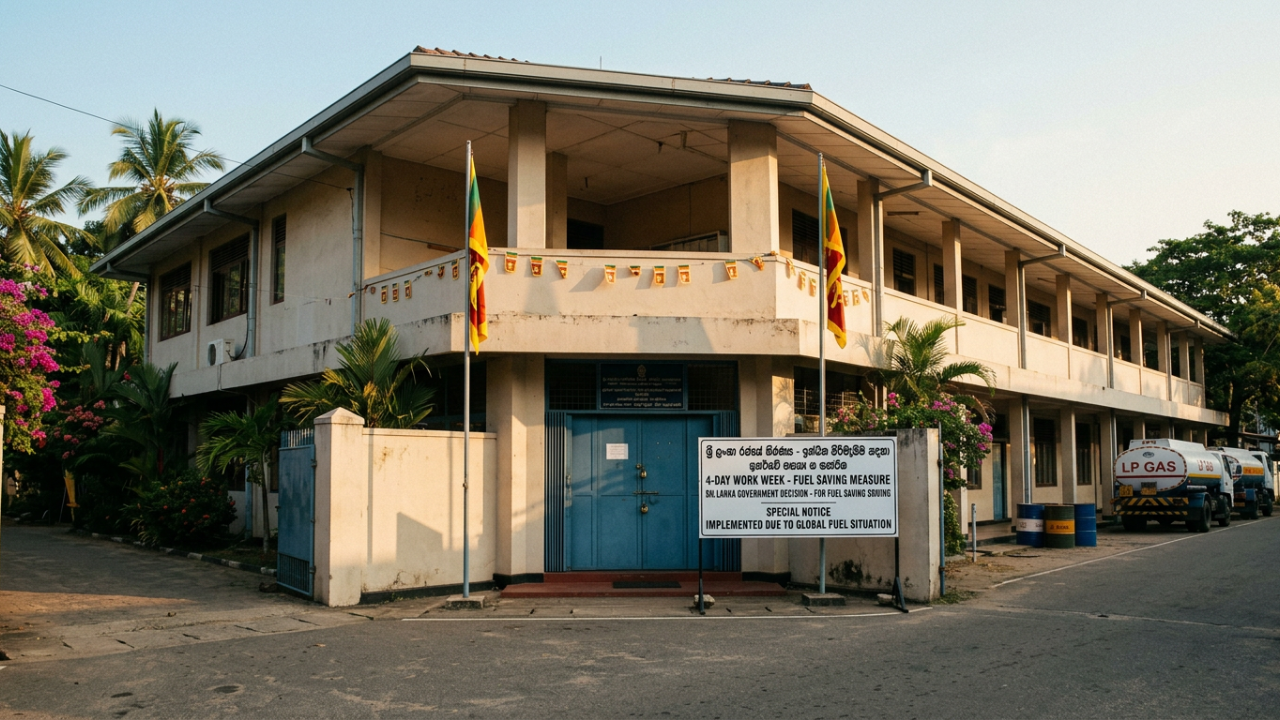
The Sri Lankan government is moving to a four-day work week for public sector employees, a drastic measure designed to slash energy consumption and preserve dwindling foreign exchange reserves. While the immediate trigger is the volatility in global oil markets linked to tensions involving Iran, the reality is more complex. This isn't just a scheduling change. It is a desperate survival tactic for an island nation that remains tethered to a fragile global supply chain. By keeping state workers at home on Fridays, the administration hopes to reduce the massive fuel bill required for commuting and powering government offices.
The Mechanics of an Energy Shutdown
To understand why a one-day reduction in the work week matters, you have to look at the sheer volume of fuel consumed by the public sector. Sri Lanka employs over one million people in various state capacities. When these workers stay home, the demand for petrol and diesel drops instantly. This reduces the frequency of shipments the Ceylon Petroleum Corporation must negotiate on the high seas, where credit terms are currently grueling.
The "why" behind the timing is found in the Strait of Hormuz. Any escalation involving Iran threatens the primary artery for the world's oil. For a country like Sri Lanka, which lacks significant domestic energy production and relies on spot market purchases, even a five percent spike in global crude prices can derail the national budget. The four-day week serves as a physical buffer against a financial shock. If the oil cannot be bought, the demand must be erased by legislative decree.
Beyond the Commute
The savings extend past the gas tank. Large bureaucratic buildings are notorious energy hogs. By shutting down central cooling, lighting, and elevator systems for an extra 24 hours, the state reduces the load on the national grid. This is particularly vital when hydropower reservoirs are low, forcing the country to rely on expensive thermal power plants that burn heavy oil or coal.
Critics argue that this move hampers productivity in a country that needs every hour of labor to climb out of its debt crisis. They aren't entirely wrong. When the Land Registry or the Department of Motor Vehicles closes an extra day, the friction in the economy increases. Private businesses that rely on state approvals find themselves stuck in a bottleneck. However, the government’s counter-argument is cold and mathematical: if the country runs out of fuel entirely, the economy won't just slow down—it will stop.
The Agricultural Pivot
An overlooked component of this policy is the encouragement of home gardening. The government has explicitly asked public servants to use their new day off to grow food. This sounds like an archaic solution to a modern problem, but it addresses a deep-seated fear of food insecurity. Following the disastrous and sudden ban on chemical fertilizers in previous years, Sri Lanka’s domestic food production suffered a blow from which it is still recovering.
By shifting the workforce from desks to dirt, the state is attempting a grassroots stabilization of food prices. If a family grows their own chilies, onions, and greens, they spend less at the market, which in turn lowers the overall inflationary pressure on the rupee. It is an admission that the high-tech, service-oriented economy is currently secondary to the basic need for calories and fuel.
The Private Sector Dilemma
While the state can mandate a shorter week for its own, the private sector remains in a difficult position. Banks, factories, and tech hubs cannot simply flip the switch. For an apparel exporter competing with Vietnam or Bangladesh, a four-day week is a death sentence for their contracts. These companies are forced to find their own solutions, often investing heavily in solar arrays or private bus fleets to transport workers without relying on the crumbling public infrastructure.
This creates a two-tier society. On one side, you have state employees with guaranteed time off and potentially lower costs. On the other, you have the industrial backbone of the country grinding away, absorbing the high costs of energy to keep the export dollars flowing. This tension is a ticking time bomb for labor relations and social stability.
Global Precedents and Local Realities
Sri Lanka is not the first to try this, but the context is unique. When western companies move to a four-day week, it is usually a play for "work-life balance" or employee retention. In Colombo, it is an emergency bypass surgery for a hemorrhaging economy. The "Iran factor" acts as a persistent shadow over these decisions. Because the Middle East remains a primary source of crude, any ripple in Tehran or Tel Aviv is felt in the queues at Sri Lankan filling stations.
The government is betting that the global oil market will stabilize before the productivity loss outweighs the fuel savings. It is a high-stakes gamble. If the conflict in the Middle East widens, no amount of Friday holidays will save the reserve bank from reaching zero.
The True Cost of Inaction
What happens if this fails? The alternative to the four-day week is the return of the "fuel pass" or QR-code-based rationing that defined the crisis of 2022. During that period, the country saw miles-long lines and sporadic violence at pumps. The shortened work week is a proactive attempt to avoid that chaos. It is an effort to manage the decline rather than being managed by it.
Economic analysts point out that the real fix isn't a shorter week, but a massive transition to renewable energy. Sri Lanka has abundant wind and sun, yet the transition has been mired in bureaucracy and lack of capital. Until the island can decouple its fate from the geopolitical whims of oil-producing nations, it will remain a hostage to external shocks.
Infrastructure Under Pressure
The reduction in working days also places an immense burden on the remaining four days. Public transport, already overcrowded and under-maintained, must handle the same volume of commuters in a compressed timeframe. Trains are packed to the point of danger. Buses, often private ventures struggling with their own maintenance costs, are pushed to the limit.
This compression of the work week leads to "burnt-out" Tuesdays and Wednesdays, where the intensity of the backlog creates its own form of inefficiency. It turns out that you can't just squeeze five days of governance into four without something leaking out of the sides.
The Geopolitical Trap
Sri Lanka’s predicament is a warning to other developing nations. When a country’s debt is denominated in a foreign currency, and its essential energy is imported, sovereignty becomes an illusion. The decision-makers in Colombo are reacting to events thousands of miles away because they have no choice. The move to a four-day week is a sign of a nation that has run out of traditional policy levers.
Instead of adjusting interest rates or tweaking tax codes, they are forced to adjust the literal passage of time for their citizens. It is a stark reminder that in the modern world, energy is the only true currency. Without it, the gears of the state simply cease to turn.
Track the daily fluctuations in the Brent Crude index and compare them to the Sri Lankan Rupee's performance; the correlation will tell you more about the country’s future than any government press release.