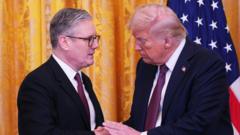
Keir Starmer’s latest posture of defiance against Washington is not a display of British sovereignty. It is a predictable rehearsal of a script that has failed every Prime Minister since Suez. The headlines suggest a "tough" stance against a hypothetical Trump administration’s hawks. The reality is far more clinical. The UK is currently trapped in a strategic vacuum, pretending it can influence a Middle Eastern chess match while its own pieces are glued to the board.
The consensus view—that the UK can act as a "restraining influence" on a second Trump term regarding Iran—is a delusion. It ignores the fundamental shift in how power is projected in 2026. Influence is bought with kinetic capability and economic leverage. Britain, currently hollowed out by decades of defense cuts and stuck in a stagnant growth loop, has neither.
The Sovereignty Myth
The British press loves a "David vs. Goliath" narrative where a Prime Minister stands up to a US President. It’s comforting. It’s also wrong. When Starmer claims he won't yield to pressure, he is fundamentally misreading the room. The United States under a "Maximum Pressure 2.0" framework doesn't need British permission to reshape the Persian Gulf. It barely needs British cooperation.
We saw this play out with the JCPOA (the Iran nuclear deal). European powers spent years trying to preserve the "spirit" of the agreement while the US Treasury Department simply used the dollar’s dominance to crush any company that dared to trade with Tehran. Starmer can say "no" to a war, but he cannot say "no" to the secondary sanctions that will force the UK economy into alignment with Washington’s foreign policy anyway.
If the White House decides to escalate, the UK faces a binary choice: total alignment or total irrelevance. There is no middle ground where Starmer acts as the "wise old head" in the room. I have seen diplomats spend months drafting "non-papers" and "memorandums of understanding" that aren't even read by the transition teams in D.C. If you aren't bringing carriers or massive trade concessions to the table, you are just a spectator with a loud voice.
The Capability Gap
Let’s talk about the math that the "not going to yield" crowd ignores. The Royal Navy is currently struggling with recruitment and maintenance cycles for its flagship carriers. To exert influence in the Middle East, you need a persistent, credible presence.
- The Destroyer Shortage: You cannot protect global shipping or deter a regional power like Iran with press releases. You need Type 45 destroyers on station. When half your fleet is in port for repairs, your "defiance" carries the weight of a wet paper towel.
- The Intelligence Trap: The UK is deeply embedded in the Five Eyes network. If the US decides to move based on intelligence they control, the UK is forced to either follow the data or admit they are flying blind.
- The Economic Tether: London remains a global financial hub only as long as it plays nice with the US financial system. A rogue UK foreign policy that actively undermines US sanctions on Iran would see the City of London's clearing houses paralyzed within forty-eight hours.
Starmer isn't fighting Trump; he’s fighting arithmetic.
Why "De-escalation" is a Failed Strategy
The most dangerous misconception in the current Cabinet is the idea that "stability" is the natural default state of the Middle East. It isn't. Stability is an expensive, artificial product of overwhelming force.
The UK’s obsession with de-escalation often translates to "inaction disguised as virtue." By signaling to Tehran that the UK will block any US-led escalation, Starmer isn't preventing war. He is inadvertently encouraging Iranian proxies to test the limits of Western resolve. When you tell a bully that his strongest opponent’s best friend won't help him fight, you aren't making the playground safer. You are telling the bully exactly where the cracks are.
Think of it like a structural dam. If one side of the dam (the US) is built of concrete and the other side (the UK/EU) is made of sand, the water doesn't care about the concrete. It just flows through the sand. Starmer is the sand.
The False Choice of 1914
Pundits love to compare the current tension to the run-up to the First World War—a series of "sleepwalking" accidents. This is a lazy analogy. We aren't sleepwalking into a conflict; we are watching a deliberate dismantling of the post-Cold War order.
Iran isn't a 19th-century empire looking for a seat at the table. It is a revolutionary state with a specific ideological goal. Starmer’s attempt to treat this as a standard diplomatic dispute that can be settled with "patience" ignores the last twenty years of IRGC (Islamic Revolutionary Guard Corps) expansion.
Imagine a scenario where the UK successfully "yields" nothing to Trump. The US goes it alone. The UK stays out. Does the UK benefit? No. It loses its "special relationship" status, its intelligence sharing is throttled, and it still ends up paying the price for the resulting oil price spike. You don't get the rewards of neutrality if your economy is inextricably linked to one of the combatants.
What People Always Ask
"Can't the UK lead a European coalition instead?"
No. France is focused on its domestic chaos and its waning influence in Africa. Germany is terrified of its own shadow and energy insecurity. A "European" alternative to US foreign policy has been a myth since the 1950s. Without US logistics, satellite coverage, and heavy lift capacity, a European coalition is a paper tiger.
"Doesn't Starmer have to follow international law?"
International law is a reflection of power, not a substitute for it. If the US declares Iran a "clear and present danger," the legal framework will be rewritten or ignored. Starmer citing international law to a Trump administration is like bringing a rulebook to a knife fight. It might make you feel superior, but it won't stop the bleeding.
"What about the risks of a wider war?"
The risks are massive. That’s exactly why half-measures are lethal. If you are going to confront a regional power, you do it with a unified front that makes the cost of retaliation unthinkable. A divided West—with Starmer briefing against the White House—makes a wider war more likely, not less.
The Brutal Reality of Mid-Sized Power
The UK is a mid-sized power with a high-tier ego. We still act as if the world is waiting for a lead from London. It isn't.
I have watched ministers sit in meetings and talk about "leveraging our diplomatic capital." Diplomatic capital is just a polite way of saying "the favors people owe us because we are useful." If the UK becomes an obstacle to US strategic goals in the Middle East, that capital evaporates.
The contrarian move isn't to "stand up" to Trump. The contrarian move is to recognize that the UK’s interests are best served by being the most capable, most indispensable partner the US has—regardless of who is in the Oval Office. This means spending 3% of GDP on defense, fixing the procurement mess, and actually having a navy that can do more than one thing at a time.
Starmer’s "defiance" is a performance for a domestic audience that still wants to believe Britain is a superpower. It’s a dangerous vanity project. If he truly wanted to prevent a war with Iran, he would be building a military so formidable that the US wouldn't dream of acting without him, and Iran wouldn't dream of provoking the pair.
Instead, we have a Prime Minister playing a game of "tough talk" while his cupboards are bare. You cannot project power from a position of managed decline. You cannot dictate terms to an ally when you rely on them for your nuclear deterrent, your satellite data, and your economic stability.
Stop asking if Starmer will yield to Trump. Start asking why the UK has allowed itself to become so weak that "yielding" is the only card it has left to play.
British foreign policy is currently a ghost in the machine. It’s a set of rituals performed by people who remember when they used to matter, directed at a world that has moved on. If the drums of war start beating in 2026, Starmer won't be the one holding the sticks. He’ll just be another person in the crowd, trying to convince himself he’s in charge of the rhythm.
Build the ships. Fix the economy. Or get out of the way.
Anything else is just a press release.