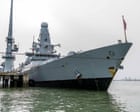
The wind off the North Sea doesn't care about politics. It is a biting, salt-crusted force that rattles the windows of coastal cottages from Hull to Bergen, reminding everyone who lives there that the water is not a border, but a shared basement. On a grey Tuesday morning, if you stand on the deck of a Type 23 frigate, the horizon looks empty. It looks peaceful. But beneath that slate-grey surface, the world has become crowded, noisy, and dangerously fragile.
Modern security is no longer just about the size of a flag on a map. It is about the pulse of data flowing through fiber-optic cables on the seabed and the quiet hum of Russian submarines testing the fences of a continent that thought it had outgrown the need for high-alert sentries.
Britain is moving. It isn't moving alone.
The announcement of a new joint naval force—comprising the United Kingdom and nine European neighbors—is being framed in the sterile language of white papers and diplomatic briefings as a "complement" to NATO. That is the polite way of saying the neighborhood has decided to stop waiting for the police and has started forming a collective watch. The group, known as the Joint Expeditionary Force (JEF), includes Denmark, Estonia, Finland, Iceland, Latvia, Lithuania, the Netherlands, Norway, and Sweden.
Consider a hypothetical officer named Elias. He is a sonar operator in the Royal Norwegian Navy. When he stares at his screen, he isn't looking for a "geopolitical shift." He is looking for a signature. A sound. A mechanical heartbeat that shouldn't be there. If he finds one, he needs to know that a British destroyer or a Dutch corvette is close enough to help him corner it. This pact is about making sure Elias has a friend within earshot.
The Weight of the Deep
For decades, we viewed the sea as a buffer. It was the thing that kept the "other" over there. But the infrastructure of our lives has migrated to the floor of the ocean. Our bank transfers, our private messages, and the electricity that heats our coffee all travel through vulnerable, unshielded lines of glass and copper resting in the silt.
The threat is "hybrid." It’s a messy, shadowy word. It means things that break in the night without an explosion. It means "accidental" anchor drags that sever internet connectivity for entire Baltic nations. It means the steady, rhythmic pressure applied to the edges of European sovereignty.
The creation of this joint force is a physical response to a digital vulnerability. By pooling resources, these ten nations are creating a persistent presence that no single country could maintain on its own. It is a shift from reactive defense to proactive patrolling. It is about being there before the cable is cut, not just investigating the darkness afterward.
A Different Kind of Alliance
NATO is a titan. It is the heavy machinery of the West, bound by the sacred gravity of Article 5. But titans can be slow. They require consensus from dozens of capitals, some of which are thousands of miles away from the freezing waters of the High North.
This new coalition is something different. It is leaner. It is more intimate.
The UK is positioning itself as the "framework nation" for this group. It’s an interesting move for a post-Brexit Britain, proving that while the political union is gone, the geography remains unchanged. You can leave a trade bloc, but you cannot move your island away from the neighbors. The North Sea remains a shared backyard.
The logic is simple: if the house next door is on fire, you don't wait for a regional summit to grab a bucket. You and the other neighbors on the street already have a plan. You know where the hydrants are. You know who has the longest ladder.
The Human Cost of Silence
We often talk about defense in terms of "assets." We count hulls, airframes, and budget percentages. We forget the fatigue.
Imagine the crew of a British P-8 Poseidon maritime patrol aircraft. They fly for hours over a featureless ocean, staring at radar returns, hunting for the wake of a periscope. It is grueling, monotonous work that demands absolute precision. When nations work in silos, that burden is crushing. One nation tries to cover too much water with too few eyes.
By integrating these nine other countries, the UK isn't just adding ships to a list. It is sharing the watch. It is allowing a Swedish sub-hunter to hand off a contact to an Estonian patrol boat. It is the military equivalent of a relay race where the baton is never dropped because there are more runners on the track.
This isn't about aggression. It's about the restoration of a baseline of safety.
There is a specific kind of anxiety that comes with uncertainty. For the people living in the Baltic states, that anxiety isn't theoretical. It’s the sight of a shadow in the bay. It’s the sudden loss of GPS signals. This naval force is intended to be a sedative for that local fever. It is a visible, tangible reminder that the horizon is being watched by ten sets of eyes instead of one.
The Invisible Stakes
Why does this matter to someone sitting in a flat in London or a cafe in Amsterdam?
Because the global economy is a maritime economy. Over 90 percent of global trade moves by sea. If the North Atlantic or the Baltic becomes a "grey zone" where laws are optional and interference is constant, the price of everything—from the gas in your car to the grain in your bread—starts to fluctuate based on the whims of a provocateur.
We are moving into an era where "peace" is no longer a binary state. It isn't just the absence of war. It is the active maintenance of stability.
The technology involved is staggering. We are talking about autonomous underwater vehicles (AUVs) that can stay submerged for weeks, acting as silent sentries. We are talking about satellite integration that can spot a suspicious vessel from hundreds of miles above the earth. But all that tech is useless without the political will to act on what it sees.
This pact is that will, written in ink and steel.
The Neighbor's Duty
There was a time when the British Navy was the undisputed master of these waters. Those days are in the history books. Today, the Royal Navy is a high-tech, specialized force, but it is smaller than it used to be. It needs the local expertise of the Norwegians, who understand the fjords like the back of their hands. It needs the ice-breaking capabilities of the Northern partners.
It is a humble admission of reality.
The world is too complex for a single hegemon. The threats are too nimble for a single bureaucracy. This joint force represents a return to a more ancient form of security: the tribal pact. A group of people with shared values and shared geography deciding that their survival is inextricably linked.
As these ships begin their coordinated maneuvers, moving in patterns that have been practiced until they are instinctual, they send a signal that doesn't need a translator. It is a signal aimed at anyone who thinks the North is an easy target.
The water is cold. The task is immense. But the watch has been set.
A sailor on a Latvian patrol boat looks out at the whitecaps, seeing the silhouette of a British carrier on the horizon. He knows he isn't the only one out there. He feels the engines thrumming beneath his boots, a vibration that matches the ships to his left and right. In the dark of the Northern winter, that shared rhythm is the only thing that keeps the shadows at bay.


.jpg?width=1200&auto=webp&trim=0%2C0%2C0%2C0)