On a humid June evening in 1926, an old man walked the streets of Barcelona. His clothes were held together by safety pins. His pockets were empty. When a tram struck him down on the Gran Via, onlookers assumed he was a beggar. Taxicabs refused to pick him up. He was eventually taken to a pauper’s hospital, where it took the chaplain to recognize the truth.
This was Antoni Gaudí.
He was not a beggar. He was the architect of God.
A century later, the dust from that tram accident has long settled, but the dust inside his masterpiece, the Sagrada Família, still dances in the sunlight. In June 2026, Pope Francis marked the centenary of Gaudí’s death by honoring Barcelona’s sacred monuments. The Vatican issued messages celebrating the architect's ability to turn cold stone into a living prayer.
Yet, to understand why a Pope is talking about a century-dead architect today, we have to look past the official press releases. We have to look at the dust.
The Man Who Sold the Future
Imagine standing on a scaffold 200 feet in the air, the Mediterranean breeze whipping at your coat, knowing with absolute certainty that you will never see the building finished. That was Gaudí’s daily reality. He knew he was designing a project that would outlive his children, his grandchildren, and his country’s political regimes.
He didn't care.
"My client is not in a hurry," Gaudí famously remarked. He was referring to God.
This philosophy required a radical kind of humility. Modern society is obsessed with the immediate. We want the app to download in seconds. We want the tower built in months. We demand to see the fruits of our labor before the next fiscal quarter. Gaudí operated on geological time. He understood that true beauty requires a sacrifice of the ego.
When you walk into the Sagrada Família today, the experience is overwhelming. It does not feel like a building. It feels like a forest.
The columns do not rise vertically like standard Greek pillars. They slant. They branch out at the top like massive stone oaks. This was not a stylistic gimmick. Gaudí was a sick child who spent his formative years in the countryside of Reus, watching how nature solved engineering problems. He realized that trees do not break under the weight of their branches because they distribute load through organic geometry.
By mimicking the curves of the natural world, he created a structure that could support immense weight without the need for traditional, ugly flying buttresses. He built a forest out of faith.
The Global Pilgrimage
The Vatican’s recent commemoration highlights a strange paradox. Gaudí’s monuments were built for a deeply Catholic Spain, yet today they draw millions of people who have never set foot in a church for prayer.
Consider a hypothetical traveler named Kenji. He is a software engineer from Tokyo. He does not practice any religion. He has spent twelve hours on a flight, shuffled through customs, and navigated the crowded streets of the Eixample district. He stands beneath the Nativity Facade, squinting up at stone that looks like it was poured out of liquid wax and left to freeze.
Kenji does not see a catechism. He sees an impossible human effort.
The stones speak a universal language of labor. Every square inch of the facade bears the marks of a chisel. It represents millions of hours of human sweat. In an era where artificial intelligence can generate a perfect blueprint in three seconds, Gaudí’s architecture reminds us of the value of friction. The value of things that are hard to make.
This is the emotional core that the Pope’s declaration taps into. The sacred monuments of Barcelona are not just tourist destinations; they are monuments to human endurance. They are proof that humanity can still dedicate its best energy to something larger than self-interest.
The Anatomy of the Stone
The engineering behind Gaudí's work is often misunderstood. People look at the melted-wax appearance of the Nativity Facade and assume he was a wild surrealist working from pure emotion.
The truth is far colder, and far more brilliant.
Gaudí was a master mathematician. In his workshop, which was tragically destroyed during the Spanish Civil War, he didn't draw traditional plans. He built upside-down models using strings and small bags of birdshot.
- The strings represented the architectural lines of the building.
- The bags of shot represented the weight of the stone.
- Gravity did the calculating.
By letting the strings hang naturally, he found the perfect catenary arches—the most stable shapes possible in physics. He would then place a mirror beneath the hanging model, look into the reflection, and see the building right side up. He let nature design the skeleton, and then he wrapped it in stone.
But the real problem lies elsewhere. It is not in the mathematics, but in the continuation.
When Gaudí died in 1926, only a fraction of the church was complete. He left behind fragmented models, sketches, and a legacy of confusion. For decades, architects argued over whether the building should even be finished. Some claimed that continuing without the master was a betrayal. Others argued that leaving it a shell was an insult to his memory.
The decision to forge ahead required a different kind of courage. It meant that subsequent generations of architects had to submerge their own artistic egos to finish another man's vision. They had to become anonymous stonecutters in Gaudí’s army.
The Light in the Nave
If you visit Barcelona in the late afternoon, the city undergoes a transformation. The sun dips toward the hills of Montjuïc, and the light hits the western windows of the Sagrada Família.
Gaudí designed the stained glass with a strict emotional narrative. The eastern windows, where the sun rises, are filled with cool blues and greens. They represent birth, youth, and renewal. But as the day wanes, the western windows catch fire. They are packed with deep reds, oranges, and yellows.
The interior of the church transforms into a furnace of light.
It is here that the secular traveler and the religious pilgrim meet. You can see it in their faces. People stop talking. They look up. Their mouths open slightly. It is the universal posture of awe.
This is what the centenary honors. It is not just the survival of a set of buildings, but the survival of the capacity for wonder. In a world that is increasingly cynical, loud, and fractured, these monuments offer a space of enforced stillness. You cannot look at the vaulting ceilings of the Sagrada Família while looking down at your phone. The architecture forces your head upward.
The Unfinished Symphony
The Pope’s tribute reminds us that the story of these monuments is still being written. The construction has faced financial crises, world wars, civil conflict, and a global pandemic. Yet, the work persists.
There is a lesson in the stone for anyone trying to build something lasting. Whether you are writing a book, raising a child, or launching a movement, the timeline matters less than the trajectory. Gaudí understood that his life was just a single brick in a much larger wall.
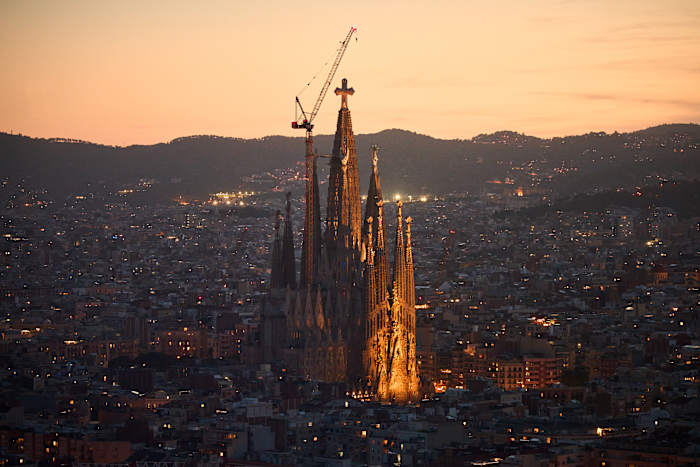
The old man who died in the pauper's hospital did not live to see his towers dominate the Barcelona skyline. He never saw the light stream through the completed transept. He died with his boots on, his fingers stained with plaster, his eyes fixed on a horizon that lay far beyond his own lifespan.
The tram on the Gran Via ended the man, but it couldn't stop the stone. The chisels are still ringing. The columns are still climbing. The dust is still rising, catching the light of a sun that Gaudí never got to see.