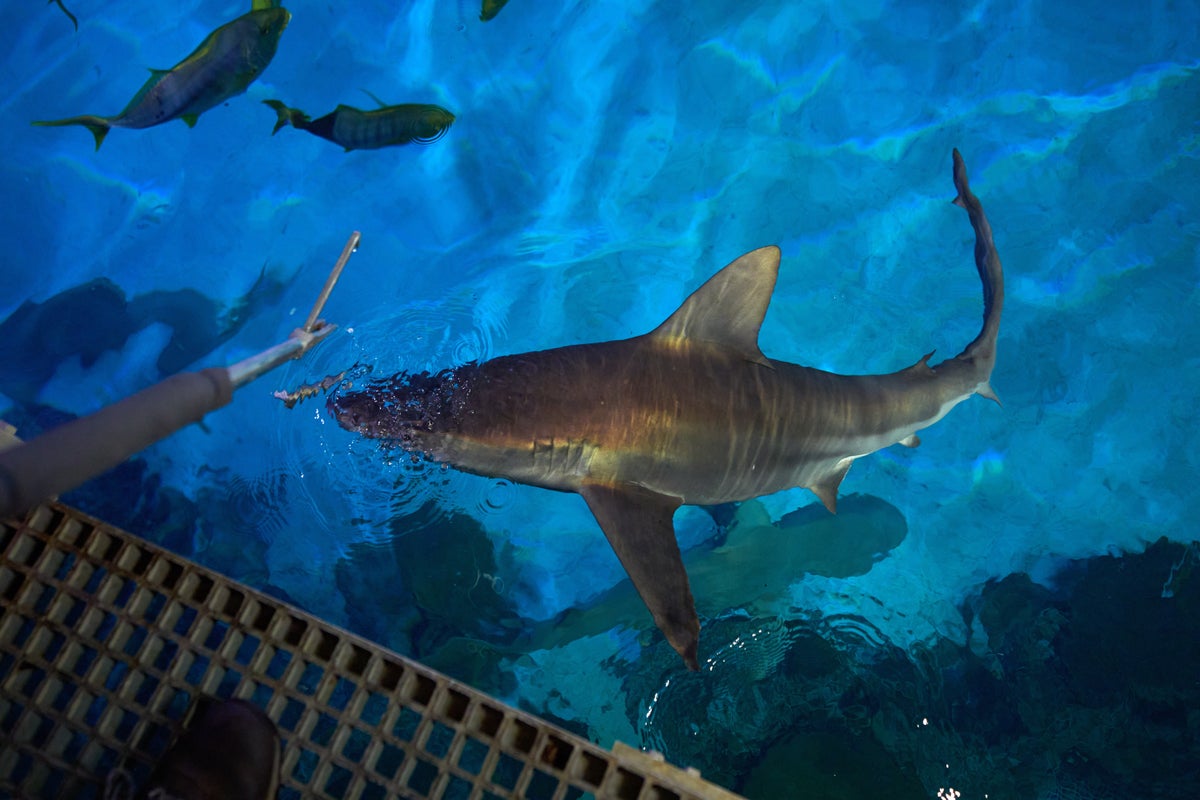
The lazy travel writer’s favorite trope is the "ocean in the desert" paradox. They walk into Mandalay Bay, stare through the acrylic at a sand tiger shark, and wax poetic about the sheer impossibility of it all. They tell you about the 1.3 million gallons of water. They gasp at the logistics of shipping hundreds of pounds of premium-grade restaurant fish to feed these "beasts" every week.
It is a charming narrative. It is also entirely wrong. Meanwhile, you can read other developments here: The White Silence and the Price of Coming Home.
The Shark Reef at Mandalay Bay isn't a miracle of logistics or a triumph of man over nature. It is a calculated, cold-blooded exercise in psychological anchoring and high-margin asset management. If you are looking at the sharks and thinking about the ocean, you’ve already lost the game. You should be looking at the sharks and thinking about the cost per square foot of floor space and the decay of the "spectacle economy."
The Myth of the Resource Sink
The common misconception is that keeping sharks in the Mojave is a massive, drain-on-the-wallet vanity project. To understand the bigger picture, we recommend the excellent report by The Points Guy.
"They eat so much fish!" the tourists cry.
In reality, the metabolic requirements of a captive shark are remarkably low compared to the revenue they generate. A sand tiger shark in a temperature-controlled environment isn’t hunting. It isn’t fighting currents. It’s a sedentary asset. They are fed on a strict schedule—usually only two or three times a week—to prevent them from getting too large or too aggressive for their roommates.
When you see a headline screaming about the "hundreds of pounds of fish" required to sustain this habitat, understand that this is marketing, not a budget crisis. In terms of operating expenses, the food bill for the Shark Reef is a rounding error compared to the electricity required to run the air conditioning in the casino floor’s high-limit lounge.
The real cost isn't the fish; it’s the filtration.
The Engineering of Illusion
Let’s talk about $LSS$—Life Support Systems. To keep a saltwater apex predator alive in a landlocked city, you are essentially running a closed-loop chemical plant.
The water isn't "shipped in." It’s tap water, stripped of its desert minerals and reconstructed with synthetic sea salts. The complexity lies in the nitrogen cycle. In a natural ocean, the volume of water handles the waste. In a tank, you are fighting a constant battle against ammonia $(\text{NH}_3)$ and nitrite $(\text{NO}_2^-)$ levels.
The "hundreds of pounds of fish" the sharks eat? That’s just fuel for the nitrogen problem. Every ounce of protein that goes in comes out as waste that must be mechanically and biologically filtered. The aquarium isn't a zoo; it’s a waste management facility with a high-end gift shop.
Why Las Vegas Needs the Predator
You aren't paying twenty-something dollars to see a shark. You are paying for the sensation of being somewhere that shouldn't exist.
Las Vegas is built on the defiance of geography. The sharks serve the same purpose as the fountains at Bellagio or the Eiffel Tower at Paris: they are "loss leaders for the soul." They ground the fantasy. If a resort can keep a lemon shark alive in a desert that hits 115°F, it convinces the gambler that the house can also defy the laws of probability.
It is a psychological trick called The Contrast Effect.
By placing something so inherently "wet" and "alive" in the middle of a city defined by neon and concrete, the resort creates a sensory reset button. It clears the palate of the gambler, making them more likely to stay on the property longer. Every minute you spend staring at a sawfish is a minute you aren't leaving the Mandalay Bay campus to spend money at a competitor’s table.
The Brutal Reality of Captivity Economics
Critics often attack these exhibits from an animal rights perspective. They miss the business point entirely.
From an insider’s view, the "miracle" isn't that the sharks are there; it’s that they are still profitable in an era where digital spectacle is cheaper. It costs nothing to project a 4K shark on a LED wall. It costs a fortune to maintain the pH balance of 1.3 million gallons of salt water.
The Shark Reef persists because it is one of the few remaining "physical truths" in a city that is becoming increasingly virtual. You can't simulate the smell of ozone and salt. You can't fake the low-frequency vibration of a massive pump system through the floorboards.
But don't mistake this for a commitment to nature. This is a commitment to Durable Spectacle.
Most Vegas attractions have a shelf life of five years before they look dated. A shark, however, is timeless. Evolution perfected the design roughly 400 million years ago. A shark doesn't need a firmware update. It doesn't need a new costume or a choreographed dance routine. It just needs to swim in a circle and look terrifying.
The "People Also Ask" Fallacy
If you look at search trends, people ask: "Are the sharks at Mandalay Bay real?" or "How often do they feed the sharks?"
These are the wrong questions. The premise assumes the shark is the protagonist. It isn’t. The shark is the wallpaper.
The right question is: "What is the conversion rate of an aquarium visitor to a hotel guest?"
The aquarium is a funnel. It draws in families—a demographic Vegas traditionally struggled to monetize—and keeps them on the southern end of the Strip. It provides a "wholesome" justification for a trip that is fundamentally about excess.
If you want to understand the shark reef, stop looking at the fish. Look at the exit. It leads directly into the gift shop, which leads directly to the convention center hallways, which leads back to the casino floor.
The Bio-Security Bluff
We are told the sharks are fed restaurant-quality fish to keep them from eating their tank mates.
That is partially true. But the real reason for the high-quality diet is Bio-Security.
In my time analyzing high-traffic hospitality assets, I’ve seen how one bad batch of frozen mackerel can take down a million-dollar exhibit. If a shark gets a parasite or a bacterial infection in a closed system, the "hospital tank" costs alone are staggering. You don't feed them "premium fish" because you want them to be happy; you feed them premium fish because the insurance premium on a dead shark is a nightmare you don't want to navigate.
The Hidden Apex Predator
The true apex predator in that building isn't the sand tiger or the komodo dragon.
It’s the Sunk Cost.
Once you build a 1.3-million-gallon tank into the architecture of a multi-billion dollar resort, you are married to it. You cannot simply turn it off. You cannot "pivot" to a different theme. You are locked into a perpetual cycle of water chemistry and life support maintenance.
The sharks are prisoners of the tank, but the resort is a prisoner of the sharks. They have to keep the "hundreds of pounds of fish" coming because the alternative is a giant, stinking hole in the ground that would cost more to remove than to maintain.
Stop Being a Tourist
Next time you stand in that glass tunnel, ignore the sharks.
Look at the seams in the acrylic. Look at the salt crust on the vent covers. Think about the massive heat exchangers hidden behind the "shipwreck" walls that are desperately fighting the Nevada sun to keep that water at exactly 76°F.
The Shark Reef isn't a window into the ocean. It’s a monument to the staggering amount of money humans will spend to prove that they can own the impossible.
The sharks aren't feasting on fish. They are feasting on the fact that you still believe in the magic of the desert.
Stop looking for "nature" in a basement. The only thing being hunted in that building is your wallet. And the sharks are doing a hell of a job.
Go buy a ticket. Just don't pretend you're doing it for the "wonder." Admit you're doing it to watch a billionaire's plumbing system work in real-time. That’s the only honest way to see the show.