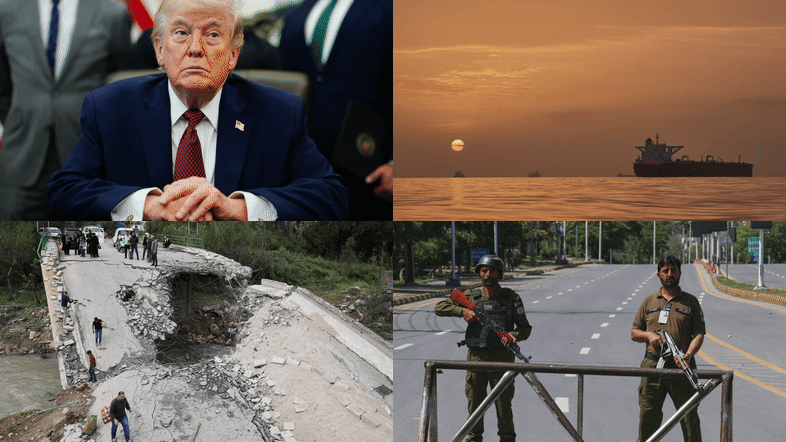
The Strait of Hormuz isn't just a stretch of water. It’s the jugular vein of the global energy economy. Right now, that vein is clamped shut. Since late February 2026, when the US and Israel launched their air campaign against Iran, the world’s maritime energy corridor has become a war zone. If you’ve noticed your fuel costs climbing, you’re seeing the direct, real-world consequence of a conflict that has paralyzed nearly 20% of the world’s liquefied natural gas and 25% of its seaborne oil trade.
It’s not just a regional skirmish. It’s a systemic shock. Expanding on this topic, you can find more in: The Harsh Reality of the Louisiana Shooting and Why Our Security Conversations Are Failing.
The Anatomy of the Blockade
For months, the situation in the Persian Gulf has fluctuated between tense standoff and active naval warfare. The Strait of Hormuz, typically bustling with tankers, is now largely deserted. The US-led naval blockade of Iranian ports is a direct response to Iran’s retaliatory mining operations and drone attacks against merchant vessels.
President Trump has maintained that the blockade is a necessity until American transactions with Tehran are complete. Meanwhile, Iranian leadership has made the math simple: the waterway stays closed as long as their ports remain blocked. It's a binary deadlock. Neither side is blinking. Analysts at Associated Press have also weighed in on this matter.
The cost of this impasse is staggering. Shipping firms have suspended operations entirely. We’re talking about over 150 ships anchored outside the strait just to avoid being targeted or mined. Insurance premiums for any vessel brave enough to even consider the route have skyrocketed to levels that make commercial transit economically impossible.
When you hear about a tugboat sinking or a merchant ship being abandoned, you aren't just hearing about a maritime incident. You're hearing about the disruption of a supply chain that keeps factories running in Asia and power grids stable in Europe.
The Failed Diplomacy in Pakistan
The recent attempt to restart negotiations in Pakistan was meant to be the off-ramp. It didn't work. Reports from the region indicate that the delegations couldn't find common ground on the basic terms of a ceasefire. Iran remains firm in its rejection of US-led peace talks while the blockade persists, and the US shows no sign of lifting that pressure until its strategic objectives—namely the degradation of Iranian enrichment capabilities—are fully realized.
Why did the Pakistan talks stall? It’s because both sides are locked into zero-sum positions. The US isn't looking for a compromise that leaves the status quo intact. They are demanding a fundamental shift in Iran’s regional posture. Tehran, for its part, sees the blockade as an existential threat to its sovereignty and its primary mechanism for economic leverage.
The result is a diplomatic vacuum. Global finance leaders, gathered recently at IMF and World Bank meetings, have essentially admitted they have no tools to fix this. They are watching the same news feeds we are, and they’ve realized that the era of counting on a quick, negotiated solution from Washington or Tehran is over.
The Cost to Your Wallet
Let’s be clear about what this means for you. Crude prices are oscillating wildly. In just the last few days, we’ve seen Brent crude climb north of $96 a barrel, and U.S. crude prices have surged over 6% in a single trading session. When crude prices jump like this, they don't just stay in the oil markets. They migrate.
They move to your local gas station. They move to your grocery bill. They move to the cost of shipping goods across the ocean. Energy Secretary Chris Wright has been tempering expectations, suggesting that while prices might eventually peak, a return to sub-$3 gasoline is unlikely anytime soon.
This is the new reality. We’ve moved past the phase where this was a temporary disruption. We are in the phase where the disruption is the environment.
The Seizure Factor
President Trump’s recent confirmation that the US seized an Iranian cargo ship for attempting to bypass the blockade adds another layer of volatile complexity. This isn't just about navies staring each other down; it’s about active interdiction. Every time a ship is seized, the threat of escalation increases.
If Iran decides to retaliate by targeting more commercial vessels or increasing the density of its minefields, we could see a complete cessation of trade in the region. This is the nightmare scenario for global logistics. We’ve already seen traffic drop to near zero, but there is still a trickle of movement. A significant escalation would turn that trickle into a complete dry-up.
How to Prepare for What Happens Next
You can’t control the geopolitical chessboard. You can’t stop the blockades, and you certainly can’t force a ceasefire in Islamabad. But you can manage your exposure to the fallout.
- Expect sustained energy volatility. If you run a business that relies on fuel or transport, bake higher energy costs into your long-term planning. Do not rely on "market corrections" or the hope that the strait will open tomorrow. Plan for the blockade to continue through the summer.
- Diversify your supply chain risks. If your business depends on goods coming through the Persian Gulf, you need to find alternative routes or alternative suppliers now. The "just-in-time" model is dead in the water.
- Watch the shipping insurance markets. The moment premiums start to stabilize or drop, it’s a sign that the shipping industry is starting to see a path back to normal. Until then, treat every news cycle about the Strait of Hormuz as a potential trigger for another price spike.
- Prepare for secondary inflation. When oil goes up, everything that requires transport—which is basically everything—goes up. Adjust your personal budget for a sustained period of higher utility and transport costs.
The situation in the Strait of Hormuz is dangerous, fluid, and far from over. Treat the current stability as temporary. The risks are real, and they aren't going away by next week. Keep your eyes on the shipping data and ignore the optimistic noise. The market reacts to oil tankers moving—or not moving—not to press releases.