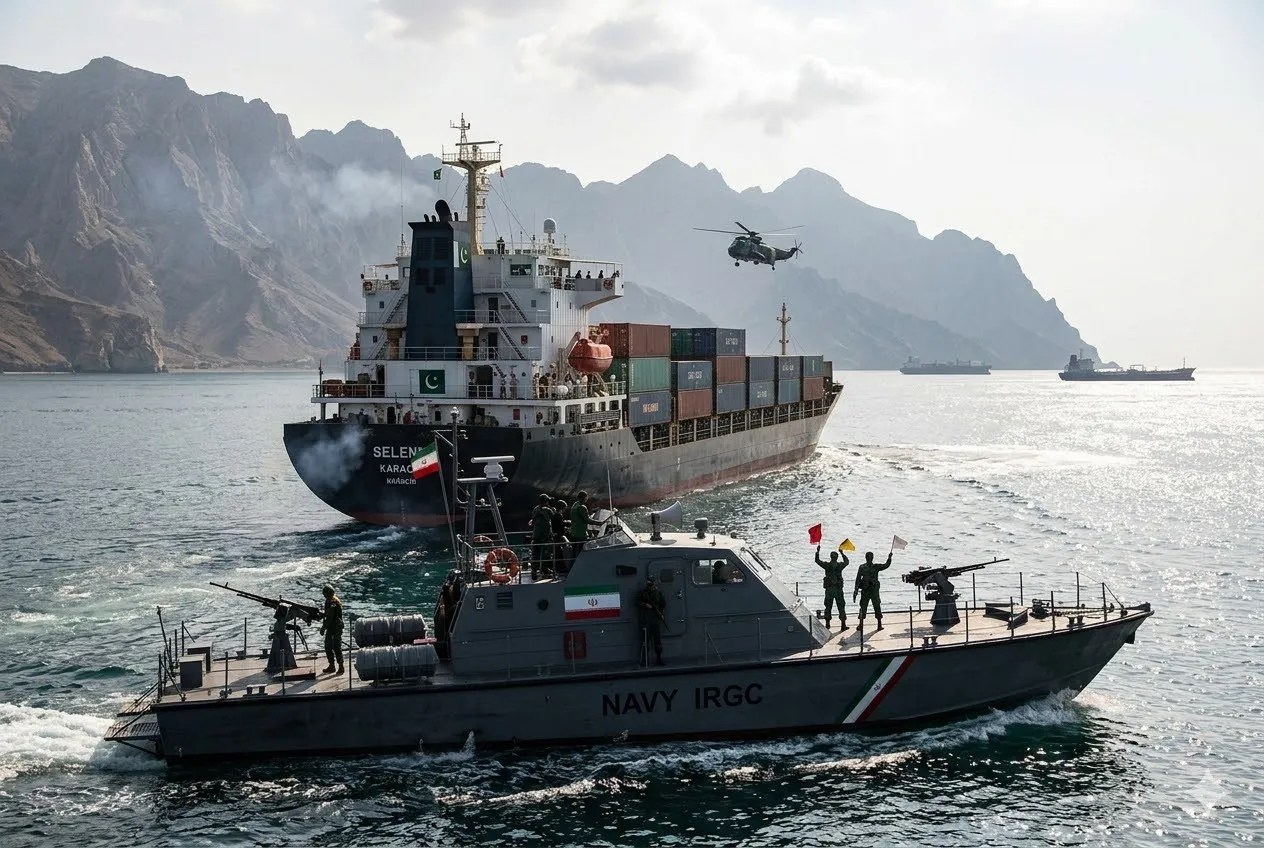
The Strait of Hormuz is not a highway. It is a choke point where geography meets raw geopolitics. When Iranian authorities recently intercepted a Pakistani-flagged vessel and denied it passage, the world saw a maritime hiccup. In reality, it was a calculated demonstration of regional dominance. This incident moves beyond a simple permit dispute. It signals a shift in how Tehran intends to manage its backyard, especially as Pakistan attempts to balance its fragile economy against its complicated relationship with both Iran and the West.
The vessel was halted under the premise of unauthorized entry or lack of proper documentation. While maritime regulations are often used as a convenient shield, the timing of this intervention suggests a deeper friction. Iran controls the northern flank of the Strait. Through this 21-mile-wide stretch of water, roughly one-fifth of the world’s liquid petroleum passes daily. By stopping a ship from a "brotherly" Islamic nation like Pakistan, Tehran is reminding every regional player that historical ties do not grant a free pass through these contested waters.
The Myth of Open Waters
International law suggests the right of "transit passage" through straits used for international navigation. Iran has a different interpretation. Because Tehran has not ratified the 1982 United Nations Convention on the Law of the Sea (UNCLOS), it views the Strait as part of its territorial waters. This legal gray area allows the Islamic Revolutionary Guard Corps (IRGC) to treat the channel as a private driveway.
When a ship is stopped, the official reason is usually technical. They cite environmental risks, safety violations, or "lack of permission." But look at the map. Look at the ledger. Pakistan is currently navigating a crushing debt crisis and has been cozying up to Gulf monarchies and Western lenders for relief. Iran, under the weight of decades of sanctions, views any regional alignment with its adversaries as a direct threat. Stopping a Pakistani ship is a low-cost, high-visibility way to signal that Tehran can disrupt the trade routes Pakistan desperately needs for its economic survival.
Shadow Boxing in the Gulf
This isn’t just about one ship. It is about the precedent of the "Permit Power." By demanding specific Iranian authorization for a Pakistani vessel, Tehran is setting a new standard for what it considers "safe" transit. For years, the IRGC has used "maritime policing" as a tool of asymmetric warfare. If you want to pass, you play by their rules.
The economic impact of these delays is immediate. Shipping insurance premiums spike the moment a vessel is detained. For a country like Pakistan, which is already struggling with inflation and a devaluing currency, even a 48-hour delay in cargo delivery has a ripple effect through its supply chain. The message sent to Islamabad was clear: Your security and your trade are contingent on our goodwill.
The Energy Equation
Pakistan relies heavily on energy imports. While there has been long-standing talk of an Iran-Pakistan (IP) gas pipeline, the project has been stalled for years due to the threat of U.S. sanctions. Iran has grown weary of Pakistan’s hesitation. Every time Islamabad pauses a joint project to appease Washington, a "technical issue" seems to arise in the Strait of Hormuz.
This isn't a coincidence. It is leverage. By flexing its muscles at sea, Iran exerts pressure on land. They are forcing Pakistan to choose between the practical necessity of Iranian energy and the political necessity of Western financial support.
The Failure of Regional De-escalation
For decades, diplomats have tried to turn the Strait of Hormuz into a zone of cooperation. Those efforts have largely failed because the Strait is the only real bargaining chip Iran has left on the global stage. If they cannot sell their oil freely, they can ensure that others find it difficult to move theirs.
The Pakistani vessel caught in this net is a pawn in a much larger game of maritime chess. Recent joint naval exercises between Iran and other regional powers were supposed to signal a new era of security. Instead, this incident highlights the fragility of those alliances. Security in the Gulf is not collective; it is dictated by who holds the keys to the gate.
Beyond the Paperwork
The official Iranian narrative focused on the ship's failure to provide proper notification. In the shipping industry, notification is a routine task. Experienced crews on international routes do not simply "forget" to signal their entry into one of the most monitored waterways on earth. This suggests that the "lack of permission" was likely a manufactured crisis or a deliberate trap designed to justify a boarding or a halt.
Logistics experts know that "technical delays" are the oldest trick in the book. When a state actor wants to send a diplomatic message without firing a shot, they use a clipboard and a patrol boat. It creates enough plausible deniability to avoid a full-blown international crisis while still making the target nation feel the heat.
The Cost of Compliance
What happens next will determine the stability of trade in the Arabian Sea. If Pakistan ignores the incident, it accepts a diminished status in the region. If it protests too loudly, it risks a complete shutdown of its trade through the Strait. There is no middle ground when dealing with a neighbor that views geography as a weapon.
Shipping companies are already recalculating their routes. Some are considering longer, more expensive paths to avoid the northern reach of the Strait where the IRGC is most active. But for many Pakistani businesses, there is no alternative. They are locked into a geography that favors the Iranian coast.
Institutional Paralysis
The international community's response to these interceptions has been consistently weak. A few statements of "concern" from maritime bureaus do nothing to change the reality on the water. The IRGC operates with the knowledge that as long as they don't sink a ship or kill a crew, the world will treat these incidents as minor administrative hurdles. This emboldens them to push the boundaries further each time.
Power is the Only Currency
In the Strait of Hormuz, sovereignty is defined by the ability to stop a hull in the water. Iran has shown that it can and will stop a Pakistani vessel whenever it needs to recalibrate its influence. This isn't about a missing document or a late radio call. It is about who owns the horizon.
For Pakistan, the lesson is brutal. You cannot trade your way out of a geopolitical trap. As long as Islamabad remains caught between its obligations to the West and its proximity to Tehran, its ships will continue to be targets of convenience. The "permission" Iran seeks is not a piece of paper; it is total regional deference.
The next time a Pakistani ship approaches those narrow waters, the captain won't just be checking his charts. He will be checking the political winds from Tehran. That is exactly what the Iranian authorities intended when they ordered that ship to stop.
Stop looking at the manifest and start looking at the map.