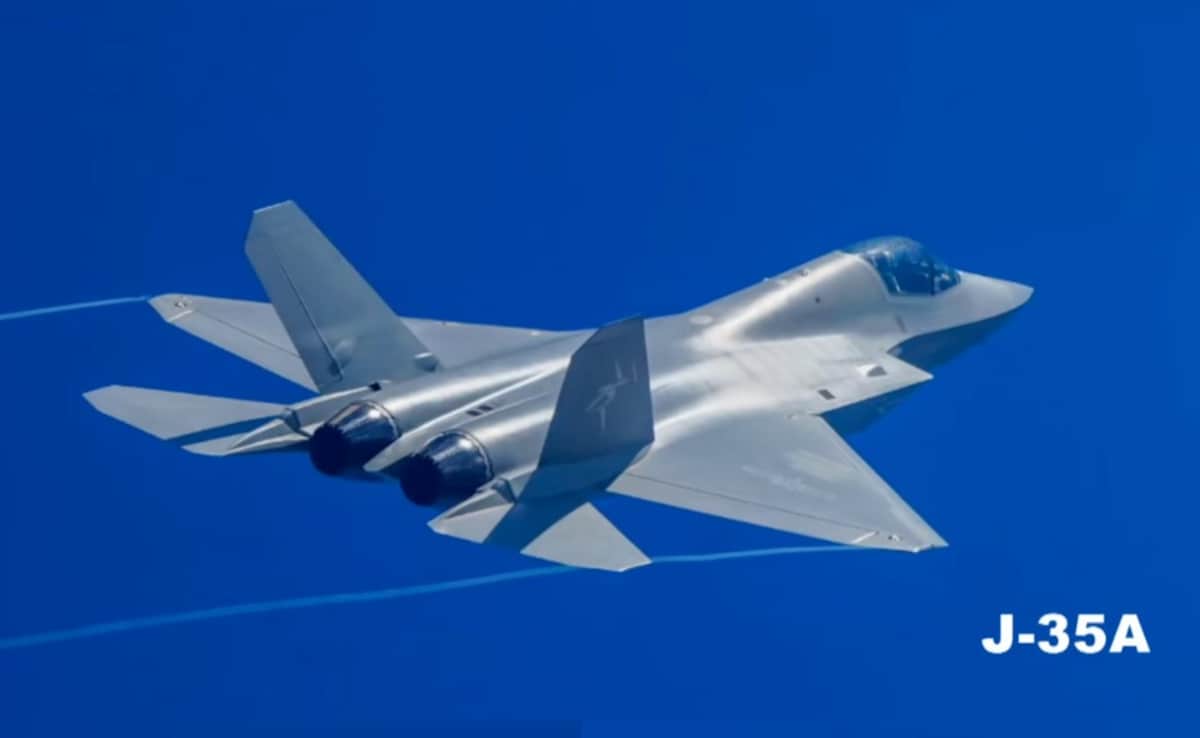
The emergence of the Shenyang J-35AE—the export variant of China’s second fifth-generation fighter—signals a shift from regional dominance to a globalized competition for low-observable air superiority. While the F-35 Lightning II has maintained a decade-long monopoly on the exportable fifth-generation market, the J-35AE introduces a distinct economic and geopolitical friction point. This platform is not merely a hardware upgrade for second-tier air forces; it is a vehicle for technical and strategic alignment with Beijing’s defense industrial complex. By offering stealth capabilities to nations currently excluded from the F-35 program—most notably Pakistan—China is effectively redefining the cost-of-entry for modern air warfare.
The Triad of Fifth-Generation Parity
To evaluate the J-35AE, one must look past superficial visual similarities to the F-35 and analyze the three fundamental pillars of fifth-generation utility: low-observable (LO) geometry, sensor-fusion architecture, and engine performance metrics.
Geometric Stealth and Material Science
The J-35AE utilizes a twin-engine configuration, a departure from the F-35’s single-engine design. This choice suggests a specific trade-off in the Cost Function of Stealth. While a twin-engine layout increases the infrared (IR) signature and complicates the rear-aspect Radar Cross Section (RCS), it provides the redundancy required for carrier-based operations and long-range maritime patrols. The airframe’s alignment of edges, internal weapons bays, and diverted intakes indicate a mature understanding of X-band radar suppression. However, the efficacy of the platform rests on the durability of its Radar Absorbent Material (RAM). China’s ability to mass-produce RAM that survives high-G maneuvers and environmental degradation without the intensive maintenance cycles required by early-gen US stealth is the primary variable in the J-35AE's operational readiness.
Sensor Fusion and the Information Asymmetry
Modern air combat is dictated by who sees first, not who flies faster. The J-35AE integrates an Active Electronically Scanned Array (AESA) radar with an Electro-Optical Targeting System (EOTS) comparable to the F-35’s AN/AAQ-40. The strategic value here lies in the Data Link Integration. If the J-35AE can seamlessly share targeting data with Chinese-made KJ-500 AWACS and HQ-9 surface-to-air missile batteries, it creates a "system-of-systems" that negates the individual technical advantages of Western fourth-generation platforms like the F-16 Block 70 or the Rafale.
The Propulsion Bottleneck
The transition from the WS-13 engine to the higher-thrust WS-19 represents the closing of a critical capability gap. The WS-19 is designed to provide the J-35AE with supercruise capability—the ability to fly at supersonic speeds without using afterburners. This reduces the thermal signature and increases combat radius. In the context of a potential Pakistani acquisition, the WS-19 eliminates the historical reliance on Russian engine components, ensuring a supply chain that is immune to Western sanctions or Russian geopolitical shifts.
The Pakistan Procurement Logic: A Case Study in Asymmetric Balancing
Pakistan’s interest in the J-35AE is a rational response to the shifting balance of power in South Asia. The Indian Air Force’s (IAF) acquisition of Rafale jets and its pursuit of the S-400 Triumf missile system have eroded Pakistan’s traditional defensive depth.
The Counter-Stealth Calculus
Pakistan cannot afford a one-for-one numerical match with the IAF. Instead, it must rely on qualitative "leapfrogging." The J-35AE provides a counter-LO capability that forces the IAF to reinvest in expensive UHF/VHF radar arrays and infrared search and track (IRST) systems. This creates an Economic Attrition Loop, where the adversary is forced to spend disproportionately on defensive sensors to counter a low-observable threat.
Political Neutrality of Hardware
The United States has historically used the F-16 program as a lever for behavioral modification in Islamabad. The J-35AE offers an "uncapped" capability. Unlike Western platforms that come with stringent End-Use Monitoring (EUM) and geographical restrictions on deployment, Chinese hardware is sold as a sovereign asset. This autonomy is a high-value intangible for the Pakistan Air Force (PAF), allowing for integrated training exercises and deployments that would be scrutinized or blocked by Washington.
The Logistics of Displacement: Why Prices Matter More Than Specs
The F-35 is a victim of its own sophistication and the exclusivity of its supply chain. The J-35AE enters the market as a high-low mix solution. For many nations, the F-35 is not just expensive; it is unavailable due to CAATSA (Countering America's Adversaries Through Sanctions Act) or political misalignment.
- The Infrastructure Barrier: Operating the F-35 requires a massive investment in the ALIS/ODIN cloud-based logistics system, which gives the US a "kill switch" over the fleet. The J-35AE is expected to utilize a more traditional, localized logistics model that appeals to nations wary of digital sovereignty.
- Maintenance Man-Hours: If the J-35AE can achieve a 60-70% mission-capable rate with a lower maintenance-to-flight-hour ratio than the F-35, it becomes the superior choice for high-tempo regional conflicts, regardless of whether its RCS is slightly larger than its American counterpart.
- Weaponry Interoperability: The J-35AE will carry the PL-15E long-range air-to-air missile. With a reported range exceeding 145km and an AESA seeker, the PL-15E matches or exceeds the current capabilities of the AIM-120D AMRAAM. This parity in "the long reach" is what transforms a stealth airframe from a defensive asset into an offensive penetrator.
Strategic Implications for Global Arms Markets
The J-35AE is the first credible threat to the F-35’s market dominance in the Middle East, Southeast Asia, and North Africa. Nations like Egypt, the UAE, and Thailand represent a "Middle Tier" of buyers who possess the capital for fifth-generation assets but face political hurdles in Washington.
The first limitation of this Chinese expansion is Battlefield Validation. The F-35 has a recorded history of operational sorties and integration in complex environments. The J-35AE remains a theoretical powerhouse until it is tested in high-end electronic warfare (EW) environments. The second limitation is Interoperability with Legacy Fleets. Most prospective buyers operate Western-origin hardware. Integrating a Chinese fifth-generation jet into a NATO-standard air defense network creates a "dual-track" logistics nightmare that many air forces may not be equipped to manage.
This creates a bottleneck where the J-35AE will likely see its first successes in "clean sheet" air forces or those already heavily committed to the Chinese ecosystem. Pakistan is the logical pioneer because it has already crossed the rubicon with the JF-17 and J-10C.
Identifying the Inflection Point
We are approaching a period where stealth is no longer a luxury of the few but a baseline requirement for survival. The J-35AE commoditizes low-observability. As the J-35AE moves into full-rate production, the global arms market will bifurcate.
The primary strategic move for Western observers is to monitor the Data Link Protocol of the export J-35AE. If China allows the integration of non-Chinese sensors or weapons onto the platform—a move they have resisted in the past—it will signal a desperate bid for market share that could undermine the F-35’s dominance even in traditionally "pro-Western" hubs. For regional powers like India, the response cannot be more fourth-generation acquisitions; it must be an accelerated investment in indigenous stealth (AMCA) and long-range, multi-static radar networks capable of detecting the J-35AE’s specific geometric signatures. The era of the "stealth monopoly" is over; the era of "stealth saturation" has begun.