The proliferation of targeted violence within Turkish educational institutions is not a series of isolated criminal acts but a predictable output of systemic failures in school security architecture and the breakdown of early-intervention psychosocial protocols. When an incident occurs—such as a high school shooting—it reveals a critical breach in the three-layer defense model: perimeter control, internal surveillance, and behavioral threat assessment. In the Turkish context, these layers are often porous, relying on passive observation rather than active risk mitigation. This analysis deconstructs the mechanics of these security breaches and the socioeconomic variables that accelerate the transition from grievance to kinetic action.
The Triad of Institutional Vulnerability
The security of a high-capacity educational environment rests on the integrity of three distinct operational domains. Failure in any single domain significantly increases the probability of a high-impact event.
1. Perimeter Kinetic Barriers
Turkish public and private schools frequently utilize "static-passive" security. This involves physical fences and a single entry point manned by personnel who are often trained for general asset protection rather than specialized threat detection. The primary failure point here is the contraband ingress window. Without standardized metal detection or mandatory bag inspections at every tier of the institution, the barrier remains purely symbolic. The weapon’s transition from the external environment to the internal "safe zone" occurs because the inspection protocol lacks the granularity to detect concealed small arms or improvised devices.
2. Internal Surveillance and Response Lag
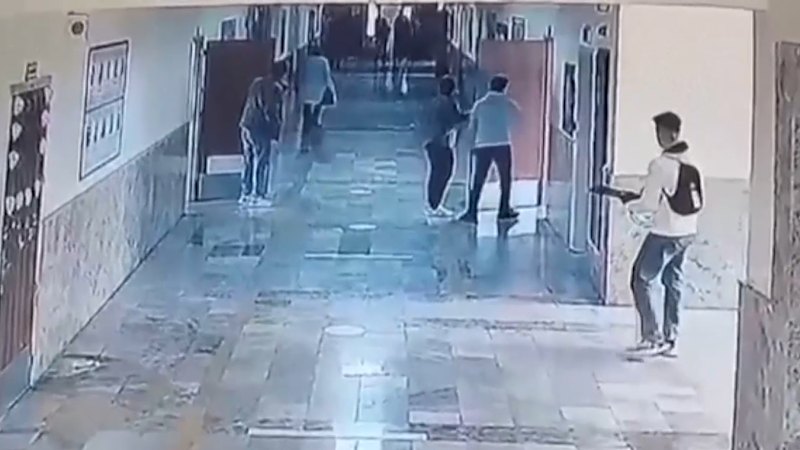
Once a threat crosses the perimeter, the "time-to-neutralization" becomes the only metric that matters. Most institutions suffer from a surveillance-response gap. While CCTV cameras may be present, they are typically used for forensic evidence after an event rather than real-time tactical awareness. This creates a vacuum where the perpetrator can move through high-density corridors without encountering immediate resistance. The lack of standardized "Lockdown-Inform-Counter" drills among the student body and faculty further compounds the casualty potential, as movement during the initial phase of an attack is often chaotic rather than governed by a tactical protocol.
3. The Behavioral Threat Assessment (BTA) Deficit
The most significant failure occurs long before a weapon is drawn. A behavioral threat assessment is a proactive process used to identify, assess, and manage students who may be on a pathway to violence. In many Turkish schools, the counseling and psychological services (PDR) are overextended, focusing on academic placement rather than deep-tier behavioral monitoring. This results in the "Leakage Phenomenon"—where a perpetrator communicates their intent to peers or through social media—being ignored or dismissed as adolescent posturing.
The Mechanics of Adolescent Radicalization and Grievance
Targeted school violence is rarely an impulsive act of "snapping." It is the culmination of a documented cognitive process known as the Pathway to Violence.
The Grievance Formation
The initial stage is the development of a perceived injustice. In the Turkish high school ecosystem, this often stems from intense academic pressure, hierarchical social bullying, or perceived institutional bias. When a student feels they have no legitimate channel for redress, the grievance calcifies.
Ideation and the "Columbine Effect"
In the digital age, isolated individuals in Turkey are no longer isolated in thought. They have access to global subcultures that fetishize previous school shooters. This "copycat" or "contagion" effect provides a script for the student to follow. They begin to view violence not as a crime, but as a performative act of "settling the score." The shift from thinking about violence to planning violence is marked by a change in consumption habits—moving from general grievances to researching weapon acquisition and school layouts.
Tactical Preparation and Breach Probing
Before an attack, perpetrators often engage in "probing." This might involve testing security response times, bringing non-lethal contraband to school to check the rigor of bag searches, or identifying blind spots in CCTV coverage. The institutional failure to log and analyze these minor infractions as "precursor events" allows the perpetrator to finalize their tactical plan with high confidence.
Socio-Legal Bottlenecks in Weapon Acquisition
The availability of firearms is a direct multiplier of the lethality of school incidents. While Turkey has stringent firearm laws compared to some Western nations, two primary bottlenecks exist that facilitate weapon acquisition for minors or young adults.
- The Secondary Unregulated Market: The rise of online black markets and encrypted messaging groups has lowered the barrier to entry for acquiring unregistered handguns or modified blank-firing pistols.
- Intra-Familial Access: A significant percentage of school-related shootings involve weapons "borrowed" from a household where a parent or guardian holds a legal license for self-defense or hunting. The lack of mandatory biometric storage or secure-lock requirements within the home creates a high-risk environment where the weapon is effectively "pre-positioned" for the perpetrator.
The Cost Function of Reactive Security
Maintaining a purely reactive security posture—waiting for an event to occur and then deploying police—is the most expensive and least effective strategy. The economic and social costs include:
- Human Capital Loss: The immediate loss of life and the long-term psychological trauma that degrades the educational output of the entire student body.
- Institutional Devaluation: Schools that experience violence see a rapid exit of high-performing students and faculty, leading to a "death spiral" of the institution's reputation and funding.
- Infrastructure Retrofitting: Post-event security upgrades are often 3-5 times more expensive than integrating security into the initial design of the school.
Optimization of the Educational Defense Architecture
To move beyond the current state of vulnerability, Turkish educational authorities must pivot to an "Active-Integrated" model. This requires moving away from the "Security Guard" mindset and toward a "Risk Management" framework.
Integration of Intelligence-Led Policing (ILP)
Local law enforcement and school administrations must establish a shared data environment. If a student is flagged for violent behavior outside of school or is part of an investigation involving illegal weapon procurement, that information must trigger an immediate, high-priority behavioral intervention within the school.
Technological Hardening: AI-Driven Analytics
Traditional CCTV must be replaced with AI-integrated systems capable of weapon detection and "unusual movement" alerts. An automated system that can detect the shape of a firearm or the sound of a gunshot and instantly trigger a lockdown of electronic doors would reduce the "Neutralization Time" from minutes to seconds.
The Professionalization of School Resource Officers (SRO)
The role of security personnel must be elevated. They require training in adolescent psychology, de-escalation, and active-shooter response. A security professional who understands the social dynamics of the cafeteria is more effective than a static guard at a gate.
The stability of the Turkish educational system depends on the immediate recognition that school shootings are a structural problem requiring a structural solution. The transition from a passive, grievance-heavy environment to a hardened, proactive institution is the only viable path to mitigating the risk of mass casualty events. Security must be viewed as an ongoing operational process, not a physical installation. The final strategic move for administrators is the immediate audit of the "leakage" reporting system; ensuring that every student has a verified, anonymous, and monitored channel to report peer threats is the most cost-effective method of preventing the next breach.