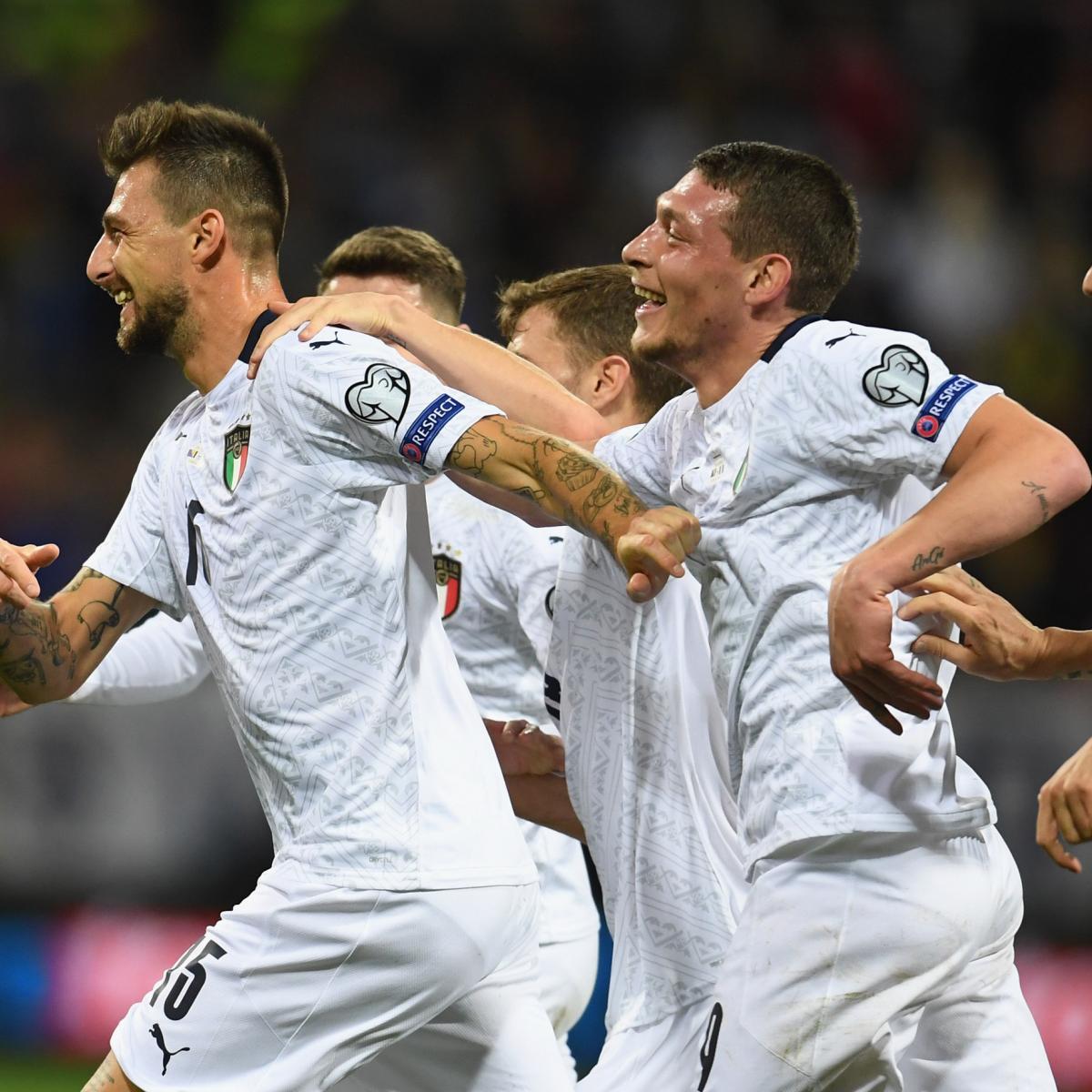
Italy’s failure to secure a victory against Bosnia and Herzegovina, culminating in a penalty shoot-out exit, is not a statistical anomaly but the terminal symptom of a decade-long erosion in technical development and psychological resilience. The obsession with a historical "winning DNA" has obscured a fundamental truth: the Italian national team now lacks the mechanical advantages required to dominate modern, high-intensity international fixtures. This exit signals a shift from a temporary slump into a systemic crisis of identity and execution.
The Technical Deficit in High Pressure Zones
The match revealed a stark breakdown in the Italian midfield's ability to maintain progressive ball control under physical duress. Bosnia’s tactical setup exploited three specific structural vulnerabilities in the Italian system.
1. The Breakdown of Vertical Connectivity
The Italian buildup play relied heavily on a deep-lying playmaker who was consistently isolated by Bosnia’s dual-pivot screen. This created a "dead zone" in the final third. When the central channels are blocked, Italy defaults to lateral recycling of possession. This behavior is measurable in high possession percentages that yield low Expected Goals (xG). The lack of a profile capable of winning individual 1v1 duels on the flanks meant the Bosnian defense was never forced to shift or rotate out of a compact block.
2. The Efficiency Gap in Shot Conversion
The inability to convert dominance into scoreline advantages stems from a lack of "clinical density." Italy’s attacking rotations often result in high-volume, low-probability shots from outside the eighteen-yard box. Bosnian defenders maintained a low block that prioritized central occupancy, forcing Italy into a cross-heavy strategy. Statistically, crossing against a set defense with a height advantage is a low-yield tactic. Italy’s refusal to adapt this approach during the 120 minutes suggests a coaching rigidity that prioritizes "the system" over real-time tactical problem-solving.
3. Transition Vulnerability
The "Nightmare" described by observers is actually a failure in rest-defense. Whenever Italy committed numbers forward to break the deadlock, they left massive vertical lanes open. Bosnia’s transition moments were few but high-impact, forcing Italian defenders into recovery sprints that sapped their aerobic capacity heading into extra time. This fatigue is a primary driver of technical errors during a shoot-out.
The Psychology of the Twelve Yard Failure
Penalty shoot-outs are often dismissed as a lottery. In reality, they are a test of neuro-motor control under extreme cortisol spikes. Italy’s performance from the spot indicated a total collapse of "clutch-state" performance metrics.
The first three shooters showed clear signs of "freezing"—a physiological response where the athlete over-thinks a previously automated motor skill. This occurs when the perceived cost of failure outweighs the focus on technical execution. Bosnian players, entering the shoot-out as the perceived underdogs, operated with a lower psychological burden. This "Underdog Alpha" state allows for more fluid movement and higher shot velocity.
Italy’s historical baggage has become a performance inhibitor. When a team is constantly reminded of its status as a "powerhouse," every missed opportunity creates a feedback loop of anxiety. This anxiety manifests as decelerated foot speed and predictable shot placement, making the goalkeeper's job significantly easier through "tells" in the kicker's approach angle.
Macro-Economic and Cultural Bottlenecks
The issues on the pitch are reflective of a broader stagnation in the Italian footballing ecosystem. Three pillars of the sport in Italy are currently crumbling, preventing the emergence of elite-tier talent.
The Academy Paradox
Italian youth systems are currently optimized for tactical compliance rather than technical bravery. Coaches at the U16-U21 levels prioritize results and defensive organization to secure their own jobs, which stifles the development of creative, risk-taking midfielders and forwards. This produces a "utility player" profile—competent in a system but incapable of breaking a game open through individual brilliance.
The Serie A Integration Barrier
There is a massive chasm between the Italian domestic league and the demands of the international game. The pace of play in Serie A remains significantly slower than that of the Premier League or the Bundesliga. When Italian internationals face a team like Bosnia—who utilized high-intensity pressing and physical transitions—they struggle to adjust their internal "processing clock." The lag in decision-making time leads to the intercepted passes and unforced errors that defined the Bosnian match.
Resource Misallocation
Investment in Italian football has shifted toward veteran acquisitions to chase immediate Champions League revenue, rather than long-term infrastructure. The result is a national team pool that is either aging out of their prime or lacks the "big game" reps necessary to handle the pressure of a World Cup qualification or tournament knockout.
The Mechanics of the Shoot-out Defeat
Analyzing the specific sequence of the loss reveals a failure in leadership and preparation. A modern shoot-out strategy requires:
- Order Optimization: Putting the most resilient kickers in positions 1 and 4. Italy’s order seemed reactive.
- Goalkeeper Analytics: There was no evidence that the Italian side had mapped the Bosnian kickers’ tendencies to a high degree of accuracy.
- Time Management: Taking longer than 0.8 seconds between the whistle and the kick is statistically linked to higher success rates. Italian players rushed their attempts, a classic sign of wanting the moment to be over rather than owning it.
Bosnia did not win through superior talent; they won through superior psychological composure and a tactical plan that maximized their limited windows of opportunity. They turned the match into a war of attrition, knowing that as the clock ticked, the pressure on Italy would compound exponentially.
Structural Requirements for Reform
To move beyond this "nightmare," the Italian Federation must abandon the narrative of "bad luck" and address the mechanical failures of their footballing model.
The first step is a total overhaul of youth coaching licenses, mandating a percentage of training time dedicated to 1v1 isolation and creative play. Without players who can beat a man without a tactical overlap, Italy will continue to struggle against disciplined low blocks.
The second step is the implementation of a "High-Intensity Mandate" for domestic officiating. By allowing more physical play and reducing the frequency of tactical fouls, the domestic league can better prepare its players for the unmitigated physicality of international competition.
The third step is a psychological recalibration. The national team must move away from the "History as Shield" mentality. Current players are being crushed by the weight of 1934, 1938, 1982, and 2006. They need to be treated as a developing nation in football terms—forced to earn their status through technical evolution rather than assuming it as a birthright.
Failure to implement these changes will result in Italy becoming a "legacy brand" in football—highly recognizable, historically significant, but increasingly irrelevant in the modern competitive landscape. The defeat to Bosnia is not the bottom; it is a signpost indicating that the current path leads to permanent mid-tier status.
Immediate action must focus on integrating high-potential U21 players into the senior squad regardless of their club-level minutes. The reliance on established names who have repeatedly failed in high-leverage moments must end. The "Nightmare" is only a dream if you have the capacity to wake up; for Italian football, this is a waking reality that requires a cold, clinical dismantling of its most basic assumptions.
Stop looking for a "new Pirlo" or a "new Baggio." Start building a system that produces players who can survive a 90-minute press and a 12-yard psychological gauntlet without collapsing under the weight of a jersey they no longer have the tools to wear.