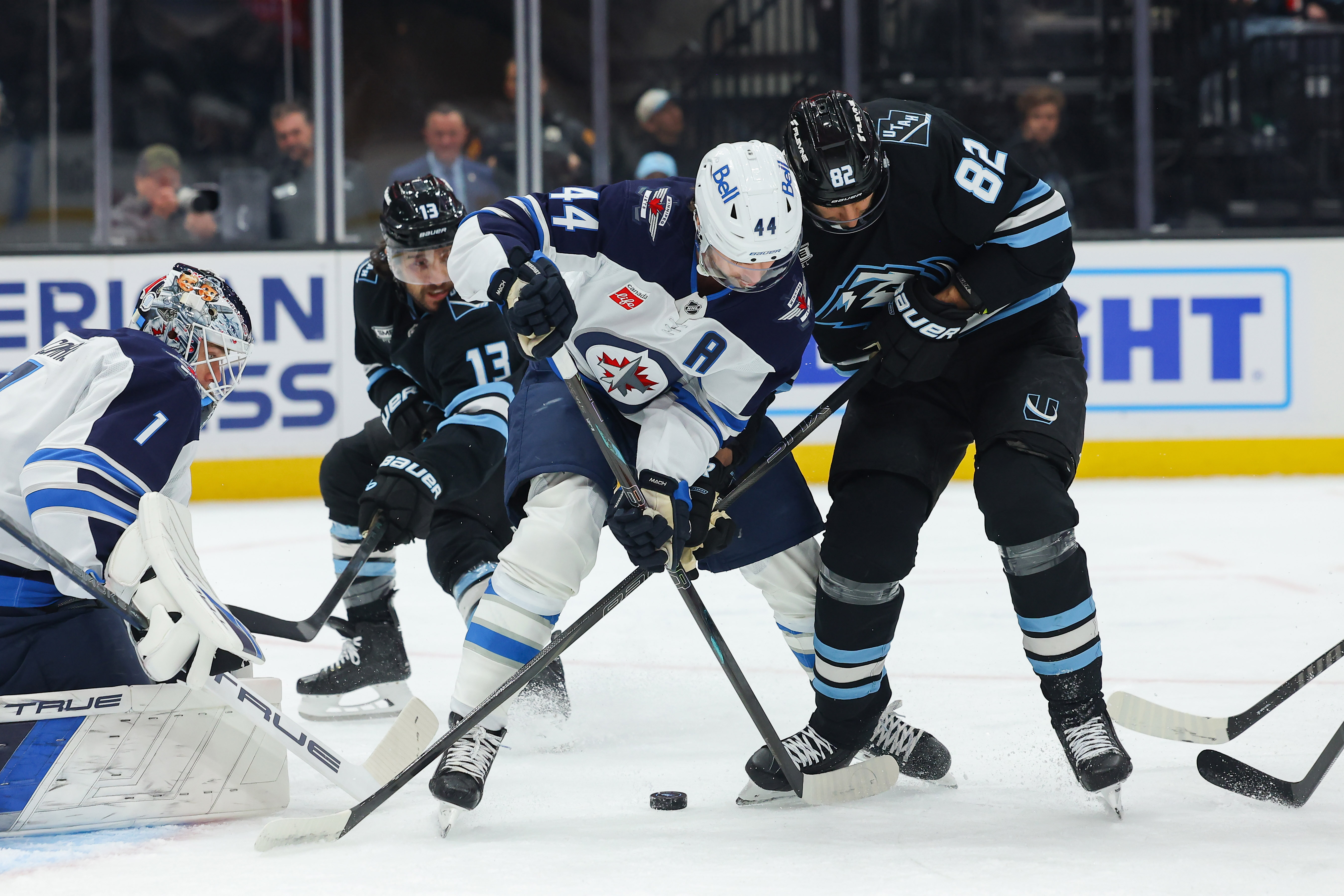
The Winnipeg Jets' 5-3 defeat against the Utah Hockey Club in their final road engagement of the 2025-26 season functions as a case study in high-variance volatility and the failure of defensive gap control. While the raw score suggests a competitive outing, a granular decomposition of the game tape reveals a systemic breakdown in Winnipeg’s defensive posture during secondary break sequences. The loss cannot be attributed to a singular tactical error but rather to a cascading failure of three specific variables: spatial management in the neutral zone, puck management at the offensive blue line, and the breakdown of low-to-high coverage.
The Neutral Zone Gap Collapse
The primary driver of Utah’s offensive efficiency was their ability to exploit Winnipeg’s aggressive pinch strategy. In a standard defensive system, the "gap"—the physical distance between the defending defenseman and the attacking forward—should remain tight enough to force a dump-in but wide enough to prevent a clean blow-by. In the second period, Winnipeg’s defensive pairs consistently miscalculated this distance.
When a defenseman pinches to keep a puck in the offensive zone, they create a high-risk, high-reward scenario. If the puck is lost, the defending team enters a "F3" coverage rotation, where the third forward must track back to cover the vacate lane. Winnipeg’s F3 support was chronically late. This created a numerical disadvantage in the neutral zone, allowing Utah to transition with speed. The physics of the 5-3 scoreline were dictated by Utah’s ability to generate 3-on-2 rushes precisely when Winnipeg’s defensemen were caught above the puck.
Mechanics of the Odd-Man Rush
Utah’s transition game focused on the "middle lane drive." By driving a center through the heart of the ice, they forced Winnipeg’s backchecking forwards to collapse toward the center, leaving the wings open for late-arriving trailers. The third and fourth goals conceded by the Jets were direct results of this "trailer" effect. Winnipeg’s defenders focused on the immediate threat—the puck carrier—and the primary drive, neglecting the second wave of the attack.
Puck Management and Negative Expected Goals
The concept of "Expected Goals" (xG) often ignores the context of the giveaway. A giveaway at the opponent's goal line is statistically less dangerous than a giveaway at the defensive blue line. Winnipeg struggled with "Negative xG" events—unforced errors in high-leverage areas of the ice that immediately flipped the script of the game.
The Jets' inability to manage the "exit-to-entry" sequence was the catalyst for Utah’s sustained pressure. When Winnipeg gained possession in their own zone, their exit passes were frequently intercepted or deflected, leading to "reset" possessions for Utah. A reset occurs when the defending team expends energy to win the puck, only to lose it immediately, forcing them to defend again while fatigued. This fatigue leads to reaching with sticks rather than moving with feet, a trend that was visible in the third period as Winnipeg’s penalty count increased.
The Cost Function of Special Teams Imbalance
Special teams performance in this matchup highlighted a disparity in tactical execution. Winnipeg’s power play, while generating shots, lacked the "high-danger" quality required to beat Utah’s compact penalty kill. Utah utilized a "wedge-plus-one" system, where three players form a tight triangle in front of the net while a fourth pressures the puck carrier. Winnipeg’s insistence on perimeter passing played directly into this strategy.
The lack of a "bumper" presence—a player located in the high slot to distract the defense—allowed Utah’s goaltender to track shots from the point with zero screen. Conversely, Winnipeg’s penalty kill suffered from a lack of "active sticks." Instead of disrupting passing lanes, the Jets’ killers remained static, allowing Utah’s playmakers to dictate the tempo. The failure to disrupt the cross-seam pass is an invitation for high-percentage scoring opportunities.
The Anchor Effect of Poor Starts
The data suggests that road teams who concede the first goal in the final weeks of a season face a steep psychological and physical climb. Conceding early goals on the road creates a "chase" mentality. When a team is chasing the game, they take suboptimal risks. Winnipeg’s third-period aggression was a byproduct of this desperation, leading to the empty-net goal that sealed the 5-3 result. The game was lost not in the final minutes, but in the first ten, where the lack of intensity allowed Utah to establish a comfortable rhythm.
Goaltending and the Variance of High-Danger Chances
Evaluation of the 5-3 score requires an objective look at the goaltending performance. While the raw save percentage might look pedestrian, the quality of chances faced must be weighted. A "high-danger" chance (HDC) is a shot taken from the "home plate" area directly in front of the net. Winnipeg allowed 14 HDCs over sixty minutes, a volume that almost guarantees a high score for the opposition.
Even elite goaltending cannot compensate for structural failures that allow uncontested shots from the slot. The third goal Utah scored involved a deflection in the low slot followed by a rebound. The initial save was made, but the secondary coverage—the responsibility of the defensemen to clear the "crease junk"—was non-existent. This reveals a lack of physical engagement in the high-leverage areas of the defensive zone.
Strategic Pivot for Post-Season Preparation
For the Winnipeg Jets to mitigate these issues before the playoffs begin, the coaching staff must implement a "safe-to-center" exit strategy. This involves prioritizing center-ice puck placement over high-risk lateral passes across the defensive zone. Additionally, the defense must recalibrate their gap control to account for faster transition teams.
The focus must shift from offensive production to "neutral zone denial." By clogging the middle of the ice and forcing opponents to the outside, Winnipeg can reduce the frequency of high-danger chances and rely on their goaltending to handle lower-percentage shots from the perimeter. The 5-3 loss in Utah serves as a final warning: high-event hockey favors the team with the least to lose, but structured, low-event hockey is the only viable path for a championship contender.
The immediate tactical requirement is the tightening of the F3 rotation. If the third forward does not commit to a defensive-side-of-the-puck mentality, the Jets will remain vulnerable to the counter-attack. This is not a matter of skill, but of disciplined adherence to a spatial framework that prioritizes defensive integrity over aggressive forechecking. The data from the Utah game confirms that without this discipline, the Jets' ceiling is significantly lowered.