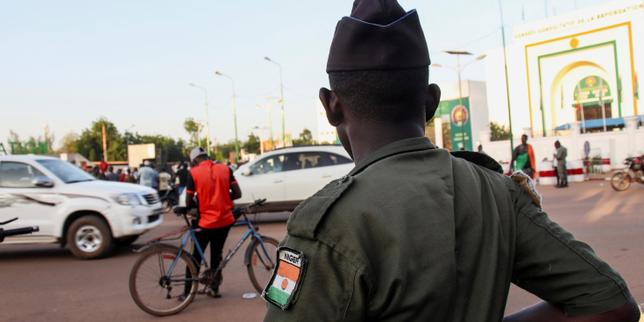
State fragility in the central Sahel is driven by the structural erosion of the state monopoly on organized violence rather than isolated political grievances. When an elite security apparatus turns inward, the survival calculus of military command structures shifts from defending constitutional order to preserving institutional survival and resource access. Deconstructing the mechanics of political destabilization requires moving past superficial descriptions of palace mutinies to examine the underlying institutional vulnerabilities that make state structures susceptible to collapse.
The Architecture of Force Asymmetry
The primary driver of political vulnerability in states like Niger is the intentional fragmentation of security forces. Regimes often cultivate specialized, heavily resourced elite units—such as presidential guards—to act as an insurance policy against traditional military coups. This creates a dangerous institutional asymmetry within the security architecture.
The structural components of this asymmetry operate through specific channels:
- Resource concentration: Elite guard units receive superior hardware, communications technology, and logistical prioritization compared to regular infantry and conventional armed forces.
- Command isolation: These units answer directly to the executive branch or operate under distinct command chains, minimizing operational integration with the wider national defense framework.
- Geographic friction: Capital-centric deployment places the best-equipped forces directly adjacent to seats of political power, removing spatial buffers that could otherwise allow loyalist forces to mobilize.
When a crisis erupts within this inner circle, regular military hierarchies face an immediate operational dilemma. Engaging an elite guard unit inside an urban center risks a catastrophic fracture of the national armed forces, inviting mutual destruction or total state paralysis. The rational choice for conventional military leadership under these conditions is non-intervention or co-optation rather than defense of the civilian executive.
The Cost Function of Institutional Patronage
Political stability in fragile states relies heavily on elite resource distribution networks. Presidents attempting structural reform often miscalculate the cost function of altering patronage systems within the military hierarchy.
The mechanism unfolds through predictable thresholds:
- Elite consolidation occurs when a leader relies on specific security figures for prolonged periods, embedding those figures deeply into state apparatuses and informal economic networks.
- Reform friction emerges when civilian leadership attempts administrative rotations, mandatory retirements for senior generals, or structural downsizing of privileged units.
- Threshold breach happens the moment an administrative decree threatens the operational autonomy or personal security of entrenched commanders.
At this juncture, the cost of compliance for the military commander exceeds the risk of rebellion. The threat of removal triggers a pre-emptive strike to capture state infrastructure before administrative decrees can be enforced. This dynamic explains why military takeovers frequently coincide with impending command shakeups or structural budget reallocations.
Regional Contagion and Security Externalities
Domestic political upheavals do not occur in a vacuum; they are heavily influenced by regional security deficits. The proliferation of non-state armed groups across the broader Sahel creates a persistent state of exception that weakens civilian oversight.
When national authorities fail to secure peripheral territories against insurgent movements, the political legitimacy of the regime erodes. Military leadership exploits this performance deficit, framing civilian oversight as an impediment to tactical effectiveness. By arguing that democratic governance introduces friction into counter-insurgency operations, security factions justify political intervention as a necessary stabilization measure.
Furthermore, regional bodies attempting to enforce democratic norms face severe operational limitations. Economic sanctions and diplomatic ultimatums often fail to alter the calculus of junta leaderships because these regimes anticipate alternative economic alignments and external partnerships. The formation of alternative regional blocs among military-led states illustrates how localized power seizures can aggregate into a broader geopolitical realignment, neutralizing traditional multilateral deterrence mechanisms.
Operationalizing Institutional Resilience
Preventing structural collapse requires shifting focus from short-term executive protection to comprehensive security sector governance. Strengthening state durability demands specific structural adjustments:
- Institutionalize rotation mechanisms early in an administration to prevent the accumulation of entrenched personal power within specialized guard units.
- Mandate operational integration between elite units and conventional forces to prevent the emergence of isolated power centers within the capital.
- Align counter-insurgency metrics with transparent civilian oversight frameworks, ensuring that operational adjustments do not compromise constitutional accountability.
Reforming security architecture in high-risk environments requires structural redundancy, balanced resource distribution across military branches, and robust institutional checks that prevent any single armed faction from acquiring a monopoly on physical coercion within the seat of government.


