Sub-surface rescue operations are governed by immutable physics, structural geology, and fluid dynamics, yet public accounts routinely reduce these events to a simple narrative of rescuers racing against time. The ongoing multi-agency effort to extract seven workers trapped within a flooded, artisanal gold-mining cave system in the Long Cheng district of Laos' Xaysomboun province requires a more rigorous analytical framework. To accurately assess probability of survival and execution risk, the situation must be broken down into three core operational variables: hydrological influx rates, geomorphological bottlenecks, and the logistical friction of the deployment pipeline.
Evaluating this emergency as an engineering challenge reveals that the primary threat is not merely the presence of water, but the systemic constraints of the subterranean environment. The trapped individuals—local workers operating an informal alluvial gold-mining site—are located inside a multi-level limestone karst matrix approximately 100 meters from the primary egress point. Survival and successful extraction depend on balancing the rate of mechanical water displacement against natural precipitation influx while navigating severe spatial restrictions.
The Hydrological Equilibrium: Displacement vs. Influx
The immediate threat to life inside the Xaysomboun system is determined by a simple fluid dynamic equation: net volumetric accumulation. For the environment to remain tenable, the volume of water extracted by mechanical pumping must exceed the volume of water entering the system via surface runoff, structural percolation, and flash-flood inflows.
Net Accumulation Rate = Influx Rate (Precipitation + Runoff) - Efflux Rate (Mechanical Pumping)
This equilibrium is highly unstable due to several compounding variables:
- The Catchment-to-Cave Vector: The cave entrance, measuring roughly 60 centimeters in height, acts as a high-velocity drainage point for the surrounding mountainous terrain. Heavy regional rainfall creates rapid surface runoff that drains directly into the downward-sloping primary conduit.
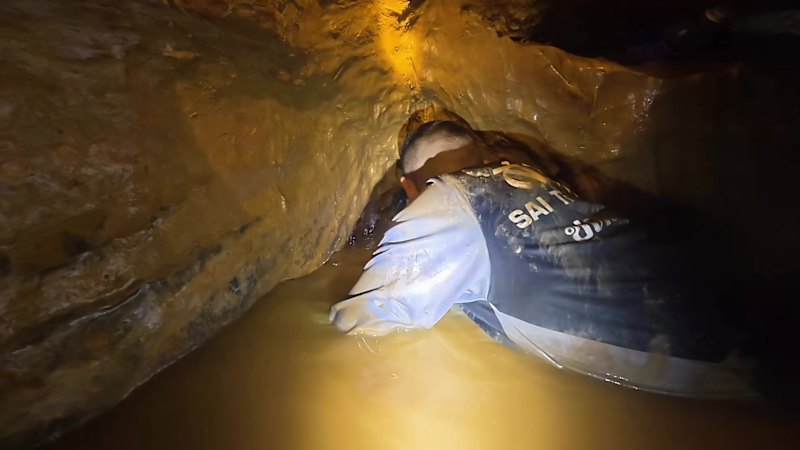
- Sedimentation and Flow Restriction: Inflows are not clean water; they carry high concentrations of suspended solids, clay, and mountain detritus. This sediment accumulates at low points, such as the 50-centimeter constriction located 40 meters inside the cave. This creates a dual problem: it reduces the physical area available for water passage—which increases local fluid velocity—and it clogs the intake valves of standard industrial submersible pumps.
- The Head-Height Pump Efficiency Decline: As water is drawn from deeper levels of the multi-tiered cave system, pumps must overcome increasing vertical head height. Standard portable diesel pumps experience a sharp drop in operational efficiency (measured in liters per minute) for every additional meter of vertical lift required, limiting the effectiveness of surface-deployed suction lines.
Geomorphological Constraints and the Spatial Bottleneck
The structural architecture of the Xaysomboun karst system dictates the tactics available to the international rescue cohort, which includes specialists from Laos, Thailand, and China. Unlike open-air search and rescue operations where personnel can be scaled linearly to accelerate progress, subterranean extraction is constrained by strict spatial bottlenecks.
The cave profile is characterized by a multi-level downward descent where larger chambers, or voids, are separated by severe horizontal and vertical constrictions. The primary entry point requires a flat crawl (60 centimeters maximum clearance) before transitioning into a series of vertical drops ranging from 10 to 20 meters each. The critical threshold of the search path is a 50-centimeter-wide gap located at a 45-degree angle.
This geometry creates severe operational constraints. First, it imposes a hard physical limit on equipment size. Large-diameter high-flow drainage pipes cannot pass through a 50-centimeter aperture, forcing reliance on smaller, less efficient flexible hoses. Second, it restricts personnel flow to a single file, serialized configuration. If a diver or technician is clearing mud at the primary blockage point, no other personnel can assist or pass through, rendering the total size of the rescue team irrelevant at the actual work face. Finally, it demands specialized physiological and psychological capabilities, explaining why the operation required the mobilization of specialized cave divers previously involved in the 2018 Tham Luang extraction.
The Three-Pronged Operational Strategy
To bypass the bottlenecks of the primary cave conduit, the joint command structure has deployed a diversified operational model. Rather than relying on a single point of failure, the rescue is organized into three distinct structural approaches.
1. The Hydraulic Pumping and Diving Conduits
This approach focuses on clearing the primary passage through aggressive dewatering and saturation diving. Dive teams use heavy guidelines to navigate completely submerged sections, clearing sediment blockages by hand to push farther into the cave. The technical limitation here is visibility. The high sediment load reduces visibility to zero, requiring divers to navigate entirely by touch along sharp limestone edges. This dramatically increases the risk of equipment damage or line entanglement.
2. The Vertical Ventilation Shaft Intervention
Surface surveys have identified a natural ventilation shaft or structural fissure located directly above the suspected survival chamber. This shaft descends approximately 50 meters vertically. Field teams are exploring this secondary vector using technical rope rescue techniques. If the shaft is stable and clear of structural blockages, it offers a direct vertical path to the trapped group, completely bypassing the flooded horizontal entry tunnels and the narrow 50-centimeter constriction.
3. Mechanical Top-Down Piercing
Concurrently, heavy earth-moving equipment provided by a nearby mining enterprise has been deployed on the mountain ridge above the cave matrix. The objective is to use large excavators and rotary drills to create an alternative vertical entry point. However, this strategy faces serious engineering hurdles:
- Geotechnical Instability: Heavy rain combined with the vibrations of heavy machinery significantly increases the risk of localized mass wasting or a catastrophic collapse of the underlying cave roof.
- Targeting Precision: Drilling a small-diameter shaft into a specific subterranean void over 50 meters deep requires precise 3D seismic mapping or ground-penetrating radar. Without exact spatial coordination, the drill bit risks missing the chamber entirely or penetrating the ceiling directly above the trapped workers, causing a fatal rockfall.
Logistical Friction in Mountain Terrains
The speed of execution is further constrained by the geographic isolation of the Xaysomboun province. The site is located in rugged, high-altitude terrain that introduces severe logistical friction into the supply chain.
The primary staging area is separated from the actual cave mouth by four kilometers of steep, mountainous terrain. Due to the grade and mud saturation caused by persistent rains, this distance cannot be traversed by wheeled or tracked supply vehicles. Personnel must complete a rigorous two-hour uphill march to move equipment from the drop zone to the operations face.
This reality creates a major energy expenditure problem. If rescue technicians commute between the base camp and the cave mouth daily, a significant portion of their daily caloric and physical capacity is spent purely on transit. Consequently, the operation has transitioned to a forward-deployed model, requiring teams to bivouac directly at the cave mouth under primitive conditions. This shift preserves operational energy for the actual extraction work but complicates the supply line for clean water, food, compressed air tanks, and generator fuel.
Structural Outlook and Strategic Play
The survival window for the seven individuals depends entirely on the atmospheric and geological conditions within the terminal chamber, located more than 100 meters from the entrance. Because the air volume within the chamber is currently sealed from the surface by water traps, the atmosphere is finite. Metabolic consumption will gradually lower oxygen levels while increasing carbon dioxide concentrations.
The primary operational priority must be establishing a reliable line of communication or physical supply to the chamber. If the mechanical drilling or vertical shaft exploration successfully pierces the void, it will equalize atmospheric pressure, provide a path for fresh air, and allow the delivery of hydration and thermal insulation supplies. Until that occurs, the operation remains a high-risk engineering challenge where success depends on the performance of small, forward-deployed technical units operating at the absolute limit of spatial and environmental tolerances. The strategic focus must remain on stabilizing the internal water level through continuous, sediment-filtered pumping while prioritizing the vertical shaft descent as the path with the lowest structural resistance.