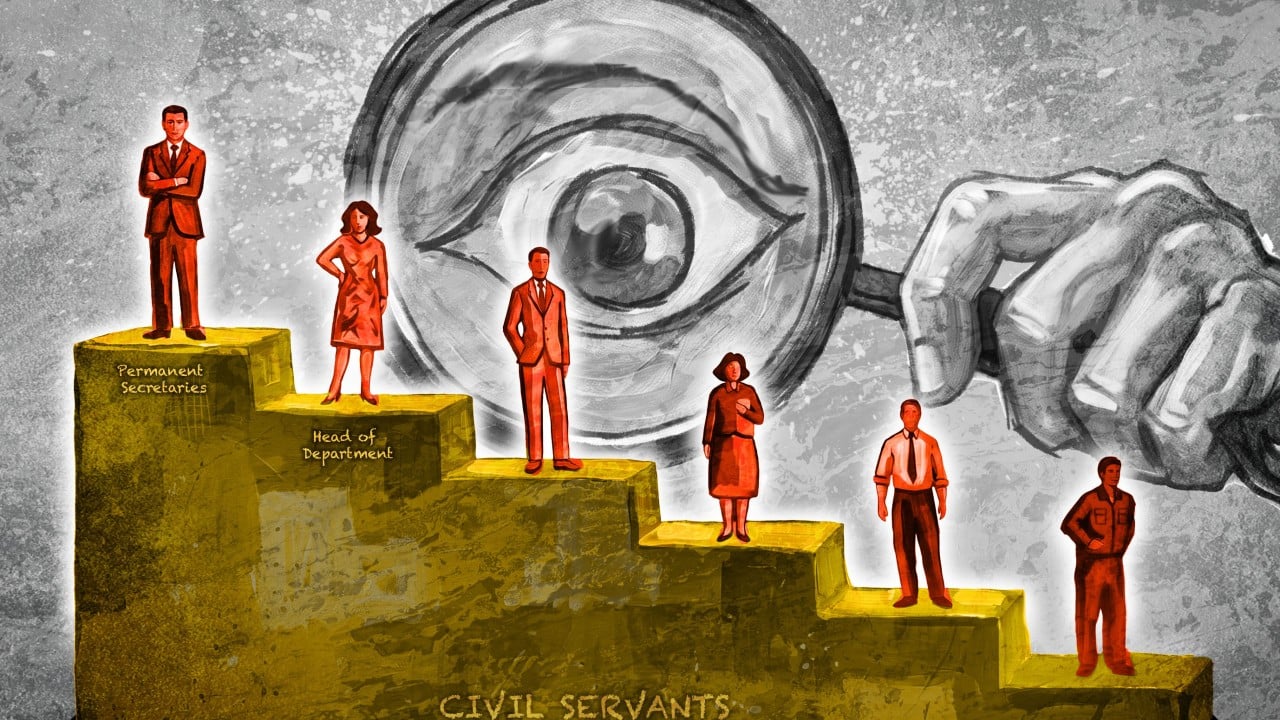
The air in the high-ceilinged offices of Tamar is filtered, cool, and carries the faint scent of expensive stationary and silence. For decades, this silence was a fortress. If you climbed high enough into the upper echelons of the Hong Kong civil service, you entered a space where tenure was ironclad and accountability was a concept reserved for the lower rungs. You didn't get fired for a policy that withered on the vine. You didn't lose your pension because a public project spiraled into a billion-dollar overrun. You simply moved sideways, or waited for the next promotion cycle to wash the dust off your shoes.
That silence is breaking. Read more on a similar subject: this related article.
Think of a hypothetical official named Arthur. He has spent thirty years navigating the labyrinth of bureaucracy. He knows which forms require three stamps and which require five. He is a master of the "long game," which is often just a polite term for ensuring that no single decision can be traced back to his signature alone. In the old world, Arthur was safe. But the rules of the game have been rewritten by the introduction of the Civil Service Code and a revamped performance appraisal system that seeks to do something radical: treat a government department like a high-stakes enterprise.
The stakes are no longer just about public perception. They are about the very survival of a career. Additional journalism by Associated Press delves into related perspectives on the subject.
The Myth of the Iron Rice Bowl
For generations, the "iron rice bowl" wasn't just a metaphor; it was a social contract. You gave the government your loyalty and your best years, and in exchange, the government gave you total immunity from the whims of the market. But as Hong Kong grapples with a shifting political identity and a desperate need for efficiency, that bowl is showing deep cracks.
The new system targets the "Administrative Officer" class—the elite thinkers and executors who drive the city's engine. Under the updated framework, the government has signaled that "good intentions" are no longer a valid currency. If a major infrastructure project fails to meet its deadline, or if a public health crisis is met with bureaucratic stuttering, the person at the top of the chain now faces a formal mechanism for removal.
Consider the psychological shift. When the fear of failure is absent, the drive for excellence often becomes a drive for "adequacy." But when the sword of Damocles is hung above the mahogany desk by a thin, transparent thread, the nature of the work changes. Arthur no longer worries about filling out the form correctly; he worries about whether the form actually achieves its purpose.
The Mechanics of the Fall
The government has streamlined the process for retiring officers in the public interest. In the past, dismissing a senior civil servant was a legal and procedural nightmare that could take years, often ending in a quiet resignation and a full payout. Now, the window for appeal has narrowed. The "notice of intention" to retire an officer for sub-standard performance is no longer a suggestion. It is a blade.
Statistics from the Civil Service Bureau show a marked increase in the number of officers being "observed." This isn't just about catching people sleeping at their desks. It is about identifying the invisible rot of incompetence. The new system demands a "merit-based" culture, but in a bureaucracy, merit is notoriously hard to measure. How do you quantify the success of a policy that takes ten years to bear fruit?
The danger lies in the potential for a culture of "defensive governance." If the price of a blunder is professional annihilation, the temptation is to do nothing at all. To hide. To wait for someone else to make the first move.
The Human Cost of High Standards
Behind every policy "blunder" is a human being who made a choice. Often, it wasn't a choice made out of malice, but out of a rigid adherence to outdated rules.
Imagine the tension in a boardroom where a senior official must decide whether to greenlight a controversial housing project. In the old days, the risk was shared by a committee, diffused until it was invisible. Today, that official knows that their name is at the top of a digital ledger. They know that if the project stalls, the Chief Executive’s office won't just ask for a report—they might ask for a resignation.
This pressure creates a new kind of civil servant. One who is perhaps more efficient, but also more isolated. The camaraderie of the "gentleman’s club" of the civil service is being replaced by the sharp-elbowed reality of modern management. We are witnessing the death of the amateur and the birth of the operative.
The Price of Accountability
Is this a victory for the public? On paper, yes. A government that holds its leaders to account is a government that serves its people. But there is a hidden cost to this transparency.
When you remove the security of the iron rice bowl, you also remove the incentive for long-term, visionary thinking. High-level civil servants may begin to prioritize "quick wins"—projects that look good on an annual appraisal but offer little long-term value to the city. The focus shifts from building a cathedral to fixing a fence. One is an act of faith; the other is a metric.
The struggle is visible in the recruitment numbers. The allure of the civil service used to be the combination of prestige and permanence. If you take away the permanence, you have to significantly increase the prestige or the pay to attract the same caliber of talent. If the government isn't careful, they may find themselves with a system that is perfectly designed to punish failure, but lacks the people capable of achieving greatness.
The New Vanguard
The shift isn't just about punishment; it’s about a fundamental change in the DNA of Hong Kong’s leadership. The new code emphasizes "patriotism" and "proactive spirit." These are not just buzzwords. They are the new benchmarks.
For someone like Arthur, the transition is agonizing. He spent decades learning how to be invisible, and now he is being told that his visibility is his primary asset. He is being asked to be a leader in a system that for years rewarded him for being a follower.
The "price" of a blunder is now personal. It is the loss of a legacy. It is the public shame of being escorted from the building not with a golden watch, but with a letter of termination. This is the reality of the new Hong Kong. The safety net has been cut, and the people at the top are realizing, for the first time, just how high up they really are.
The lights in the offices at Tamar stay on later now. The silence is gone, replaced by the frantic tapping of keyboards and the hushed, urgent tones of people who realize that their next mistake might be their last. The fortress has become a stage, and the audience is no longer willing to accept a mediocre performance.
The bowl is broken. The sword is falling. And the era of the untouchable official has ended.