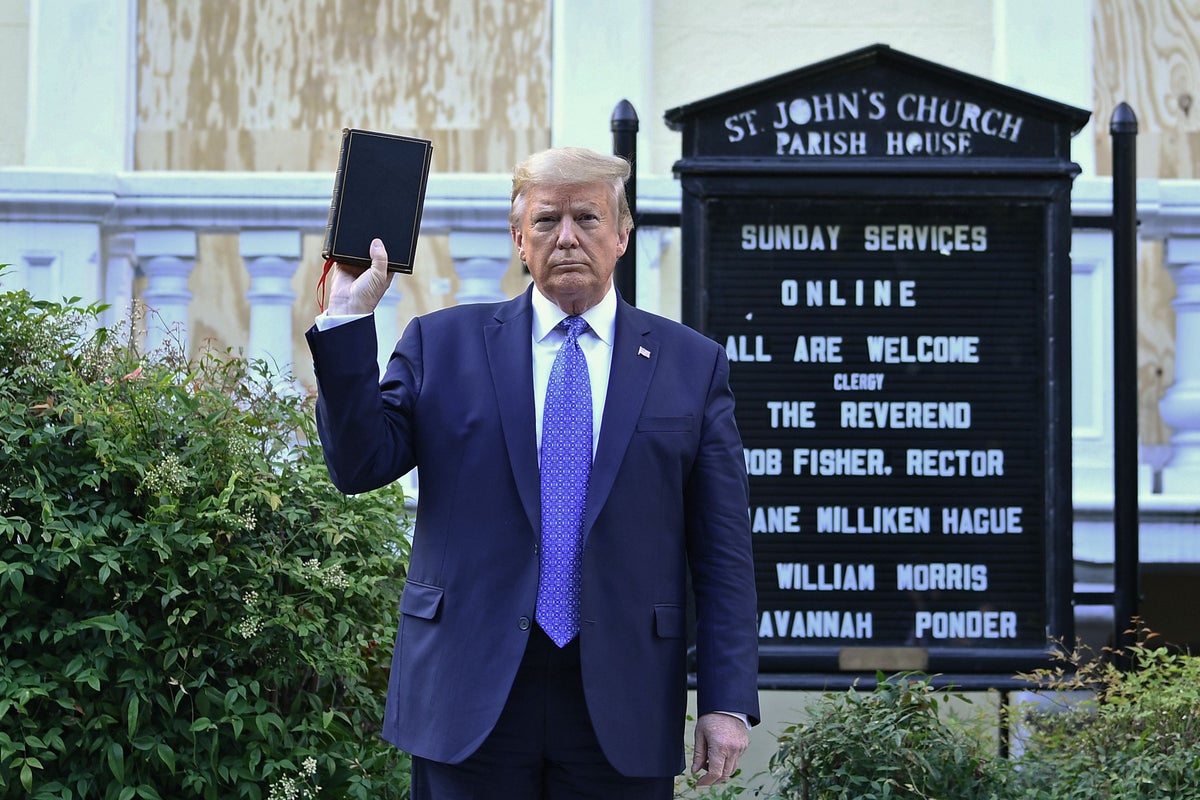
Donald Trump’s shift from circulating AI-generated religious iconography to the live recitation of scripture represents a calculated pivot in the management of political brand perception. This transition functions as a mechanism for stabilizing a voter base by moving from high-risk digital abstraction to high-fidelity traditional performance. Analyzing this shift requires a deconstruction of the interaction between generative artificial intelligence and established theological frameworks, specifically how they serve the functional requirements of a populist campaign.
The Synthetic Authority Loop
The deployment of an AI image portraying the candidate as a messianic figure serves a specific utility: the acceleration of mythology. Synthetic media bypasses the constraints of physical reality, allowing a campaign to visualize ideological narratives that would be impossible—or socially prohibitive—to stage in person. However, the use of AI introduces a "dilution of authenticity" variable. While the image triggers an immediate emotional response within a friendly echo chamber, it simultaneously provides critics with a technical vector for dismissal based on the inherent "falseness" of the medium. For a closer look into similar topics, we recommend: this related article.
To counteract this dilution, the candidate utilizes a sequence of re-grounding. The public reading of a Bible passage functions as a corrective measure. It bridges the gap between the synthetic (the AI image) and the organic (the physical presence at the pulpit). This creates a reinforcement loop where the digital mythos is validated by the physical ritual.
The Friction of Digital Sacrilege
In digital marketing and political strategy, the "Uncanny Valley" is typically discussed in terms of aesthetics. In the context of religious voters, a secondary "Theological Uncanny Valley" exists. When an AI generates an image of a political figure in a divine context, it risks crossing a threshold from "honored leader" to "blasphemous imitation." For additional context on this issue, extensive analysis can also be found at Reuters.
The strategic risk is quantified by the potential loss of the "Strict Institutionalist" segment of the evangelical vote. These voters prioritize the sanctity of the text and the tradition over the charisma of the leader. The live reading of scripture is a tactical maneuver designed to recapture this segment by demonstrating subservience to the literal word, effectively neutralizing the perceived arrogance of the previous week’s AI-generated imagery.
The Architecture of Perception Management
The transition from a pixels-based messiah to a text-based orator follows three structural pillars of political signaling:
- Iconographic Saturation: Using AI to flood the information space with high-impact, low-cost imagery that frames the candidate’s struggle as metaphysical rather than purely political.
- Ritualistic Verification: Following a digital "excess" with a traditional "anchor." The recitation of a specific passage acts as a proof-of-work, signaling to the base that the candidate remains tethered to the foundational document of their worldview.
- Linguistic Alignment: AI images lack nuance; they are blunt instruments. Scripture reading allows for the selective emphasis of specific verses that can be framed as allegories for current legal or political challenges.
Analyzing the Narrative Cost Function
Every piece of political content carries a cost-benefit ratio defined by its reach versus its polarization potential. The AI Jesus image has a high reach but carries a significant "cringe" or "sacrilege" cost among moderate religious demographics.
The Bible reading event serves as a Cost-Mitigation Protocol. It costs the candidate very little in terms of effort but significantly lowers the "Sacrilege Cost" by performing a standard, accepted religious act. This re-balances the campaign's "Trust Index" among religious voters who may have been alienated by the overtness of the AI-generated worship.
The Mechanization of Faith in the Digital Age
The convergence of generative AI and political campaigning has fundamentally altered the "Truth Baseline" for the American electorate. We are observing the emergence of Post-Veracity Signaling. In this framework, the voter does not ask "Is this image real?" but rather "Does this image represent how I feel?"
The AI image functions as an emotional shortcut. It bypasses the need for complex policy debate by replacing it with a visceral, visual identity. When the candidate later reads from the Bible, he isn't just reading a text; he is providing a physical container for the emotions generated by the AI image. This is a sophisticated application of Transmedia Storytelling where different platforms (Social Media vs. Live Event) and different mediums (AI Art vs. Oral Tradition) are used to build a single, cohesive identity.
Structural Divergence in Voter Reception
The effectiveness of this strategy depends on the divergence between two primary voter types:
- The Aesthetic Voter: Influenced primarily by the "vibe" and visual dominance. For this group, the AI image is the primary driver of loyalty.
- The Canonical Voter: Influenced by adherence to rules, texts, and traditions. For this group, the AI image is a distraction, and the Bible reading is the primary driver of loyalty.
The candidate's strategy is to oscillate between these two poles, ensuring neither group becomes completely alienated while maximizing the total surface area of his appeal.
The Engineering of Martyrdom
The specific timing—one week after the AI image—suggests a deliberate pacing of the "Ascension Narrative." In structured analysis, this is known as Escalation Layering. You begin with a provocative claim (the image) to capture the news cycle and dominate the mental space. You then follow with a "sober" or "traditional" act to demonstrate gravity and seriousness.
This creates a "Ratchet Effect." Each cycle of provocation and grounding moves the goalposts of acceptable behavior further. The AI image, which would have been a career-ending scandal a decade ago, is normalized by the subsequent "presidential" act of reading scripture.
The Feedback Mechanism of Social Proof
The AI image generates a massive amount of metadata—likes, shares, and comments. This data provides the campaign with a real-time heat map of which segments of the base respond most fervently to religious-nationalist imagery. The Bible reading is then tailored to reflect the sentiments found in the most viral engagement clusters. If the AI image generated significant commentary regarding "persecution," the chosen Bible passage will almost certainly focus on endurance, trials, and ultimate vindication.
Strategic Constraints and Long-term Volatility
This model of perception management is not without its failure points. The primary risk is Symbolic Exhaustion. When symbols as potent as the figure of Christ are used as routine campaign collateral, their ability to motivate the base diminishes over time.
The second limitation is the Contradiction Bottleneck. If the gap between the synthetic persona (the AI Jesus) and the physical persona (the candidate) becomes too wide, the cognitive dissonance required to support the candidate becomes an intellectual burden even for the most loyal supporters. This leads to "Voter Fatigue," where the constant need to defend or rationalize extreme imagery saps the energy of the grassroots movement.
The third limitation is the Technological Counter-Move. As AI becomes more accessible, opposing campaigns or bad actors can generate "Counter-Synthetic Media" that uses the same religious motifs to satirize or undermine the candidate. This creates a "Synthetic Arms Race" where the loudest and most extreme visuals dominate the discourse, drowning out policy and substance entirely.
The Operational Recommendation
To maintain the efficacy of this strategy without triggering the Contradiction Bottleneck, the campaign must transition from Static Iconography to Contextual Performance.
The move to read the Bible is the correct first step in this transition, but it must be followed by a decoupling of the candidate's likeness from divine figures in AI generations. Instead, the AI should be used to generate environmental and historical contexts that place the candidate within a "Traditional Hero's Journey" rather than a messianic one. This lowers the theological risk while maintaining the emotional impact of high-end synthetic visuals.
The strategic play is the institutionalization of the "Synthetic-Traditional Hybrid." Future campaigns should not view AI and live performance as separate silos but as a single, integrated "Reality-Bending" apparatus. The goal is not to be "real" or "fake," but to be Resonant. By constantly shifting between the hyper-real (AI) and the hyper-traditional (Scripture), a candidate can occupy the entire cognitive space of their audience, leaving no room for alternative narratives to take root.