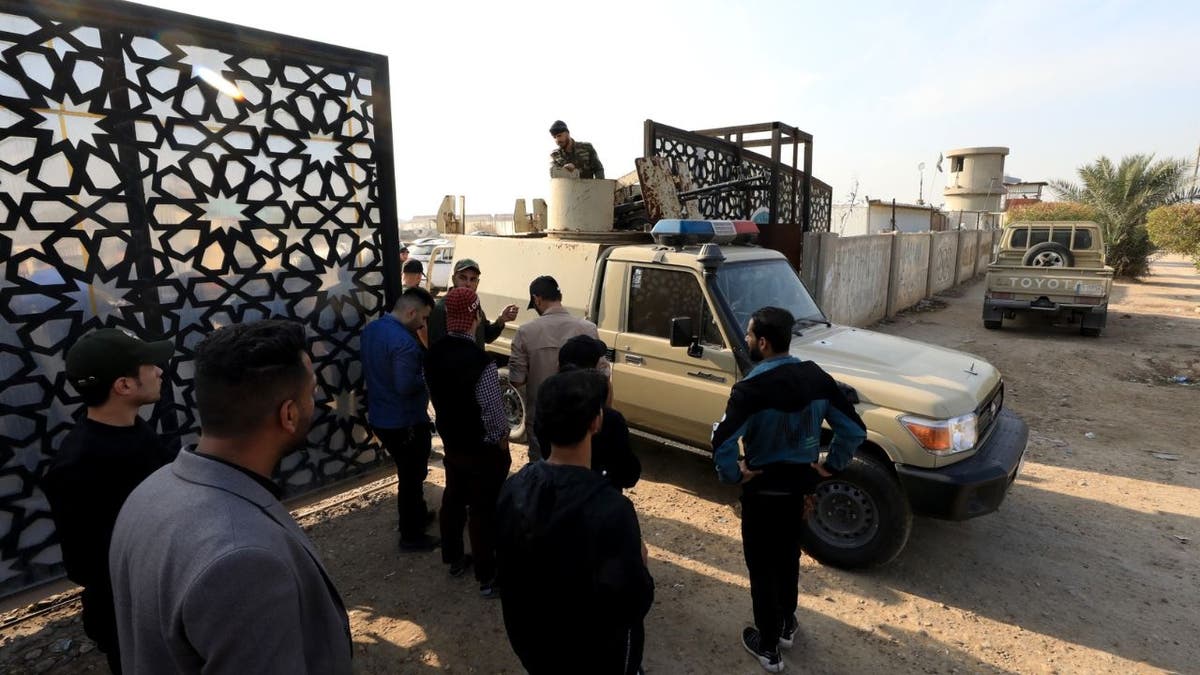
The imposition of sanctions against seven senior commanders of Iran-aligned militias in Iraq represents a shift from broad-spectrum economic pressure to a granular, network-based interdiction strategy. This tactical pivot aims to decapitate the operational continuity of the Popular Mobilization Forces (PMF) elements—specifically Kata’ib Hezbollah (KH) and Asa’ib Ahl al-Haq (AAH)—by isolating their leadership from the international financial system. The effectiveness of these measures rests not on the immediate seizure of liquid assets, but on the systematic increase of friction within the militia's procurement and logistics pipelines.
The Architecture of Proscribed Leadership
The selection of these seven individuals indicates a sophisticated mapping of the Iraqi security landscape. These commanders do not operate in a vacuum; they function as dual-hatted actors who bridge the gap between official state institutions and extra-judicial militia activities. By designating these specific nodes, the administration targets the "interface layer" of the Iranian proxy model.
- Operational Command and Control (C2): The primary target is the ability of these commanders to direct kinetic operations against sovereign interests. Sanctions serve as a formal signal to the Iraqi state apparatus that continued integration of these individuals into the national security framework carries a secondary-sanctions risk.
- Financial Intermediation: These commanders often oversee "economic offices" that manage a portfolio of front companies, ranging from construction to oil smuggling. Freezing their access to dollar-clearing mechanisms disrupts the laundering of illicit revenue into the legitimate banking sector.
- The Sovereignty Paradox: The Iraqi government faces an asymmetrical challenge. These commanders are technically part of the state-funded PMF. Sanctioning them forces the Iraqi Central Bank to choose between compliance with global financial standards (Basel III) and the internal political pressure to protect PMF leadership.
The Mechanism of Financial Attrition
Sanctions against militia commanders are often criticized as "symbolic" under the assumption that these individuals do not hold personal bank accounts in Western jurisdictions. This view ignores the secondary effects on the cost of doing business.
The Risk Premium Inflation
When a commander is designated by the U.S. Treasury, every entity in their personal and professional orbit incurs a compliance tax. International banks utilize automated screening tools that flag not just the sanctioned individual, but any entity "owned or controlled" by them. This creates a "chilling effect" where risk-averse third-party vendors—suppliers of dual-use technology, logistical equipment, or telecommunications—terminate contracts to avoid the risk of being cut off from the U.S. financial system. The militia must then move to "gray market" facilitators who charge a significantly higher premium for anonymity, thereby depleting the militia's operational budget through sheer inefficiency.
The Breakdown of the Patron-Client Model
The Iranian Revolutionary Guard Corps (IRGC) provides the strategic impetus and high-end hardware, but the Iraqi militias are expected to be increasingly self-financing through local extortion and state budget appropriation. By isolating the commanders responsible for these revenue streams, the administration forces a resource allocation crisis. If a commander can no longer guarantee the flow of "unofficial" salaries due to banking restrictions, their internal authority within the militia wanes. This encourages factionalism and creates opportunities for intelligence penetration.
Quantifying the Impact on Proxy Kineticism
To measure the success of these sanctions, one must look beyond the "assets frozen" metric and instead analyze the latency of operations.
- Procurement Lead Times: Sanctions disrupt the acquisition of specialized components for Unmanned Aerial Vehicles (UAVs) and Improvised Explosive Devices (IEDs). When the primary financier is sanctioned, the procurement chain must be rebuilt through more circuitous, slower routes.
- Intelligence Degradation: Commanders under heavy financial surveillance must limit their electronic footprint and physical movements, reducing their ability to provide real-time battlefield leadership.
- Political De-leveraging: The designation acts as a scarlet letter in the Iraqi parliament. It weakens the "Fatah Alliance" (the political wing of the militias) by making it toxic for moderate blocks to form coalitions with sanctioned leadership.
The Three Pillars of Network Disruption
The administration’s strategy employs a tripartite framework designed to achieve long-term strategic denial rather than immediate tactical surrender.
1. Legal Delegitimization
By categorizing these commanders as terrorists or human rights abusers under Executive Orders like EO 13224, the administration removes the veneer of "national defense" from their actions. This provides legal cover for the Iraqi government to eventually move against these elements under the guise of international compliance rather than internal sectarian politics.
2. Transactional Friction
The goal is to make every dollar spent by the KH or AAH command structure more expensive. This is achieved through:
- Designation of Front Companies: Mapping the shell companies used for payroll.
- Interdicting "Basra to Beirut" Corridors: Stopping the physical movement of bulk cash that bypasses electronic tracking.
3. Psychological Isolation
There is a profound psychological impact on the mid-tier officer corps. Seeing their superiors sanctioned, restricted from travel, and unable to protect their wealth creates a "succession anxiety." It signals that the Iranian security umbrella cannot provide total immunity against global financial pressure.
Constraints and Systemic Risks
While the logic of targeted sanctions is sound, the strategy faces two critical bottlenecks.
The Resilience of the Informal Economy
Iraq remains a heavily cash-based society. A significant portion of the militia’s revenue is generated through "informal" taxation at checkpoints and the siphoning of oil. Sanctions have limited visibility into these non-digital transactions. Until the Iraqi economy undergoes a digital transformation that brings these flows into the light, the "checkpoint economy" will provide a baseline level of survival for these militias.
The "Squeeze-and-Splinter" Effect
Pressure on established commanders may lead to the "splintering" of militias into smaller, more radical "shadow cells." These smaller groups are often harder to track and may be less concerned with political legitimacy than their parent organizations. While the large-scale command structure is degraded, the threat of localized, low-level kinetic activity may actually increase in the short term as rogue elements attempt to prove their continued relevance.
Strategic Realignment of the Iraq Policy
The sanctions must be viewed as one component of a broader "integrated deterrence" model. Financial pressure alone is a slow-acting poison; it requires a kinetic and diplomatic counterweight to be effective.
To maximize the ROI of these designations, the policy must move toward systemic auditing of the Iraqi Dollar Auction. The Central Bank of Iraq’s daily sale of USD is the primary artery through which militia-aligned banks acquire the currency needed for international transactions. Strengthening the audit requirements for the banks participating in this auction is the only way to ensure that the "seven commanders" cannot simply use proxies to bypass their individual restrictions.
The current trajectory suggests a move toward a "maximum transparency" requirement for the Iraqi security budget. If the PMF remains a state-funded entity, the U.S. will likely begin demanding line-item vetos on the salaries of designated individuals. This would force a terminal confrontation between the Iraqi government’s need for U.S. dollar liquidity and its internal reliance on militia power-sharing.
The final strategic play involves the "multilateralization" of these sanctions. While U.S. designations carry the most weight, securing similar listings from the European Union and regional partners (the GCC) is necessary to close the "safe haven" loopholes in Dubai and London where militia-linked wealth often seeks refuge. Only when the command structure is isolated globally—not just from the U.S. market—will the cost of proxy kineticism become unsustainable for Tehran's Iraqi partners.



