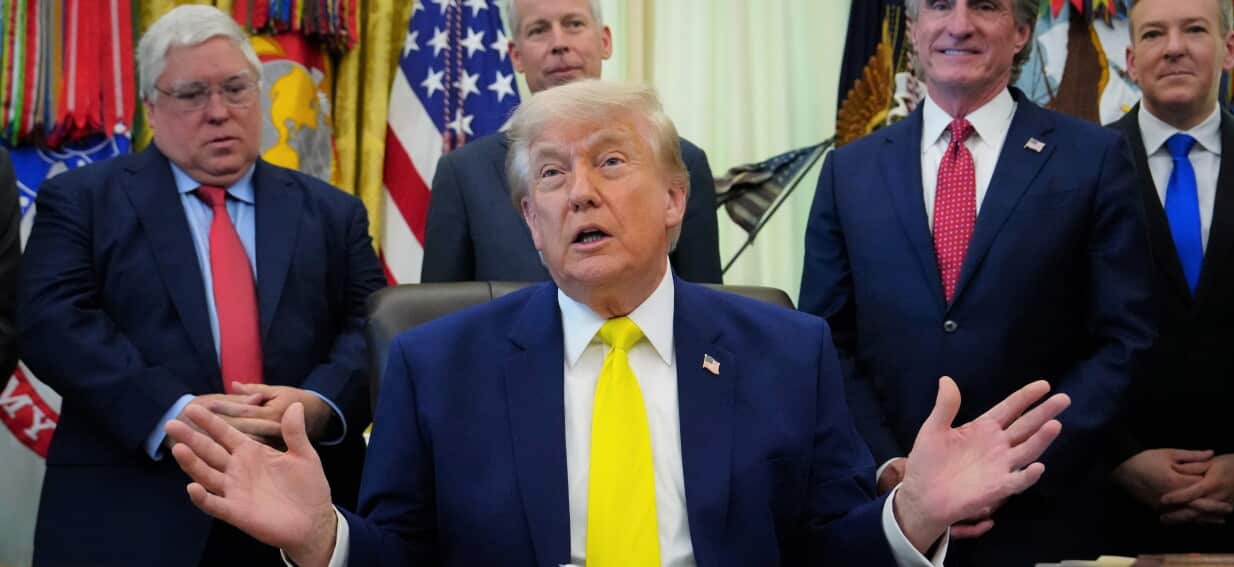
The Oval Office smells of old leather, polished mahogany, and the faint, distinct hum of high-stakes anxiety. On a humid afternoon in early June, reporters gathered around the Resolute Desk, their notebooks poised. They wanted answers about the nation's keys to the kingdom. Specifically, they wanted to know why a multi-millionaire real estate heir who spent his career thinking about drywall and interest rates was suddenly handed the steering wheel of the American intelligence apparatus.
Donald Trump leaned forward, his voice cutting through the clicking of camera shutters. Bill Pulte, the newly minted acting director of national intelligence, would not be staying forever.
"It's an acting position, it's not permanent," the president said, waving a hand to dismiss the mounting furor on Capitol Hill. "He's a very smart guy and he may find out some things about the rigged elections, etcetera, etcetera."
With those words, the true nature of the appointment crystallized. It was never about tracking submarine movements in the South China Sea or parsing satellite telemetry over Eastern Europe. It was about an entirely different kind of reconnaissance.
From Mortgages to Whispers
To understand how a housing regulator ends up commanding sixteen spy agencies, you have to look at the paperwork he left behind. Before this week, Pulte sat at the apex of the Federal Housing Finance Agency, overseeing Fannie Mae and Freddie Mac. It is a world of balance sheets, risk assessments, and ten trillion dollars in American housing assets. It is vital, grinding, and undeniably bureaucratic.
But Pulte brought a unique energy to the spreadsheets.
Imagine a neighborhood where one resident decides to audit everyone else's trash to find out who voted for the wrong HOA president. That is the structural reality of what occurred. During his tenure, Pulte turned the quiet tools of housing compliance into a spotlight. He launched high-profile fraud referrals against the president’s most prominent adversaries, targeting Federal Reserve Governor Lisa Cook, New York Attorney General Letitia James, and lawmakers like Adam Schiff. The allegations were widely criticized as thin, but the message was loud. He was looking at the books.
Now, he has been handed a larger ledger.
The Office of the Director of National Intelligence was born in the scarred wake of September 11. It was designed for a singular purpose: to force America's fiercely tribal intelligence agencies—the CIA, the NSA, military intelligence—to talk to each other. It was meant to be a clearinghouse of cold, hard reality, delivering an unvarnished truth to the commander-in-chief, even when that truth was painful to hear.
When Tulsi Gabbard walked away from the post to care for her ailing husband, she left behind a vacuum. The vacancy required a steady hand. Instead, it received a partisan lightning rod.
The Cold Shoulder on the Hill
Washington runs on a currency of unspoken rules, and right now, the accounts are flashing red. The reaction from Congress has not been a standard partisan groan; it is a deep, structural shiver that crosses party lines.
Consider the silence of the old guard. Mitch McConnell issued a statement that did not mention Pulte by name but left no room for misinterpretation, noting that anyone occupying a role of such immense public trust must possess extensive national security experience to earn his vote. On the other side of the aisle, Senate Majority Leader John Thune was uncharacteristically blunt.
"We don't need a weaponized DNI," Thune told reporters. "We need professionals there."
The anxiety is not about Pulte's ability to read a map. It is about access. The intelligence community sits on a mountain of domestic and foreign surveillance data. It holds the secrets of allies and the private communications of adversaries. When an official with a track record of auditing political rivals gains access to those systems, the institutional guardrails begin to warp. Democrats are already threatening to freeze the reauthorization of key federal surveillance powers if Pulte remains at the helm. The machinery of state security is grinding to a halt over a question of trust.
The Sunset on the Clock
The saving grace for the nervous institutionalists is the calendar. Under federal law, an acting official can only occupy the big chair for 210 days without a formal Senate confirmation. Pulte is on a short leash, a reality the president acknowledged by noting that the administration is actively interviewing long-term candidates.
But a lot can happen in seven months.
By tying Pulte’s temporary tenure to an investigation into "rigged elections," the administration has signaled that the objective is not continuity, but disruption. The intelligence community is being asked to turn its eyes inward, focusing its immense analytical power on domestic political grievances rather than external threats.
The true cost of this strategy is rarely measured in the headlines. It is found in the quiet rooms in Langley and Fort Meade, where career analysts are trying to decide whether to write the report the president needs to see, or the report the president wants to see. When the line between objective reality and political loyalty becomes blurred, the whole system falters.
The press pool eventually filed out of the Oval Office, leaving the politicians to their strategy sessions. Outside, the world remained indifferent to the political maneuvering in Washington. Satellites kept spinning. Cyber threats kept probing the power grids. The real dangers remained outside the gates, waiting for an intelligence apparatus that might be too busy looking in the mirror to notice them.