The Structural Impossibility of Unmanaged Thermal Mass
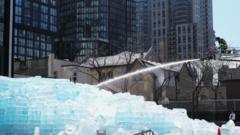
The deployment of a massive ice installation in an urban environment like Toronto represents a conflict between artistic intent and the laws of thermodynamics. When musician Drake commissioned a multi-ton ice structure to promote his "Certified Lover Boy" brand, the project ignored the critical relationship between ambient temperature, structural integrity, and public safety. The subsequent intervention by Toronto Fire Services to "thaw" the structure using high-pressure water was not merely a cleanup operation; it was a necessary mitigation of a high-probability kinetic hazard.
Public installations of this scale are governed by three primary variables:
- The Phase Transition Threshold: The energy required to maintain solid-state integrity in a fluctuating outdoor climate.
- The Kinetic Potential Energy: The mass of the ice multiplied by the height of the installation ($PE = mgh$), which dictates the danger posed to pedestrians during a structural collapse.
- The Regulatory Friction: The intersection of private marketing assets with municipal safety codes.
The failure of the Toronto installation reveals a lack of predictive modeling regarding how ice behaves as a non-homogeneous structural material when exposed to urban heat island effects and direct solar radiation.
The Physics of Structural Instability in Large-Scale Ice
Ice is a brittle material with a compressive strength that fluctuates wildly based on its temperature and purity. As the internal temperature of a block approaches $0^\circ\text{C}$, "pre-melting" occurs at the grain boundaries. This liquid phase significantly reduces the friction between ice crystals, leading to internal shearing.
The Melting Vector
When an ice sculpture is placed on a city sidewalk, it is subjected to heat transfer from three sources:
- Convection: Air currents moving over the surface of the ice.
- Radiation: Direct UV exposure and infrared radiation reflected from surrounding glass and asphalt.
- Conduction: Heat transfer from the pavement or the base platform into the bottom of the structure.
Toronto’s climate in late winter is notorious for rapid temperature swings. A sculpture designed for a stable $-10^\circ\text{C}$ environment becomes a ticking clock when the temperature rises to $2^\circ\text{C}$. The competitor's reporting focused on the "spectacle" of the fire crews, but the real story is the Coefficient of Thermal Expansion. As the outer layers of the ice installation melted and refroze, they created internal stresses that made the structure unpredictable.
The Failure of the Internal Support Matrix
Large-scale ice installations often use internal metal skeletons to provide tensile strength, which ice lacks. However, metal has a much higher thermal conductivity than ice. These skeletons act as "heat pipes," drawing energy into the center of the sculpture and melting it from the inside out. This creates a hollow shell—a phenomenon known as "honeycombing"—where the structure appears solid but has lost its load-bearing capacity.
Strategic Risk Assessment in Brand Activations
The decision to place a massive ice block on a public thoroughfare without a climate-controlled enclosure is an exercise in extreme brand risk. In a consulting framework, this falls under Liability vs. Exposure. While the visual impact (Exposure) was high, the potential for a multi-ton block of ice to crush a bystander or obstruct emergency services (Liability) was catastrophic.
The Cost Function of Municipal Intervention
When the Toronto Fire Services arrived to dismantle the structure, they utilized heated water cannons. This was not a standard maintenance task; it was a tactical demolition. The cost-benefit analysis for the city was clear:
- Direct Costs: Labor hours for fire crews, fuel for heavy machinery, and water usage.
- Indirect Costs: Traffic congestion on major Toronto arteries, diversion of emergency resources, and potential damage to underground utilities from sudden runoff.
The brand owner (Drake) likely faced significant fines, but the reputational damage is the more complex metric. A brand that prides itself on "cool" and "calculated" precision is undermined when its physical assets require a municipal rescue operation to prevent a public disaster.
Logistics of the "Thaw" Operation
The fire department’s intervention was a calculated thermodynamic strike. They did not simply wait for the sun to melt the ice; they used latent heat of fusion against the structure.
Forced Convection via High-Pressure Streams
By applying high-pressure water, the fire crews increased the rate of heat transfer. The water acts as a carrier of thermal energy, stripping away the boundary layer of cold air that naturally surrounds an ice block. This is an application of Newton's Law of Cooling, where the rate of heat loss is proportional to the difference in temperatures between the body and its surroundings.
The crews targeted the base and the joints. By compromising the structural nodes, they forced a controlled collapse of the upper masses into smaller, manageable fragments. This prevents a "pancake collapse" where the entire structure falls outward into the street.
The Runoff Bottleneck
A primary concern during a forced thaw is the management of liquid volume. A multi-ton ice structure converted to water in a short window can overwhelm local drainage systems, especially if those drains are partially blocked by winter debris or ice. If the runoff refreezes on the asphalt, the fire department has traded a static hazard (the sculpture) for a dynamic hazard (a black ice roadway). To mitigate this, crews must coordinate with sanitation departments to salt the area immediately following the thaw.
Operational Lessons for Future Urban Installations
Marketing agencies and production firms must move beyond the aesthetic and into the engineering of temporary structures. If a brand intends to use non-standard materials in an urban center, they must employ a Structural Health Monitoring (SHM) protocol.
Requirement 1: Active Thermal Management
Any ice installation intended to last more than 24 hours in a variable climate requires a refrigeration loop. This involves embedding cooling coils within the ice and connecting them to a portable chiller. This transforms the installation from a decaying asset into a stable structure.
Requirement 2: Perimeter Geofencing
The "Drake Ice" incident was exacerbated by the proximity of the public. A 1:1 safety radius—where the height of the sculpture dictates the distance of the barrier—is the minimum standard for high-mass temporary objects.
Requirement 3: Predictive Weather Modeling
Project managers must use Monte Carlo simulations to predict the lifespan of the material based on historical weather data. If the probability of temperatures exceeding $0^\circ\text{C}$ for more than four hours is higher than 20%, the project should be deemed "Unfeasible" without mechanical cooling.
The Regulatory Horizon for Influencer-Driven Installations
The intersection of celebrity influence and urban logistics is creating a new category of "Flash Assets"—objects placed in public spaces for short-term viral impact. Municipalities are currently behind the curve in regulating these items. We can expect a shift toward:
- Mandated Bonds: Requiring a cash deposit that covers the full cost of emergency demolition.
- Engineering Sign-offs: Treating large-scale "art" as temporary buildings, requiring a professional engineer’s stamp on the structural plans.
- Material Limitations: Banning phase-change materials (like ice or wax) in high-density pedestrian zones during specific seasonal windows.
The Toronto incident serves as a case study in the failure of "Visual-First" planning. When the desire for a social media moment overrides the fundamental physics of the material being used, the result is an inevitable transition from a marketing win to a logistical emergency.
Future installations must prioritize the Mechanical Integrity of the Asset over its initial aesthetic impact. Brands that fail to integrate thermodynamic reality into their creative briefs will find their investments literally washed away by municipal crews, leaving behind nothing but a bill for the cleanup and a fractured public image. Any firm planning a similar activation must now treat the "Toronto Fire" event as the baseline for what not to do: never build a high-mass gravity hazard in a warming environment without a decommissioning plan that is more sophisticated than "let the city handle it."